
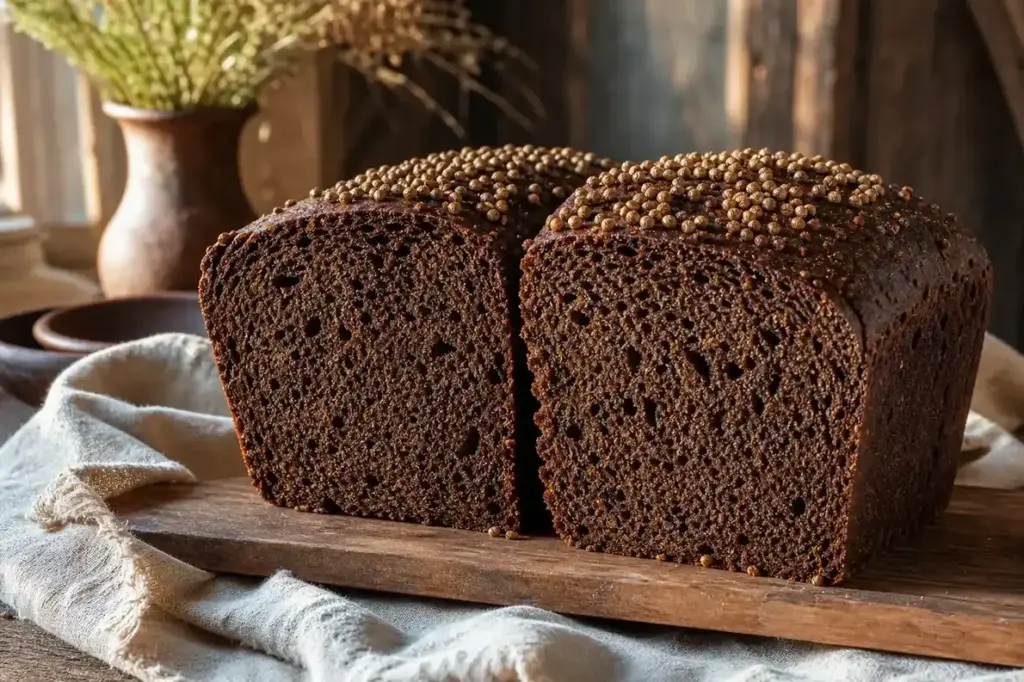
Borodinsky rye bread is one of Russia’s most iconic foods, recognised by its dark brown colour, slightly sweet taste and distinctive aroma of coriander seeds. If you want to make how to make Borodinsky rye bread at home, this guide walks you through a straightforward method using sourdough or yeast.
The bread is traditionally dense and moist, suited to serving with cured fish, cheese or simply with butter. A loaf takes around 3–4 hours of active time across two days, though most of that is resting. The easiest approach uses commercial yeast and a simple scalded flour mixture.
Quick answer: Mix a scald (rye flour, malt and coriander scalded with boiling water), combine with a preferment or starter, knead with wheat flour, molasses and salt, and bake in a loaf pan for 60 minutes. Total active time is about 3 hours spread over two days.
At a Glance
| Type | Dishes |
|---|---|
| Local name | Бородинский хлеб |
| Origin | Moscow, early 1920s. First documented mention in 1929; standardised recipe approved at Moscow's head bakery in 1933. The name is linked to the 1812 Battle of Borodino, though the bread itself developed during the Soviet period. |
| Servings | 1 loaf (8–10 slices) |
| Total time | 3–4 hours across two days (including overnight fermentation) |
| Difficulty | Medium |
History and Story of Borodinsky Rye Bread (Бородинский хлеб)
The bread name was not in use until the late 1910s and early 1920s, most likely first appearing around 1922 during a celebration of 110 years since the Battle of Borodino. One of the first documented mentions of Borodino bread appears in the 1929 work on baking technology by the Soviet scientist Boris Sarychev. During the 1920s, Vladimir Lenin’s New Economic Policy allowed small private bakeries to open, and these Moscow bakeries competed with one another by inventing Borodinsky rye bread. The recipe for modern Borodinsky bread was officially approved in 1933 at Moscow’s head bakery. Recipes for malt rye breads had made their way into Russia from Belarus and the Baltic States, where they had been very popular for centuries. Coriander in Borodinsky bread appeared later in the Soviet period; before that, anise and caraway were used.
Ingredients
- 200 g rye flour (medium or wholemeal)
- 120 g wheat or all-purpose flour
- 25 g fermented rye malt powder
- 2–3 tsp ground coriander (or 1–2 tsp caraway seeds)
- 30–35 g molasses or honey
- 7–10 g salt
- 7 g instant yeast
- 250–270 ml water
How Borodinsky Rye Bread (Бородинский хлеб) Is Made
Step 1: Make the scald (the night before)
In a bowl, combine 80 g rye flour, 25 g fermented rye malt powder, and 2 tsp ground coriander (or 1 tsp caraway seeds, crushed). Pour 200 ml boiling water over the mixture and stir well until no dry flour remains. Cover with a cloth or lid and leave at room temperature for at least 2–3 hours, or overnight. This scald develops the bread's distinctive flavour and colour.
Tip: If you cannot find rye malt powder, substitute with 2 tbsp liquid chicory, dark beer, or concentrated kvass.
Step 2: Make the preferment or starter (the night before or 12 hours ahead)
In a separate bowl, mix 60 g rye flour, 60 ml water, and a tiny pinch of yeast (about 1⁄8 tsp). Stir until smooth. Cover and leave to ferment at room temperature for 10–12 hours. If using ripe sourdough starter instead, use 100 g starter with 100 g water and 100 g rye flour, fermented for 10–12 hours.
Tip: This preferment can be made at the same time as the scald; both need similar resting time.
Step 3: Mix the final dough (the next day)
In a large bowl, combine the cooled scald and the fermented preferment. Add 120 g wheat flour, 30 g molasses or honey, 7–10 g salt, and 50–70 ml lukewarm water. Stir with a wooden spoon until all flour is incorporated. The dough will be sticky and wet; do not add extra flour. This high moisture content is essential for proper gluten development.
Tip: If using instant yeast (not a preferment), dissolve 7 g yeast in the water first, wait 5 minutes for it to froth, then add to the other ingredients.
Step 4: Knead the dough
Transfer the dough to a floured work surface or use a stand mixer with a dough hook. Knead for 8–10 minutes by hand (or 5–6 minutes in a mixer) until the dough is smooth and elastic. Oil your hands to prevent sticking if the dough is very wet. The texture should be firm but slightly tacky.
Tip: Wet hands work better than flouring them when handling sticky dough.
Step 5: First rise
Oil a clean bowl and place the dough inside. Cover with plastic wrap or a damp cloth. Leave in a warm spot (24–26°C is ideal) for 1 hour until visibly risen and puffy. Alternatively, refrigerate overnight for a cooler, slower fermentation, which deepens flavour.
Tip: In a cooler kitchen, the rise may take 1.5–2 hours. Look for the dough to increase noticeably in volume rather than a specific time.
Step 6: Shape and second rise
Lightly oil a loaf pan (roughly 21 × 11 cm). Turn the dough out onto a lightly floured surface. Flatten it gently and shape it into a log that fits the pan. Place it seam-side down in the pan. Mix a little flour with water to make a paste, brush it over the top of the dough, and sprinkle generously with coriander seeds or caraway. Cover and let rise for 30–60 minutes until the dough crowns just above the rim of the pan.
Tip: Do not let it over-proof; the dough should rise noticeably but not dramatically collapse when poked gently.
Step 7: Bake
Preheat the oven to 210°C. Place the loaf pan in the centre of the oven and bake for 30 minutes. Lower the temperature to 180°C and bake for another 30 minutes, or until the loaf sounds hollow when tapped on the bottom. Remove from the pan and cool on a wire rack for at least 1 hour before slicing.
Tip: The crust should be dark brown but not burnt. If it darkens too quickly, tent loosely with foil for the last 15 minutes.
Variants
- 100% rye version: Some traditional recipes omit wheat flour and use only rye flour and sourdough starter, resulting in a denser, darker loaf.
- Caraway instead of coriander: Authentic Borodinsky can be flavoured with crushed caraway seeds rather than coriander, or a mix of both.
- Without malt: Simplified versions substitute malt with coffee, cocoa powder, or concentrated kvass, though the taste differs.
- Honey instead of molasses: Light or dark honey can replace molasses for a slightly different sweetness and colour.
Common Mistakes to Avoid
- Adding too much extra flour during mixing. The dough is supposed to be wet and sticky. Resist the urge to flour it further; moisture is needed for the bread's dense, moist crumb.
- Skipping or rushing the scald. The scald is essential; it gelatinises the starches, develops colour and flavour, and cannot be replaced by simply adding malt powder to the dough.
- Using fresh yeast without activating it, or adding expired yeast. Always bloom yeast in warm water for 5 minutes first to confirm it is active; old yeast will give a flat, dense loaf with poor rise.
- Omitting fermented rye malt entirely. No substitute truly works; molasses alone will not replicate the bread's signature taste and colour. Chicory, kvass or dark beer are closer than nothing, but malt is worth sourcing online.
- Baking at too high a temperature. Borodinsky bread browns quickly because of its sugar content. Baking above 220°C will char the crust before the interior is done. Follow the two-stage temperature precisely.
- Slicing too soon after baking. The bread continues to set as it cools. Cutting while still warm makes it crumbly. Wait at least 1 hour, ideally until fully cool.
How to Order and Eat It
Borodinsky is served sliced, typically with cured fish (herring, salmon), salted pork fat (salo), strong cheese, or simply with good butter. It is traditionally paired with cold vodka. The bread’s dense texture and slight sweetness make it sturdy enough for open sandwiches. Toasting thin slices and serving with soups or stews is also common. A single thick slice, plain or spread with butter, is a satisfying breakfast or snack.
To order: Один ломтик бородинского хлеба, пожалуйста [Adin lomtik borodinskogo khleba, pozhaluysta]
Diet and Allergens
- Typically contains gluten
- Vegan when made without honey
Moscow Vibes Tips
- Fermented rye malt powder is the non-negotiable ingredient. Online suppliers (search "solod rye malt" or "fermented rye malt") stock it; regular brewing malt is different. If truly unavailable, dark beer or concentrated kvass adds colour and depth, but nothing fully replaces malt.
- Temperature matters. Fermentation is faster in a warm kitchen (26°C) and slower in a cool one (18°C). Adjust resting times accordingly by watching the dough's volume, not the clock. A long, cool fermentation overnight gives deeper flavour.
- The dough is wetter than typical bread dough and will stick to your hands. Oiling your hands rather than flouring them makes it easier to work with and prevents the flour from drying out the dough.
- Borodinsky keeps well. Wrap the cooled loaf in paper or store it in a bread bag at room temperature for 3–4 days. The dense crumb does not dry out as quickly as lighter breads. Slices can be frozen for several weeks.
- Moscow bakeries often mark Borodinsky loaves with a distinctive pattern on top using coriander seeds. This is decorative but also functional: whole seeds on top add texture and flavour to each slice.
Explore Nearby Borodinsky Rye Bread (Бородинский хлеб)
Related guides
 10 Best Places to Try Russian Food in Moscow: Classics and Canteens
Main image: AI-generated illustration. It may not show the place exactly as it looks.
 10 Best Food Markets and Food Halls in Moscow: Where to Eat Indoors
Main image: AI-generated illustration. It may not show the place exactly as it looks.
 Moscow Food Tour: Russian Cuisine and Local Specialties: One-Day Route
Main image: AI-generated illustration. It may not show the place exactly as it looks.
Browse more: All Food & Drink · All Other
FAQ
Is Borodinsky bread the same as Russian black bread?
Not quite. Russian black bread is a general term for dense rye breads of various kinds. Borodinsky is a specific dark rye bread with a standardised recipe: it includes wheat flour, molasses, and coriander seeds, and was formally defined in 1933. Other Russian rye breads may use different spices or proportions.
Can I make Borodinsky without a sourdough starter?
Yes. You can use instant or active dry yeast instead of a sourdough starter. The rise will be faster (1 hour instead of 12), and the flavour slightly different, but the bread will still be authentic. Activate the yeast in warm water first, then mix it with the other ingredients.
What if I cannot find rye malt powder?
Fermented rye malt is important for the distinctive taste and colour. If unavailable, substitute 2 tbsp of concentrated kvass, dark beer, or chicory liquid. The bread will work but taste less like authentic Borodinsky. Malt is available online from baking suppliers.
Why is my dough so sticky? Should I add more flour?
No. Borodinsky dough is deliberately wet. The high moisture develops the bread's dense, moist crumb. If the dough sticks to your hands, oil them instead of flouring. This is normal and correct.
How long does Borodinsky bread keep?
The dense crumb stays fresh for 3–4 days at room temperature in a bread bag or wrapped in paper. Do not refrigerate; cold makes it stale faster. Slices freeze well for several weeks.
Can I bake Borodinsky in a different pan shape?
Yes. A round Dutch oven or banneton basket works, though the traditional shape is a rectangular loaf pan. Baking time may vary slightly depending on shape and size. Watch for a hollow sound when tapped to judge doneness rather than relying on time alone.
Is Borodinsky bread vegan?
Yes, if you use molasses or sugar instead of honey. The basic recipe contains only flour, water, malt, spices, salt and yeast—all plant-based.
What does authentic Borodinsky taste like?
Borodinsky is a scalded bread containing rye malt, molasses, and coriander. Its unique sweet flavour and aroma is much loved across the former Soviet Union. The bread is slightly sweet, dense, and aromatic from the coriander seeds. It is not sour (unlike some sourdoughs) but has a subtle malt and molasses depth.
Discover More of Moscow with Our Travel Tips
Get practical Moscow travel tips, new destination guides and useful updates on attractions, opening hours and prices. Plan your visit with clear, helpful information delivered to your inbox.
Moscow Vibes is a one-person project. A coffee keeps it going
Looking for more on this? Dark Rye Bread: Recipe, History and How to Bake It at Home (Russia Vibes)

Take this guide with you
Get a free PDF of this guide to print or read offline: key facts, tips and a map link on a few clean pages.
Report an issue on this page
Paying for your trip: please read
Payments and bookings between Russia and many other countries are currently restricted. In practice, cards issued in the EU, the UK, the US and several other countries often cannot be used in Russia, Russian cards usually cannot be used abroad, and some booking platforms, airlines and payment providers limit or pause their services for Russia. The situation changes frequently.
We do not give legal or financial advice, and this site does not encourage anyone to break any rule that applies to them. Whatever you plan, you are responsible for following the laws and regulations that apply to you, including those of your country of residence and citizenship.
Many travelers still organise their stay without problems. It is worth asking your bank or payment provider what is currently possible, contacting hotels, tour operators and carriers directly about the payment methods they accept, and checking which services are open to customers from your country. Clarify payment, cancellation and refund terms before you commit to a booking, and keep your plans flexible.
Partner links on this site may not be available in every country, and prices, availability and rules in our guides can differ from what you see when you book.
How we research and update our guides
About this guide: AI assistance and accuracy
This guide is created with the help of AI and is based on official sources where available. Mistakes can still happen. Opening hours, prices, rules and other details are given to the best of our knowledge as of the date shown and can change without notice. It offers general recommendations only, not professional, legal or travel advice. Please confirm important details with the official source before you travel; you are responsible for your own plans and decisions.
* Affiliate link: as an Amazon Associate we earn from qualifying purchases at no extra cost to you.