
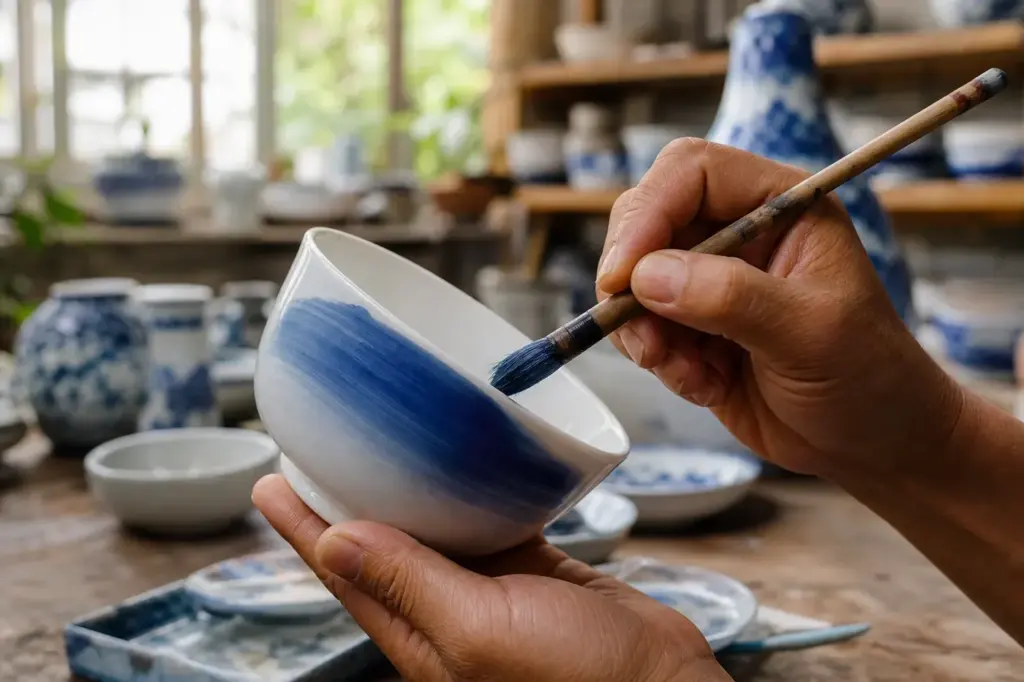
The name Gzhel became associated with pottery in the 14th century, and since then the Gzhel area and some 30 villages in the neighborhood have become the center of Russian ceramic production. A Gzhel day trip from Moscow takes you to the heart of this centuries-old craft tradition, where the distinctive blue-and-white style is still made entirely by hand.
Today the pottery features distinctive blue designs on white background. Gzhel ceramics are always hand-made, with artists painting every plate or vase with a brush, making each object an individual piece of art. Workshops and factories throughout the region welcome visitors to watch artisans at work and purchase authentic ceramics.
Quick Facts
| Russian name | Гжель |
|---|---|
| Distance from Moscow | 52–60 km southeast |
| Travel time from Moscow | 1–1.5 hours by car; 58 minutes by train |
| Built / opened | 1802 |
| Address | Gzhel Village, Ramensky District, Moscow Oblast, Russia Google MapsApple MapsYandex Maps2GIS |
| Best time to visit | Visit Tuesday through Thursday mornings or early afternoons, when production and painting are most active. Weekends have reduced activity. May to September offers pleasant weather for exploring the village. October and November are cool but clear; winter can be cold and roads may be icy. |
| Website | gzhel.ru |
What Is (and Isn't) Part of a Visit to Gzhel Day Trip from Moscow?
| Part | Status | Notes |
|---|---|---|
| Ceramic workshops and studios | Included in the standard ticket | Open to visitors; many offer demonstrations and sell directly. |
| Factory tours (specific facilities) | Included in the standard ticket | Some major factories offer guided tours; call ahead to arrange. |
| Museum exhibits | Separate ticket or institution | If a dedicated ceramics museum exists, it may require a separate ticket. |
| Shopping at artisan workshops | Included in the standard ticket | Direct purchase from makers; no separate fee. |
| Masterclasses or painting workshops | Separate ticket or institution | Some studios offer hands-on painting sessions for an additional fee. |
| Restaurants and cafes in Gzhel | Separate ticket or institution | Local food service; independent businesses. |
How to Get from Moscow to Gzhel Day Trip from Moscow
| Option | Duration | Price | Notes |
|---|---|---|---|
| Train from Kazansky Railway Terminal | 58 minutes plus local transport | ₽ | Central PPK operates a train from Kazansky Railway Terminal to Grigorovo hourly. Tickets cost around budget and the journey takes 58 minutes. From Grigorovo station you will need a taxi or local bus to reach the villages and studios. |
| Rental car or private driver from Moscow | 1–1.5 hours | ₽₽ | The driving distance between Moscow to Gzhel is approximately 1 hour 2 minutes. This is the most convenient option as you can visit multiple workshops and studios without waiting for local transport. |
| Organized tour from Moscow | Full day, 8–10 hours including travel | ₽₽₽ | Gzhel is typically reached by car or organized tour from Moscow, taking about 1.5 to 2 hours. Guided tours are often the easiest way and it is a popular day trip destination from Moscow. |
| Taxi from Moscow | 1–1.5 hours each way | ₽₽ | Less economical than renting a car if traveling solo, but straightforward. |
₽ budget · ₽₽ moderate · ₽₽₽ upscale · ₽₽₽₽ splurge. Price levels are estimates compared with typical prices for visitors.
Why Visit Gzhel Day Trip from Moscow?
The technique itself is distinctive: the object is first painted with cobalt oxide which is black, then covered with white glaze and placed in the oven, after which the glaze becomes transparent and cobalt acquires sky-blue color. You can see this entire process at working studios.
The village itself offers rural atmosphere and a chance to understand why this clay-rich region became Russia’s most important ceramic center. If you collect or appreciate traditional craftsmanship, a Gzhel day trip is one of the few ways to see working artisans and buy directly, distinguishing authentic hand-painted pieces from mass-produced souvenirs.
Highlights of Gzhel Day Trip from Moscow
The Blue Painting Technique
The heart of the technique is a stroke with a gradient: the painter loads a brush so that one edge carries dense cobalt and the other a washed tone, and a single pull of the wrist lays a petal that shades from deep blue to near white, the color thinning as the brush empties. No two strokes on an honest piece are identical, because the hand reloads the brush and the kiln has the final word.
Tip: Watch a painter at work in a studio to see how the gradient stroke is achieved in real time.
Factory Tours and Demonstrations
Several factories in the Gzhel region, including major production facilities, offer guided tours where you can see the full cycle of ceramic creation: clay shaping, glazing, painting, and firing. Guides show how each stage transforms raw clay into finished art.
Tip: Tours are typically offered on weekdays; call ahead to confirm times and arrange if visiting on a weekend.
Direct Purchase from Artisans
Many Russian people today collect Gzhel, decorating their houses with cups and plates, pitchers and samovars, clocks, teapots, and funny figurines. You can buy directly from workshops and factory shops, ensuring authenticity.
Tip: Look for the gradient brushstroke and hand-painted details; sameness and dots indicate printing, not hand-painting.
The Gzhelka River Setting
The villages of Gzhel, Kosherovo, Obukhovo and Troshkovo are located on the banks of the river Gzhelka, a left tributary of the Moscow River. The Gzhelka is 32 km long and frozen from mid-November to mid-April.
Tip: The river setting offers peaceful countryside views; visit in warmer months for a pleasanter walking experience.
Historical Clay Mining
Extensive mining of various types of clay was carried out here from the middle of the 17th century. In 1663, Tsar Alexey Mikhailovich issued a decree to make Gzhel the exclusive supplier of Apothecary and alchemical vessels for the Apothecary's order in Moscow.
Tip: The region's clay deposits remain fundamental to production; understanding this geology helps explain why Gzhel's monopoly has endured for centuries.
Comparing Hand-Painted vs. Printed Pieces
To identify authentic hand-painted pieces, look for the gradient stroke: one petal with many blues is the technique's fingerprint. Compare roses across a service; sameness is the printer's confession. Use a loupe to examine one flower; dots mean print, bristle edges mean hand.
Tip: Examine pieces carefully before purchasing; authentic hand-painted Gzhel holds value and beauty far better than printed imitations.
Atmosphere
Gzhel village has a quiet, rural character quite different from Moscow. The area around the main factory is pleasant, featuring a cozy park. Workshops tend to be active on weekdays, when you can hear the sounds of the kilns and watch painters concentrate intently over their work. The pace is unhurried, and staff are usually welcoming to visitors curious about the craft.
On weekends, some facilities operate with reduced activity; many artisans do not work Sundays. The best times to visit are Tuesday through Thursday mornings or early afternoons, when production is in full swing and you can see the full range of activity.
History of Gzhel Day Trip from Moscow
The first documentary evidence about the village dates back to the 1339 ecclesiastical charter of the Russian czar Ivan Kalita. This area has long been famous for its clays. Since the XIV century, the Gzhel and some 30 villages in the neighborhood have become the center of Russian ceramic production.
Extensive mining of various types of clay was carried out here from the middle of the 17th century. In 1663, Tsar Alexey Mikhailovich issued a decree to make Gzhel the exclusive supplier of Apothecary and alchemical vessels for the Apothecary’s order in Moscow. They had to comply with increased quality requirements. This was the beginning of ceramic production in Russia.
By 1871, Gzhel had prospered, with the population audit recording eleven retail shops, fifteen pubs, five inns, and eighty-eight manufacturing shops. Farmland was scarce; most of the population made a living in ceramic trade or worked in Moscow.
In the distant past Gzhel drawings were colored. Local masters painted clay household items: plates, dinner sets, mugs, jugs, toys, etc. The style of paintings was borrowed from the Dutch. White-and-blue paintings are created by painting with cobalt oxide which is black, then covering with white glaze and placing in the oven, after heating the glaze becomes transparent and cobalt acquires sky-blue color.
In the 1830s, the Gzhel potters developed a faience, or white earthenware, of a quality that rivaled the creamware being produced in England at the time. They followed the development of faience with the acquisition of porcelain. After the revolution of 1917, the private workshops and factories were appropriated by the Soviet state and united as a ceramics guild in Turygino Village, about 60 kilometers from Moscow.
Tickets and Booking for Gzhel Day Trip from Moscow
| Ticket | Price | Includes |
|---|---|---|
| Factory tour (per group or per person) | ₽₽ | Guided tour of production facilities, demonstration of techniques, access to showroom. |
| Workshop visit and purchase | Free | Access to artisan studios; no entry fee, pay only for items purchased. |
₽ budget · ₽₽ moderate · ₽₽₽ upscale · ₽₽₽₽ splurge. Price levels are estimates compared with typical prices for visitors.
Most workshops and studios do not require advance booking for individual visitors but welcome groups of 5 or more by appointment. For organized factory tours, book ahead by phone or through the Association Gzhel office to confirm times and language of your guide.
Contact: Association Gzhel, Moscow region, Ramensky district, village Turygino. Email: tourism@gzhel.ru
Prices differ between Russian citizens and foreign visitors; confirm when booking. For detailed current information on tours, hours and prices, contact the official tourism contact above or check the official Gzhel website.
Suggested itineraries Gzhel Day Trip from Moscow
3–4 hours on site
Depart Moscow early morning. Drive or take train to Gzhel, arriving mid-morning. Visit one major factory for a guided tour (1.5–2 hours). Lunch at a local cafe (30 minutes). Shop at two or three artisan workshops (1 hour). Return to Moscow by late afternoon.
Full day (8–10 hours total)
Depart Moscow early. Spend the morning at a large factory with a full production tour. Lunch locally. Afternoon: visit smaller independent studios, talk with painters, observe the work. Late afternoon: shopping and final visits. Return to Moscow by evening.
2.5 hours on site (short visit)
Stop briefly at the main shopping area and one studio. View painted pieces and make purchases. Take photos and depart. Suitable only if combining with other destinations.
How to Get to Gzhel Day Trip from Moscow
By train (most direct): Central PPK operates a train from Kazansky Railway Terminal to Grigorovo hourly. Tickets cost budget level and the journey takes 58 minutes. From Grigorovo, take a taxi to Gzhel village (15–20 minutes).
By car: From central Moscow, head southeast on the M5 highway (Ryazansky Prospekt) toward Ryazan. Continue for approximately 50–60 km. Follow signs to Gzhel village or specific factory names. Parking is usually available at workshops and studios.
By organized tour: Many Moscow hotels and travel agencies offer day tours to Gzhel with hotel pickup, transportation, and guide services included.
Accessibility
Most workshops are in converted buildings or facilities designed for artisans rather than mass tourism, so accessibility features vary. Ground-floor studios are easier to access; some may have steps or uneven floors. Confirm accessibility with the specific workshop when booking.
Food Nearby
Local cafes in Gzhel village serve basic Russian food. Options are limited compared to Moscow; pack snacks or arrange meals in advance if you have dietary restrictions. The Association Gzhel office or your hotel concierge can recommend nearby options.
What to Bring
Comfortable walking shoes (uneven floors in studios), a small bag for purchases, a camera (though ask permission before photographing artisans at work). Cash is helpful as not all small workshops accept cards. In colder months bring a jacket.
Best Views and Photo Spots of Gzhel Day Trip from Moscow
Active painter at work with light from studio windows
The concentration on a painter's face as they hold the gradient stroke, cobalt pigment visible beside them, captures the meditative focus of the craft.
Best time: Morning light from the south-facing windows of studios
Finished pieces in a showroom, arranged by type
The visual power of the blue-and-white palette repeating across shelves of teapots, plates, and figurines shows why this style became iconic.
Best time: Midday, when artificial lighting complements natural light
A kiln room or glazing station
The industrial scale of production contrasts with the handmade finish; stacked pieces waiting to fire tell the story of volume.
Best time: When the kiln is operating (usually morning)
Photography Rules
Photography of finished pieces is generally permitted. However, always ask before photographing artisans at work; some prefer not to be photographed. Commercial or professional photography may require permission. Tripods and drones are not recommended in workshop areas.
Family Suitability
Older children (8+) who can observe quietly are welcome in studios. Very young children may find the environment overwhelming (heat from kilns, breakable items everywhere, slow pace). Strollers are impractical in workshops. Families with children are better served by organized tours, which often include hands-on painting activities for kids.
Moscow Vibes Tips
- Arrive on a weekday morning or early afternoon to see the full production in action. Many artisans take Saturdays off and workshops may close or operate with skeleton staff on Sundays.
- Bring a loupe or magnifying glass if you plan to compare hand-painted pieces carefully. The difference between authentic hand-painting and printing becomes obvious under magnification.
- A guide (either hired or included in a tour) vastly improves understanding of the technique and history. Self-guided visits can feel long without context.
- Buy directly from the maker if possible; prices are often lower than Moscow shops and you can ask about the specific design or maker's name.
- Do not carry valuables or large sums of cash; focus on one or two studios rather than many, to avoid decision fatigue and overpurchasing.
Explore Nearby Gzhel Day Trip from Moscow
Related guides
 Melikhovo Chekhov Estate Day Trip from Moscow: Hours and Transport
Main image: AI-generated illustration. It may not show the place exactly as it looks.
 Ryazan Day Trip from Moscow: Kremlin, Trains and Day Plan
Main image: AI-generated illustration. It may not show the place exactly as it looks.
 Kaluga Day Trip from Moscow: Trains, Space Museum and Timing
Main image: AI-generated illustration. It may not show the place exactly as it looks.
More guides
 5 Days in Moscow: Complete Travel Itinerary
Main image: AI-generated illustration. It may not show the place exactly as it looks.
 Moscow Airport Transit and Layovers: Visa Rules and Leaving the Airport
Main image: AI-generated illustration. It may not show the place exactly as it looks.
 Moscow Art Nouveau Architecture Walking Itinerary
Main image: AI-generated illustration. It may not show the place exactly as it looks.
 Moscow Space Exploration Itinerary: VDNKh and Cosmonautics
Main image: AI-generated illustration. It may not show the place exactly as it looks.
 4 Days in Moscow: Sightseeing Itinerary
Main image: AI-generated illustration. It may not show the place exactly as it looks.
Browse more: All Day Trips
FAQ: Gzhel Day Trip from Moscow
Is Gzhel a place or a style?
Gzhel is a place before it is a style: a district of clay villages some sixty kilometers southeast of Moscow, documented as a source of pottery since the fourteenth century. The distinctive blue-and-white ceramic style takes its name from the village.
How is Gzhel pottery made?
Gzhel ceramics are always hand-made, with artists painting every plate or vase with a brush, making each object an individual piece of art. The cobalt pigment is applied by hand, then the piece is glazed and fired, at which point the cobalt turns from nearly black to sky blue.
Can I visit workshops without a tour?
Yes, many workshops welcome individual visitors without advance booking. Simply arrive during business hours. For organized factory tours, book ahead to ensure a guide is available and to confirm they can accommodate your group.
What is a realistic budget for this day trip?
Round-trip transport by car or organized tour ranges from moderate to upscale depending on how you travel. Factory tours are moderate. Items purchased depend on your taste; a small painted mug is budget, a large serving dish is moderate to upscale.
How long should I spend in Gzhel?
You may think of a day trip to Gzhel factory if you have at least three days in Moscow. Plan 4–5 hours on site minimum to enjoy a factory tour and shopping without feeling rushed.
Can I learn to paint pottery myself?
Some studios offer masterclass or painting workshops for visitors who want hands-on experience. These are usually bookable in advance and cost extra. Ask at your hotel concierge or contact tourism@gzhel.ru to arrange.
What is the difference between authentic Gzhel and imitations?
Look for the gradient stroke: one petal with many blues is the technique's fingerprint. Compare roses across a service; sameness is the printer's confession. Use a loupe; dots mean print, bristle edges mean hand. Authentic pieces ring when tapped (hard porcelain); imitations sound dull (soft or chalky).
Is Gzhel pottery food-safe?
Authentic Gzhel ceramics made by established manufacturers are food and dishwasher-safe. Ask the maker or shop when purchasing. Very old pieces or decorative items may have glazing that is not food-safe; confirm if you plan to use the piece for dining.
Discover More of Moscow with Our Travel Tips
Get practical Moscow travel tips, new destination guides and useful updates on attractions, opening hours and prices. Plan your visit with clear, helpful information delivered to your inbox.
Moscow Vibes is a one-person project. A coffee keeps it going
Looking for more on this? Journey: Cihangir Cafe for Breakfast, Pizza and Late Evenings (Istanbul Vibes)

Take this guide with you
Get a free PDF of this guide to print or read offline: key facts, tips and a map link on a few clean pages.
Report an issue on this page
Paying for your trip: please read
Payments and bookings between Russia and many other countries are currently restricted. In practice, cards issued in the EU, the UK, the US and several other countries often cannot be used in Russia, Russian cards usually cannot be used abroad, and some booking platforms, airlines and payment providers limit or pause their services for Russia. The situation changes frequently.
We do not give legal or financial advice, and this site does not encourage anyone to break any rule that applies to them. Whatever you plan, you are responsible for following the laws and regulations that apply to you, including those of your country of residence and citizenship.
Many travelers still organise their stay without problems. It is worth asking your bank or payment provider what is currently possible, contacting hotels, tour operators and carriers directly about the payment methods they accept, and checking which services are open to customers from your country. Clarify payment, cancellation and refund terms before you commit to a booking, and keep your plans flexible.
Partner links on this site may not be available in every country, and prices, availability and rules in our guides can differ from what you see when you book.
How we research and update our guides
About this guide: AI assistance and accuracy
This guide is created with the help of AI and is based on official sources where available. Mistakes can still happen. Opening hours, prices, rules and other details are given to the best of our knowledge as of the date shown and can change without notice. It offers general recommendations only, not professional, legal or travel advice. Please confirm important details with the official source before you travel; you are responsible for your own plans and decisions.
* Affiliate link: as an Amazon Associate we earn from qualifying purchases at no extra cost to you.