
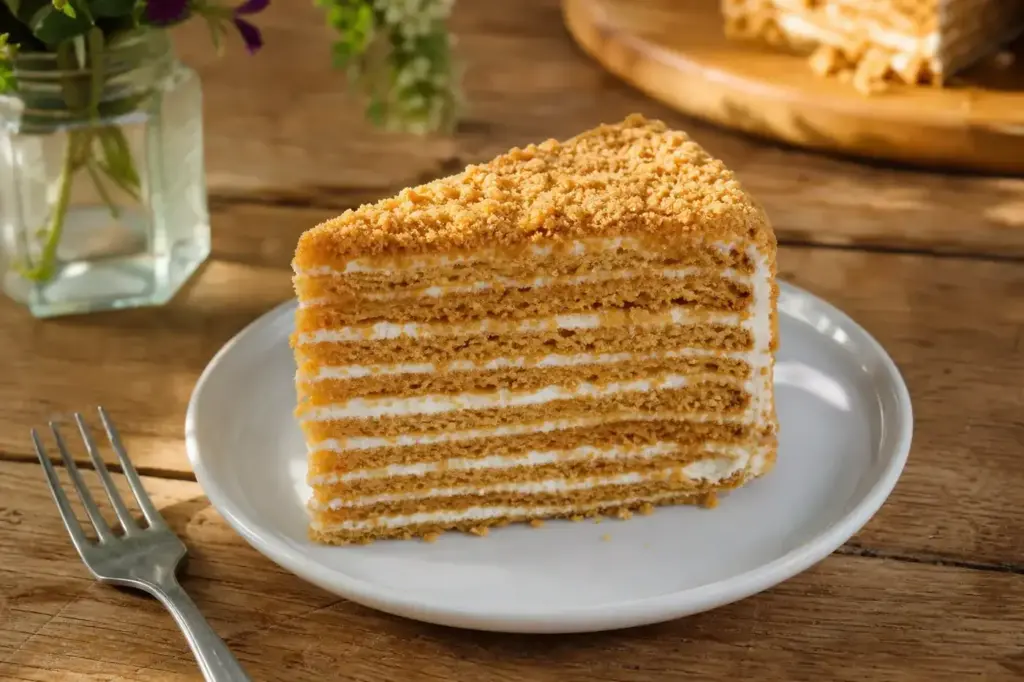
Medovik represents one of the most famous desserts of Russian and Eastern European cuisine. Whether you want to experience it in a Moscow café or make it at home, this guide covers the traditional recipe, technique and the story behind it.
You’ll discover how to build the thin layers, prepare the tangy filling, and achieve the characteristic soft texture that develops overnight. The recommended approach is to plan ahead: this cake rewards patience. A classic batch serves 3–4 people and takes about 2 hours of active work plus overnight refrigeration.
Quick answer: Medovik requires active preparation time of 1–2 hours to make the dough, roll and bake individual layers, plus at least 8 hours of refrigeration. The filling softens the crisp layers during resting, creating the signature tender texture. Total time from start to eating: roughly 14 hours across two days.
At a Glance
| Type | Desserts & sweets |
|---|---|
| Local name | Медовик |
| Origin | Created in the 19th century in the Russian Empire, medovik carries a legendary origin story. According to tradition, a young chef in the imperial kitchen sought to impress Empress Elizabeth Alexeievna, wife of Alexander I. The empress famously disliked honey, but the chef unknowingly baked a new cake with honey and thick sour cream, and she loved it. While medovik is Russian in origin, Ukraine has its own nearly identical version called medivnyk, and both countries consider honey layer cakes part of their culinary heritage. |
| Servings | 3–4 people |
| Total time | 2 hours active work plus 8–12 hours resting (overnight refrigeration required) |
| Difficulty | Medium |
History and Story of Medovik (Медовик)
Medovik is a layer cake popular in countries of the former Soviet Union. The identifying ingredients are honey and smetana (sour cream) or condensed milk. The dessert, famous for its lengthy preparation time, consists of layers of sponge cake with a cream filling and is often covered with nuts or crumbs made from leftover cake. While the thin layers harden shortly after coming out of the oven, the moisture of the filling softens it again over time. This contrast between the crisp baked layers and the softening effect of the cream is what gives medovik its distinctive tender character.
Ingredients
- 200 ml honey (liquid, mild variety preferred)
- 100 g unsalted butter
- 80 g granulated sugar
- 2–3 large eggs
- 250 g all-purpose flour
- 1 teaspoon baking soda
- 1/2 teaspoon salt
- 240 ml heavy cream (minimum 35% fat)
- 200 ml sour cream
How Medovik (Медовик) Is Made
Step 1: Heat the honey, butter and sugar
Combine honey, butter and sugar in a medium saucepan. Place over medium-low heat and stir occasionally for 5–7 minutes until the sugar dissolves completely. Do not let the mixture scorch. Once it starts to simmer, whisk continuously for 4 minutes; honey darkens slightly when heated properly.
Tip: The mixture should smell fragrant and turn a slightly deeper colour. If using a double boiler for gentler heat, add 2–3 minutes to this step.
Step 2: Add baking soda and cool slightly
Remove from heat and whisk in baking soda and salt. Let it sit for a couple of minutes, stirring often, so it calms down without cooling too much. The mixture will bubble and lighten as the baking soda reacts.
Tip: Do not skip the resting period; it prevents the eggs from scrambling when added.
Step 3: Incorporate eggs and flour
Beat the eggs lightly in a small bowl. Add them to the cooled honey mixture gradually, whisking constantly to prevent scrambling. Once combined, sift in the flour and stir until you have a thick, sticky dough. The consistency should resemble soft cookie dough.
Tip: Work quickly with the dough while it is still pliable. If it cools and hardens, gently reheat over warm water.
Step 4: Roll and bake the layers
The cake layers are incredibly thin; the dough can be rolled out and the thin layers only get baked for a short time. After approximately 5 minutes, they will be golden brown and ready to come out of the oven. Divide the dough into 8–10 equal pieces, roll each between parchment paper to about 2–3 mm thickness, cut into a circle using a plate as guide, and bake on a preheated tray.
Tip: Poke small holes across each layer with a fork to prevent puffing. Layer baking sheets in rotation: while one bakes, roll the next. Save all scraps to bake and crush into crumbs for the top.
Step 5: Prepare the sour cream filling
Whip the heavy cream until it holds soft peaks. Fold in the sour cream gently along with a pinch of salt. Some versions add a touch of sugar or vanilla. The filling should be light, spreadable and slightly tangy to balance the sweetness of the cake.
Tip: Keep the cream cold throughout. Chill the bowl and beaters for best results.
Step 6: Assemble and refrigerate overnight
Place the assembled cake in the refrigerator and wait at least eight hours (preferably overnight) until you can dig in. The frosting needs time to soften the layers and form a cohesive cake. Layer cake and filling alternately, dust the outside with crushed crumbs, and refrigerate.
Tip: This resting step is not optional—it transforms crispy layers into a tender, melt-in-the-mouth texture.
Variants
- Medovik with burnt honey: some recipes caramelize half the honey before mixing to add depth and a hint of bitterness
- Condensed milk filling: sweetened condensed milk cooked for hours until thick and caramel-like, used instead of sour cream
- Walnut or hazelnut topping: crushed nuts mixed with or replacing cake crumbs on the exterior
- With fresh fruit: layers of sliced berries between the cake and cream, added before refrigeration
Common Mistakes to Avoid
- Rushing the assembly: the cake must rest overnight in the refrigerator for the filling to soften the layers. Eating it too soon results in a harsh, crumbly texture.
- Letting the honey mixture cool too much before adding eggs: this causes the mixture to seize or the eggs to scramble. Add eggs while the mixture is still warm but comfortable to touch.
- Oversweetening the filling: many home bakers add too much sugar to the cream. The filling should be tangy and balance the sweet cake. Sour cream is essential.
- Not watching the thin layers closely while baking: they brown quickly (4–7 minutes) and can go from golden to burnt in seconds. Watch the first batch carefully to learn the timing.
- Making the filling too stiff: if you whip the cream too much, the texture becomes grainy when combined with sour cream. Whip just until it holds soft peaks.
How to Order and Eat It
The moisture of the filling softens the layers over time, so the cake is best served cold, straight from the refrigerator. Slice with a sharp knife dipped in hot water between each cut to prevent the delicate layers from crumbling. The contrast of soft, honey-scented cake with tangy cream and the faint crunch of crumbs on top is what makes it special. Serve as dessert after a heavy meal—its tender texture and balanced sweetness feel light despite the richness.
To order: Кусок медовика, пожалуйста [Kusok medovika, pozhaluysta] (A piece of medovik, please)
Where to Try Medovik (Медовик)
 Mari Vanna Russian
Main image: AI-generated illustration. It may not show the place exactly as it looks.
 Karavaev Brothers Russian, Eastern European, Jewish, European
Main image: AI-generated illustration. It may not show the place exactly as it looks.
Moscow Vibes Tips
- If the dough becomes too hard to roll as it cools, rest it gently over warm water (not directly) for a minute or two to make it pliable again. This is normal and expected.
- Make medovik two days ahead if possible. The cake improves as it sits—the flavour deepens and the layers soften further. It keeps well covered in the refrigerator for up to 5 days.
- Use mild honey (clover, wildflower) for a gentle flavour that lets the sour cream shine. Dark honeys like buckwheat will dominate. Avoid honey with additions like honeycomb pieces.
- A common mistake is overbaking the individual layers. They should be pale golden at the edges but still look slightly soft in the centre when removed. They firm up as they cool.
- If you find the cake layers still too crisp even after overnight refrigeration, brush each layer very lightly with simple sugar syrup (equal parts water and sugar, cooled) before assembling. This softens them further.
Explore Nearby Medovik (Медовик)
Browse more: All Food & Drink · All Other
FAQ
Why does medovik need to rest overnight?
The moisture from the sour cream filling gradually penetrates the crisp honey cake layers, softening them into a cohesive, tender cake. This transformation cannot be rushed. Eating the cake before 8 hours of refrigeration results in a harsh, crumbly texture. Patience is part of the recipe.
Can I use sweetened condensed milk instead of sour cream?
Yes. Traditional medovik has many variations. Some use thick sweetened condensed milk (cooked for hours until caramel-like), others use a mixture of butter and condensed milk. The sour cream version is more common now and offers a lighter, tangier result. Choose based on preference and what you have available.
How thin should each cake layer be?
Aim for 2–3 mm thickness—thin enough that you can almost see light through it, but thick enough that it holds together when baked. This is why the dough is rolled between parchment paper rather than shaped like traditional cake batter. Thinner layers bake faster and create the signature delicate texture.
What if my layers puff up too much in the oven?
Poke small holes all over each layer with a fork before baking to prevent uneven puffing. This is a standard step and essential for getting even layers.
Can I freeze medovik?
Yes, medovik freezes well for up to 2–3 weeks. Freeze after assembly and refrigeration, wrapped tightly. Thaw slowly in the refrigerator before serving. The texture remains good. Do not freeze unbaked dough or individual layers, as they can become tough.
Why did my layers crack when I transferred them from the oven?
Layers are fragile when hot. Let them cool for 1–2 minutes on the baking sheet before transferring to a cooling rack. If they crack, simply use the crumbs or broken pieces in the cake crumb topping—nothing is wasted.
Is medovik difficult to make?
The technique is straightforward—mix, roll, bake, assemble—but it requires attention to timing and temperature. The main challenge is rolling thin layers quickly before the dough cools and becomes unworkable, and then waiting overnight for the cake to set. It is a medium-difficulty recipe, not because it is technically complex, but because it demands patience and careful monitoring.
What is the difference between medovik and the Ukrainian version, medivnyk?
Ukraine has its own nearly identical version called medivnyk, and both countries consider honey layer cakes part of their culinary heritage. The core concept is the same—honey layers with creamy filling—but recipes vary slightly between regions and families.
Discover More of Moscow with Our Travel Tips
Get practical Moscow travel tips, new destination guides and useful updates on attractions, opening hours and prices. Plan your visit with clear, helpful information delivered to your inbox.
Moscow Vibes is a one-person project. A coffee keeps it going

Take this guide with you
Get a free PDF of this guide to print or read offline: key facts, tips and a map link on a few clean pages.
Report an issue on this page
Paying for your trip: please read
Payments and bookings between Russia and many other countries are currently restricted. In practice, cards issued in the EU, the UK, the US and several other countries often cannot be used in Russia, Russian cards usually cannot be used abroad, and some booking platforms, airlines and payment providers limit or pause their services for Russia. The situation changes frequently.
We do not give legal or financial advice, and this site does not encourage anyone to break any rule that applies to them. Whatever you plan, you are responsible for following the laws and regulations that apply to you, including those of your country of residence and citizenship.
Many travelers still organise their stay without problems. It is worth asking your bank or payment provider what is currently possible, contacting hotels, tour operators and carriers directly about the payment methods they accept, and checking which services are open to customers from your country. Clarify payment, cancellation and refund terms before you commit to a booking, and keep your plans flexible.
Partner links on this site may not be available in every country, and prices, availability and rules in our guides can differ from what you see when you book.
How we research and update our guides
About this guide: AI assistance and accuracy
This guide is created with the help of AI and is based on official sources where available. Mistakes can still happen. Opening hours, prices, rules and other details are given to the best of our knowledge as of the date shown and can change without notice. It offers general recommendations only, not professional, legal or travel advice. Please confirm important details with the official source before you travel; you are responsible for your own plans and decisions.
* Affiliate link: as an Amazon Associate we earn from qualifying purchases at no extra cost to you.