
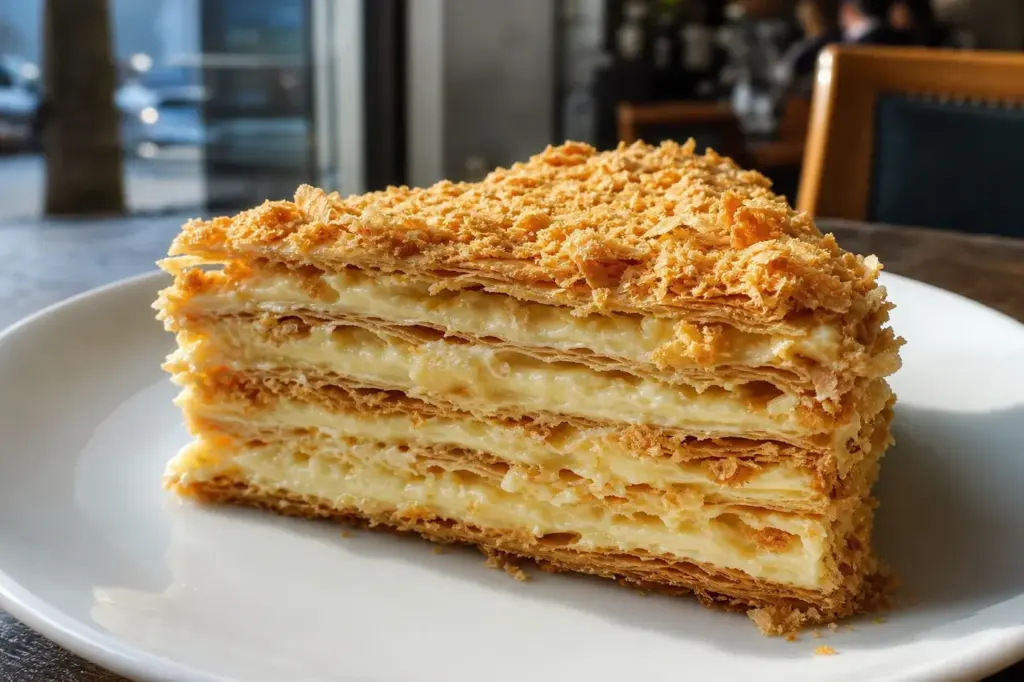
Napoleon Cake is one of Russia’s most beloved desserts, instantly recognizable for its towering layers of crisp pastry alternating with rich, buttery cream. If you’re staying in Moscow, you’ll find it in every bakery and patisserie from neighbourhood shops to high-end hotels. This guide shows you how to make an authentic Napoleon Cake at home.
This recipe serves 3-4 people and is ideal for a dinner party or special occasion. The cake requires advance planning—it’s at its best when left overnight in the refrigerator so the cream softens the pastry slightly while keeping it crisp enough to slice cleanly. The recommended approach is to prepare the components a day ahead and assemble before serving.
Quick answer: Make a laminated puff pastry dough, bake it into thin layers, prepare a vanilla custard cream, and layer them alternately, finishing with crumbs on the outside. Total time: 3-4 hours active work plus overnight chilling. Cost: ₽₽.
At a Glance
| Type | Desserts & sweets |
|---|---|
| Local name | Торт «Наполеон» |
| Origin | Russia, created in 1912 to mark the 100th anniversary of victory over Napoleon in 1812 |
| Servings | 3–4 people |
| Total time | 3–4 hours active work, plus overnight chilling |
| Difficulty | Hard |
History and Story of Napoleon Cake (Торт «Наполеон»)
Napoleon Cake became a Russian classic in 1912, created to commemorate the 100th anniversary of Russia’s victory over Napoleon during the Patriotic War of 1812. The cake was inspired by the French mille-feuille (meaning “thousand leaves”), but Russians reimagined it with many more layers and a richer, butter-enriched custard. Over the past century, it has evolved into a national dessert, found in every Russian bakery and appearing at celebrations. The traditional recipe calls for 8 to 20+ paper-thin layers of pastry, each separated by silky cream and finished with a coating of crushed pastry on the sides.
Ingredients
- 500 g all-purpose flour
- 350 g cold butter
- 2 eggs
- 150 ml ice water
- 15 ml white vinegar
- 5 ml salt
- 500 ml whole milk
- 120 g granulated sugar
- 4 egg yolks
- 40 g cornstarch
- 30 g all-purpose flour
- 100 g room-temperature butter
- 5 ml vanilla extract
How Napoleon Cake (Торт «Наполеон») Is Made
Step 1: Make the puff pastry dough
In a small bowl, whisk together the eggs, ice water, vinegar, and salt. In a food processor, pulse the flour, salt, and cold butter cubes until the mixture resembles coarse breadcrumbs. Transfer to a large bowl, add the egg mixture, and stir until a rough dough forms. Knead by hand on a lightly floured surface until smooth, being careful not to overwork it. Divide the dough into 10–12 equal balls, wrap in plastic, and refrigerate for at least 1 hour.
Tip: Keep all ingredients cold; this prevents the butter from melting into the flour, which creates the layers.
Step 2: Roll and bake the pastry layers
Preheat the oven to 200°C (400°F). On parchment paper, roll each dough ball into a very thin sheet, as thin as you can make it. Using an 8-inch cake ring or plate as a guide, cut out a circle and trim it. Pierce the entire surface with a fork. Place on a baking sheet and bake for 9–12 minutes until lightly golden. Cool completely on a wire rack. Repeat with remaining dough, baking only two layers at a time. Crush any leftover pastry scraps and set aside for decoration.
Tip: The thinner you roll the pastry, the more delicate and authentic the layers will be. Don't skip pricking with a fork—this prevents excessive puffing.
Step 3: Prepare the custard cream
In a saucepan over medium heat, warm the whole milk until it just begins to steam but does not boil. In a separate bowl, whisk the egg yolks with sugar until pale and fluffy. Sift the cornstarch and flour into the egg mixture and whisk until smooth. Slowly pour the hot milk into the egg mixture while whisking constantly to temper the eggs. Pour the entire mixture back into the saucepan and cook over medium heat, stirring constantly, until it thickens to a custard-like consistency (about 1–2 minutes). Remove from heat, stir in the butter and vanilla, then transfer to a bowl. Cover directly with plastic wrap (pressing it onto the surface) to prevent a skin from forming, and cool completely.
Tip: Straining the cooled custard through a fine sieve removes any lumps and ensures a silky filling.
Step 4: Assemble the cake
Place the first pastry layer on your serving plate or cake board. Spread a generous layer of custard cream (about 2–3 tablespoons) over it. Continue layering pastry and cream, gently pressing each layer so they stick together slightly. Use most of the custard between the layers, reserving some for the outside coating. Once all layers are stacked, spread the remaining cream over the top and sides of the cake.
Tip: Each cream layer should be thick enough to notice—thin layers will get compressed and disappear.
Step 5: Coat with pastry crumbs and chill
Take the reserved pastry crumbs (from trimmings and leftover layers), crush them into small pieces, and pat them onto the top and sides of the cake. This gives the Napoleon its traditional appearance and prevents the cream from drying out. Wrap the cake loosely and refrigerate overnight (or at minimum 6 hours) before serving. The cake is best within two days but remains pleasant for up to three days.
Tip: Let the cake come to room temperature for 15–20 minutes before slicing for the cleanest, most elegant cuts.
Variants
- Simplified modern version: made with store-bought puff pastry instead of homemade dough, reducing labour
- Whipped-cream filling: some recipes use heavy cream whipped with condensed milk instead of custard, creating a lighter texture
- Single-sheet assembly: some cafes and bakeries assemble the cake in a long rectangular shape from strips of pastry instead of stacking circles
- Chocolate-glazed top: a thin layer of icing or melted chocolate instead of pastry crumbs
Common Mistakes to Avoid
- Overworking the dough: Mix just until the dough comes together. Overworking develops gluten and prevents the layers from flaking.
- Not keeping ingredients cold: Warm butter melts into the flour instead of creating layers. Keep eggs, water, and butter chilled throughout.
- Spreading the cream too thin: A thin cream layer gets compressed and disappears between the flaky pastry. Use generous amounts, at least 2–3 tablespoons per layer.
- Slicing too soon: Cutting the cake while it's freshly assembled causes the layers to slide apart. Always refrigerate overnight and let it set so the cream firms up.
- Skipping the fork pricks: Unpierced pastry puffs excessively and becomes too thick, losing the delicate, thin-layer character of a proper Napoleon.
- Using room-temperature milk: Hot milk tempers the eggs properly; if the milk isn't warm enough, you risk scrambling the yolks or having a lumpy custard.
How to Order and Eat It
Serve the cake chilled, cut into thick slices with a sharp, hot knife—dip the blade in hot water and wipe it dry between cuts to prevent the cream from dragging. A chilled dessert plate keeps the pastry crisp longer. Napoleon pairs beautifully with strong black tea, hot chocolate, or coffee. Eat it slowly to appreciate each delicate layer of pastry and the smooth cream inside.
To order: Торт «Наполеон», пожалуйста [Tort «Napoleon», pozhaluysta]
Diet and Allergens
- Contains gluten
- Contains eggs
- Contains dairy
Moscow Vibes Tips
- Plan ahead: make the dough and pastry a day before, and prepare the custard the morning of assembly. This spreads the work and gives everything time to chill properly.
- Use a springform or cake ring when rolling and baking the pastry—it keeps the circles even and prevents uneven baking.
- If the pastry splits or breaks during rolling, don't discard it; use the pieces as part of the middle layers and save the best-looking circles for the top and bottom.
- The longer the cake sits in the refrigerator, the more the cream seeps into the pastry, creating a slightly softer, more uniform texture—some prefer this; others prefer serving it sooner for crispier layers.
- Keep a hot, damp cloth nearby while slicing; wipe the knife between cuts to prevent dragging.
- Store the cake loosely covered in the refrigerator; wrapping it too tightly traps moisture and softens the pastry too much.
Explore Nearby Napoleon Cake (Торт «Наполеон»)
Browse more: All Food & Drink · All Other
FAQ
Can I use store-bought puff pastry?
Yes. Store-bought puff pastry is convenient and produces good results, though homemade pastry creates thinner, more delicate layers. If using store-bought, thaw it, roll it thinner than the package suggests, and follow the same baking method.
Why does my pastry puff too much in the oven?
You likely didn't pierce it enough with a fork, or the dough was too thick when rolled. Pierce the entire surface thoroughly and roll thinner next time. The pastry should be almost transparent when you hold it up to the light.
Can I make it a day ahead?
Yes—this is ideal. Assemble the cake the day before, wrap it loosely, and refrigerate overnight. This allows the flavours to meld and the texture to set so slicing is clean and neat.
What if my custard is lumpy?
Strain it through a fine sieve after it cools. If lumps formed while cooking, you either added cold milk to hot eggs or didn't whisk enough—next time, temper the eggs by slowly adding hot milk while whisking constantly.
How many layers should there be?
Traditional Russian Napoleons have 8 to 12+ pastry layers. More layers create a taller, more dramatic cake, but require more rolling and baking. Even 6–7 layers creates a stunning dessert.
Can I freeze it?
Yes, freeze it wrapped tightly for up to 2 weeks. Thaw slowly in the refrigerator for several hours before serving. The texture will be slightly softer but still delicious.
Why does the recipe include vinegar?
Vinegar prevents gluten development and adds flavour, helping create tender, flaky layers. It's a traditional addition to Russian puff pastry dough.
Is it difficult to make at home?
It's moderately challenging because of the many thin layers and the time required, but the steps themselves are straightforward. The main skill is rolling the dough thin and working patiently. First-time bakers often succeed with careful attention to detail and proper chilling times.
Discover More of Moscow with Our Travel Tips
Get practical Moscow travel tips, new destination guides and useful updates on attractions, opening hours and prices. Plan your visit with clear, helpful information delivered to your inbox.
Moscow Vibes is a one-person project. A coffee keeps it going

Take this guide with you
Get a free PDF of this guide to print or read offline: key facts, tips and a map link on a few clean pages.
Report an issue on this page
Paying for your trip: please read
Payments and bookings between Russia and many other countries are currently restricted. In practice, cards issued in the EU, the UK, the US and several other countries often cannot be used in Russia, Russian cards usually cannot be used abroad, and some booking platforms, airlines and payment providers limit or pause their services for Russia. The situation changes frequently.
We do not give legal or financial advice, and this site does not encourage anyone to break any rule that applies to them. Whatever you plan, you are responsible for following the laws and regulations that apply to you, including those of your country of residence and citizenship.
Many travelers still organise their stay without problems. It is worth asking your bank or payment provider what is currently possible, contacting hotels, tour operators and carriers directly about the payment methods they accept, and checking which services are open to customers from your country. Clarify payment, cancellation and refund terms before you commit to a booking, and keep your plans flexible.
Partner links on this site may not be available in every country, and prices, availability and rules in our guides can differ from what you see when you book.
How we research and update our guides
About this guide: AI assistance and accuracy
This guide is created with the help of AI and is based on official sources where available. Mistakes can still happen. Opening hours, prices, rules and other details are given to the best of our knowledge as of the date shown and can change without notice. It offers general recommendations only, not professional, legal or travel advice. Please confirm important details with the official source before you travel; you are responsible for your own plans and decisions.
* Affiliate link: as an Amazon Associate we earn from qualifying purchases at no extra cost to you.