
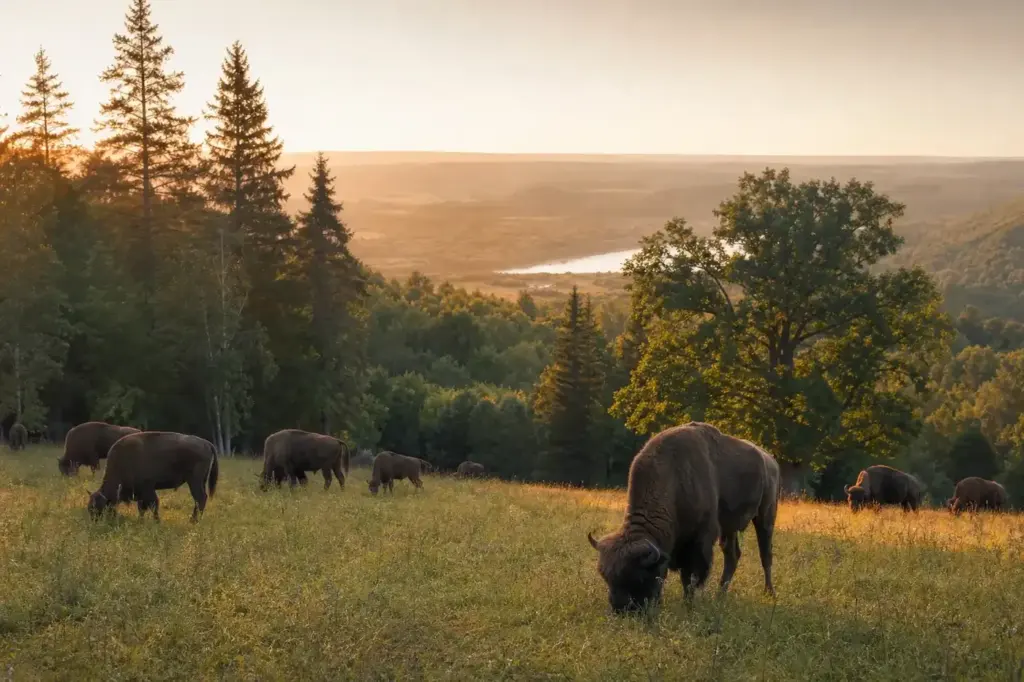
Prioksko-Terrasny Nature Reserve is a day trip from Moscow through an exceptional pocket of wilderness in the most densely populated region of Russia. Located 100 kilometres south of Moscow near the village of Danki in Serpukhov District, this 5,000-hectare protected area represents an island of intact forest-steppe ecosystem on terraces above the Oka River.
The reserve is best known for its European bison breeding centre, where herds of these massive, Ice Age-era animals live in a landscape that combines pine forests, mixed woodlands, oak forests and patches of steppe vegetation—a rare combination that exists nowhere else so close to Moscow.
Quick Facts
| Russian name | Приокско-Террасный государственный природный биосферный заповедник |
|---|---|
| Distance from Moscow | approximately 100 km south |
| Travel time from Moscow | 2–2.5 hours by car or train plus bus |
| Built / opened | 1945 |
| Address | Danki, Serpukhov District, Moscow Region, 142200, Russia Google MapsApple MapsYandex Maps2GIS |
| Opening hours | Daily 09:00-17:00 |
| Admission | ₽–₽₽ for adults; lower for children under 7; includes guided tour of Bison Breeding Centre and Nature House museum |
| Best time to visit | May through September for comfortable weather and active wildlife. Early autumn (September) is particularly rewarding: temperatures are moderate, summer heat has passed, steppe vegetation displays colour, and bird migration brings diverse species. Winter (December–February) is possible but cold and muddy; some trails may be difficult. Spring (April–May) offers bird migration and wildflowers but can be wet. Summer (June–August) is warm but often crowded on weekends; midweek visits are more peaceful. |
| Website | pt-zapovednik.ru |
What Is (and Isn't) Part of a Visit to Prioksko-Terrasny Nature Reserve Day Trip from Moscow?
| Part | Status | Notes |
|---|---|---|
| Bison Breeding Centre and viewing area | Included in the standard ticket | Core attraction; part of standard admission ticket and guided eco-trail. |
| Nature House museum (on Central Estate) | Included in the standard ticket | Included in standard admission; typically 20–30 minutes as part of guided tour. |
| Leshy House museum (forest spirit pavilion) | Included in the standard ticket | Small structure on eco-trail; included in standard admission. |
| Main eco-trail (2 km forest walk) | Included in the standard ticket | Guided walk past bison, museums and forest terraces; requires standard admission and mandatory guide. |
| Tree-House adventure park (canopy walkway and obstacles) | Separate ticket or institution | Additional ticket required beyond main admission; not included in standard eco-trail package. Approximately 1–1.5 hours. Best for families with children aged 5+. |
| Self-guided exploration beyond marked areas | Not open to visitors | The reserve is a strict nature reserve; visitors cannot wander independently off marked trails. All visits are guided or on designated routes. |
| Serpukhov town attractions (separate destination) | Outside / not part of it | Serpukhov city is 12 km from the reserve; not part of the reserve visit but can be combined as a separate half-day trip if time allows. |
| Direct access to Oka River | Not open to visitors | The river valley is visible from terraces and trails but direct access to the riverbank itself is restricted for ecological protection. |
| Overnight accommodation at the reserve | Not open to visitors | The reserve does not offer accommodation; a day trip is the standard model. Accommodation available in nearby Serpukhov town. |
How to Get from Moscow to Prioksko-Terrasny Nature Reserve Day Trip from Moscow
| Option | Duration | Price | Notes |
|---|---|---|---|
| Car (private or rental) | 2–2.5 hours from central Moscow | ₽₽ | Most flexible option. Drive south from Moscow toward Serpukhov; reserve is 12 km from Serpukhov town in the village of Danki. Parking available at Central Estate. Return journey adds 2–2.5 hours. Toll roads (M2 highway) may apply. Good for groups. |
| Train and bus combination | 3–3.5 hours from Moscow Paveletsky Station | ₽–₽₽ | Take a commuter train (elektrichka) from Moscow Paveletsky Station toward Serpukhov (approximately 1.5 hours). From Serpukhov railway station, take a local bus or taxi (15–20 minutes, 12 km) to Danki. More economical than driving. Last trains back to Moscow typically depart Serpukhov around 22:00–23:00. Frequency: trains run approximately every 1–2 hours during the day. |
| Organized tour from Moscow | 8–10 hours total (includes transport) | ₽₽–₽₽₽ | Several Moscow tour operators offer package day trips including transport, entry fee and guided tour. Convenient if you prefer not to navigate independently. Includes hotel pickup and return. Tour typically covers reserve highlights and return by evening. |
| Taxi or ride-share | 2–2.5 hours each way from central Moscow | ₽₽₽–₽₽₽₽ | Most straightforward if driving independently is not comfortable. Higher cost but door-to-door service. Arrange return pickup in advance or request taxi via app. Suitable for 1–4 people. |
₽ budget · ₽₽ moderate · ₽₽₽ upscale · ₽₽₽₽ splurge. Price levels are estimates compared with typical prices for visitors.
Why Visit Prioksko-Terrasny Nature Reserve Day Trip from Moscow?
The reserve offers something few day trips from Moscow provide: genuine wilderness with large wild animals visible from marked trails. The focal point is meeting European bison, the largest ungulate in Europe, nearly extinct as recently as the mid-20th century. Visitors also encounter the ecological richness of the forest-steppe transition zone, home to 142 bird species, pine and mixed forests, and ancient oak woodlands. The guided 2-kilometre eco-trail passes the bison herd, a nature museum in a traditional manor, and a museum dedicated to the forest spirit Leshy from Slavic folklore. It’s a place to experience intact Russian ecosystems without crowds or development.
Highlights of Prioksko-Terrasny Nature Reserve Day Trip from Moscow
European Bison Herd
The reserve's symbol and main attraction: a working breeding programme for European bison (wisent), the largest wild land mammal in Europe. Founded in 1948 when the species stood at the edge of extinction, the centre now hosts more than 700 bison and has reintroduced over 116 animals to wild populations across Russia. Visitors typically see animals grazing or resting in a large enclosure. Peak viewing is late morning or early afternoon. Arrive by 12:00 to join scheduled tours; bison are fed at 17:00.
Tip: Bring binoculars or a camera with good zoom. Bison are large but distance and vegetation can make detail photography challenging. Morning light is best.
The Nature House Museum
A small museum in a traditional estate building explaining the reserve's ecosystems, wildlife and history. Displays cover the forest-steppe transition zone, bird migration, plant diversity (981 vascular plant species recorded), and the restoration of European bison. The building itself sits on the terrace landscape the reserve protects. Typically visited as part of the guided eco-trail; allow 20–30 minutes inside.
Tip: Ask the guide to explain the old estate's pre-Soviet history and its role in the reserve's foundation. The architecture and setting are as informative as the exhibits.
The Leshy House
A smaller museum building dedicated to Leshy, the forest spirit of Slavic folklore. Displays interpret traditional Russian woodland beliefs and the ecological role of forests in ancient Russian culture. The structure sits within the forest landscape and offers context for understanding how indigenous Russians viewed these ecosystems. Usually 10–15 minutes to view.
Tip: This small pavilion is atmospheric and often quiet. Visit before or after the main eco-trail crowds if you prefer reflection on the mythology.
Oka River Terrace Landscape
The reserve's defining geography: the Oka River's sandy terraces support an unusual plant community mixing boreal pine and oak forests with southern steppe species. This forest-steppe transition is rare and vulnerable; sandy soils and subtle elevation changes create microclimates. The terrace terraces can be seen from the eco-trail and offer views of the river valley. This landscape explains why the reserve was established—it preserves something scientifically important and increasingly rare.
Tip: The terrace topography is subtle but real. Look for the shift from dense forest to more open, dry clearings with steppe-like vegetation. Spring (late May) and autumn (September) make the plant diversity most visible.
Tree-House Adventure Park
An optional separate activity (requires additional ticket): an elevated obstacle course and suspended walkway system winding through the forest canopy. Platforms, rope bridges and climbing challenges are set 2–4 metres above ground among the pines and oaks. Suitable for ages roughly 5–60 depending on fitness; no prior experience needed. Takes 1–1.5 hours. This is a modern addition distinct from the traditional eco-trail and museum.
Tip: Book the Tree-House in advance if visiting with children; summer weekends fill up. It extends your day trip significantly (add 2+ hours) but is genuinely enjoyable for families with older children.
Autumn Steppe Vegetation
In September and early October, patches of the reserve's steppe community—adapted to sandy, dry soil—display their seasonal appearance. Unlike typical Russian forest, these clearings show wildflowers, grasses and low shrubs typical of southern dry steppes. They exist at the northern edge of their range, preserved by the sandy terrace soil unsuitable for agriculture. This microhabitat is one reason the reserve has international conservation status.
Tip: Visit September through October to see the steppe community in bloom. In summer it looks dry and sparse; in winter and spring the distinction is less obvious.
Bird Migration Observation
The reserve lies on a major migration route for northern and central European birds. In spring (April–May) and autumn (August–September), 142 bird species pass through or winter here, including rare raptors and waterfowl. The Oka River and terraces create diverse habitats for different species. Serious birdwatchers can arrange guided birdwatching tours in advance.
Tip: Bring binoculars and a bird identification guide. Early morning visits (arrive by opening time) offer the best chance to see and hear migratory species. Spring and autumn are peak seasons.
Atmosphere
The reserve feels like genuine Russian nature: forests of pine, oak and birch interspersed with clearings, the distant Oka River in its valley, and quiet paths where visitor groups pause to listen. The Central Estate has a Soviet-era administrative building and traditional manor structures, humble and utilitarian. Bison are visible as large, dark silhouettes at distance, often grazing quietly; your approach prompts them to shift but rarely flee. The air smells of earth, pine resin and damp forest floor.
Morning is peaceful and contemplative—few visitors, clear light through the canopy. Weekends and fair-weather days bring crowds, especially families with children heading for the Tree-House adventure park. The guided-tour system means you move as a small group at a steady pace, not rushing. The landscape feels protected and intentional, like a functioning nature reserve where research and species recovery happen. There is no kitsch, no souvenir stands beyond basic refreshments, no music—just the sounds of birds and wind in trees.
History of Prioksko-Terrasny Nature Reserve Day Trip from Moscow
The reserve was established by decree on 19 June 1945, immediately after World War II, when Soviet science prioritized preserving intact ecosystems of the Moscow Region. Sandy terrace forests along the Oka had survived centuries of settlement and agriculture because sandy soils were poor for farming and the terraces’ elevated position made them less valuable than lowlands. By the 1940s, these forests remained one of the few relatively untouched examples of the forest-steppe transition zone near Moscow.
In 1948, three years after the reserve’s founding, Soviet biologists established a European bison breeding programme. The species had been hunted to extinction in the wild; only about a dozen individuals survived in zoos and private collections. Using animals from Belovezhskaya Pushcha (in Belarus) and the Western Caucasus, the breeding centre began the long work of population recovery. This programme became the reserve’s defining mission and international reputation.
In 1978, UNESCO designated the Prioksko-Terrasny reserve as a Biosphere Reserve under the Man and the Biosphere Programme, recognizing its role in preserving rare forest-steppe ecosystems and its scientific work on endangered species. By the 1990s and 2000s, the breeding centre had produced over 600 bison calves; between 1999 and 2015, more than 116 were reintroduced into wild populations across Russia and nearby countries, helping restore the species to viable wild herds. The reserve shifted gradually from a closed scientific station to a destination open to guided public visits, while maintaining its core research and breeding mission.
Today, the reserve remains under state protection and operates as both a functioning nature reserve and an eco-education site. The European bison has recovered from the brink of extinction—largely due to this programme—and now numbers in the thousands across European wild populations, a conservation success story that began here.
Tickets and Booking for Prioksko-Terrasny Nature Reserve Day Trip from Moscow
| Ticket | Price | Includes |
|---|---|---|
| Adult entrance (eco-trail with bison and museums) | ₽₽ | Guided eco-trail tour (1.5–2 hours) including Bison Breeding Centre viewing, Nature House museum, Leshy House museum, and forest paths; group sizes typically 10–20 people per guide. |
| Child entrance (ages 7–17 or school groups) | ₽ | Same as adult tour, typically lower rate for children. |
| Children under 7 | Free | Free admission for children under 7; must be accompanied by paid adult. |
| Tree-House adventure park (additional ticket) | ₽–₽₽ | Elevated canopy walk and obstacle course through forest; separate from main eco-trail. Requires separate booking. |
| Concessions (pensioners, students, Russian citizens) | varies | Lower rates available; check official website or at ticket office for current rates and eligibility requirements. |
₽ budget · ₽₽ moderate · ₽₽₽ upscale · ₽₽₽₽ splurge. Price levels are estimates compared with typical prices for visitors.
Tickets must be purchased at the reserve’s Central Estate ticket office. Tickets for the main eco-trail include a mandatory guide; you cannot visit independently. Tours depart regularly throughout the day (typically at 09:00, 11:00, 13:00, 15:00 on weekdays; more frequently on weekends). Same-day tickets are available if you arrive by mid-morning, though late arrivals (after 14:00) may miss the final tour slots of the day. The last tour typically departs at 15:00 to allow completion before the site closes at 17:00.
For the Tree-House adventure park, advance booking is recommended, especially for weekends and holidays, as spaces are limited. Pre-booking can sometimes be arranged by contacting the reserve directly (telephone: +7 (4967) 707-145; email: ptz@pt-zapovednik.ru).
Rates for Russian citizens and concessions (students, pensioners) differ from international visitor rates. For all ticket categories, current prices and special rates should be verified on the official website (pt-zapovednik.ru) before your visit, as rates change seasonally and may vary for groups.
Suggested itineraries Prioksko-Terrasny Nature Reserve Day Trip from Moscow
4 hours on site
Morning visit. Arrive by 10:00 and purchase tickets immediately. Join the 11:00 guided eco-trail tour (1.5–2 hours). After the tour, spend 30 minutes exploring the gift shop and café, then depart by 13:30. This works if you travel by private car and want a half-day excursion. By train, expect to leave Moscow by 07:30–08:00 and return by late afternoon.
6–7 hours on site (full day)
Arrive by 10:00. Join a morning eco-trail tour at 11:00 (2 hours). Lunch at the café (30–45 minutes). Afternoon: visit Tree-House adventure park (1–1.5 hours, if interested). Second smaller nature walk or rest before departure. Leave by 16:00–17:00. Ideal if you travel by train and want a leisurely pace without rushing.
3–4 hours on site (minimal visit)
Arrive by 12:00, purchase tickets and join the 12:30 or 13:00 tour (1.5–2 hours). Quick café stop, then depart by 15:00–15:30. Tight but possible if you drive and want only core bison viewing without the Tree-House extension. Return to Moscow by 18:00–19:00.
Full day with Serpukhov
Visit the reserve in the morning (depart Moscow 07:30 by car or train). Complete the eco-trail and Tree-House by 14:00–15:00. Spend 2–3 hours in nearby Serpukhov town (historic town with its own museums, churches and riverside walks). Return to Moscow by 20:00–21:00. Ideal for combining wilderness and cultural interest.
How to Get to Prioksko-Terrasny Nature Reserve Day Trip from Moscow
By private car: From central Moscow, drive south on the M2 (Crimean) highway toward Tula. Continue approximately 100 km; follow signs to Serpukhov. Exit toward Danki village (turn east off the main highway about 12 km before Serpukhov). The reserve’s Central Estate is in Danki on the Oka River embankment (address: Danki, Serpukhov District, Moscow Region, 142200). GPS coordinates: 54.90361°N, 37.54667°E. Parking is available at the entrance.
By train and bus: From Moscow Paveletsky Station, take a commuter train (elektrichka) on the Paveletsky line toward Serpukhov. Journey time: approximately 1.5 hours. Exit at Serpukhov railway station. From the station, take a local bus (routes vary; ask at the station) or hail a taxi to Danki (12 km, approximately 20 minutes). Some visitors rent cars at Serpukhov station for this leg if buses are infrequent.
Walking from the nearest transport: There is no realistic walking distance from Serpukhov town (12 km); a vehicle is necessary for the final leg. Once at the Central Estate, all trails are on foot (2–4 km total, depending on activities).
Accessibility
The Central Estate and immediate visitor facilities (museum building, café, ticket office) are at ground level with minimal steps. However, the main eco-trail involves approximately 2 kilometres of walking on forest paths with natural surface (earth, roots, occasional stones); surfaces are uneven and may be muddy after rain. Wheelchair access is not feasible on the trail itself. The Tree-House adventure park requires climbing ability and is not accessible for mobility-impaired visitors. There are benches at rest points along the trail. A companion ticket is not separately discounted for attendants assisting disabled visitors; inquire at the ticket office. If mobility is limited, the museum and café offer some experience without the full trail walk.
Food Nearby
A small café at the Central Estate serves basic refreshments: tea, coffee, sandwiches, snacks and soft drinks. Quality is simple but adequate. No restaurants are immediately at the reserve. Nearby Serpukhov town (12 km away) offers restaurants and cafés but requires driving separately. Plan to eat before arriving or bring a packed lunch and picnic snacks if you prefer more choice or lower prices.
What to Bring
Comfortable walking shoes with grip for forest paths; muddy conditions are common even after light rain. Binoculars for bison and bird watching. Insect repellent (especially spring and summer). Hat and sunscreen for exposed moments on terraces. Light rain jacket or umbrella (weather changes quickly in forests). Water bottle. Camera with zoom lens for distant bison. Layers for temperature changes. A small daypack is sufficient; no heavy backpack needed.
Best Views and Photo Spots of Prioksko-Terrasny Nature Reserve Day Trip from Moscow
Bison viewing area (main enclosure)
Large herd of dark bison against green pasture or forest backdrop; dramatic because of the animals' massive size and presence. Early morning light on their fur creates contrast. Best angle from slightly elevated observation platform.
Best time: Early morning (09:00–11:00) for clean light and active animals; 17:00 (feeding time) for concentrated bison activity, though light may be lower. Avoid midday harsh shadows.
Oka River terrace overlook
The river valley below, forested banks and water visible through pine and oak trees. The terrace elevation creates perspective of landscape. Particularly picturesque in autumn when foliage colours change.
Best time: Late afternoon for warm, angled light through the canopy. Autumn (September–October) for golden and red leaf colours. Early spring for bare trees and river flow visibility.
Central Estate with traditional manor buildings
Historic buildings set among trees; architectural perspective with nature integration. Useful as context for understanding the reserve's human history and Soviet-era science mission.
Best time: Morning light illuminates the buildings well. Spring (with blooming undergrowth) or autumn (with leaf colour) adds seasonal context.
Tree-House canopy walkway and forest interior
Elevated perspective through oak and pine canopy; open sky framed by trees; modern structure integrated into old forest. Unique vantage not possible from ground level.
Best time: Late morning for clear canopy light. Early autumn for dappled light and foliage colour beginning to turn. Avoid midday harsh brightness.
Steppe vegetation patches on sandy terrace
Contrast between forest and open grassland with low steppe species; wildflowers and grass texture visible. Photogenic for botanical and landscape interest.
Best time: September–October during flowering and before frost. Early morning or late afternoon for side-lighting of grasses and flowers.
Photography Rules
Photography is freely permitted on the trails and at bison viewing areas. Flash is not required and may disturb animals. Drones are not permitted in the reserve. Tripods are acceptable but can obstruct group movement on narrow paths; use only at viewpoints. Photograph the bison from designated viewing areas only; do not approach enclosures or leave marked trails. Professional photography or filming may require advance permission from the reserve administration.
Family Suitability
Suitable for families with children aged 5 and up. Younger children can manage the 2-kilometre eco-trail if they are comfortable walkers; allow extra time. The bison viewing is engaging for children (large animals, clear visibility). The Tree-House adventure park is excellent for children aged 5–15; younger children under 5 can access some parts but may struggle with higher obstacles. Strollers can navigate the Central Estate and museum areas but are difficult on forest trails; carrying a baby or young toddler may be preferable. No dedicated children's facilities beyond the Tree-House. Museum exhibits are simple but engage school-age children. Total duration (eco-trail plus activities) is 3–5 hours; plan accordingly for nap times and meal breaks.
Moscow Vibes Tips
- Arrive early if visiting on a weekend or holiday. Tour groups fill up quickly, especially in June–August and during school holidays. Arriving by 10:00 ensures a place on a mid-morning tour. Late afternoon arrivals (after 14:00) risk missing the final tours.
- Weekday visits are quieter and allow a more intimate experience with the reserve. If possible, visit Tuesday–Thursday for fewer crowds and a more peaceful forest atmosphere. Summer weekends and Russian school holidays are busiest.
- Wear sturdy hiking shoes or boots, not casual sneakers. Forest paths become muddy after any rain; good tread prevents slipping and ankle turning. Flat shoes struggle with tree roots and stones.
- If bison viewing is your priority, arrive by noon and aim for a 13:00 or 14:00 tour. Bison are often more active in the afternoon and gather closer to viewing areas during feeding preparations (17:00 daily). Don't expect them to be close at all times; they are wild animals, not zoo exhibits.
- If time is limited, prioritize the eco-trail over the Tree-House. The trail offers the core experience (bison, ecosystems, museums). The Tree-House is a modern addition; missing it doesn't diminish your visit. However, if you have young children (5–12), the Tree-House often delights them more than the trail.
- Download the reserve's official contact number (+7 (4967) 707-145) before you go. Reception and tour schedules can change, especially in off-season or bad weather. A quick call in advance clarifies whether tours are running and what to expect on the day.
Explore Nearby Prioksko-Terrasny Nature Reserve Day Trip from Moscow
Related guides
 Serpukhov Day Trip from Moscow: Monasteries, Museum and Train
Main image: AI-generated illustration. It may not show the place exactly as it looks.
 Polenovo Estate Day Trip from Moscow: Park, House Museum and Travel
Main image: AI-generated illustration. It may not show the place exactly as it looks.
More guides
 Kolomenskoye Museum-Reserve Moscow
Main image: AI-generated illustration. It may not show the place exactly as it looks.
 Kolomenskoye Museum-Reserve: Half-Day Itinerary
Main image: AI-generated illustration. It may not show the place exactly as it looks.
 Tsaritsyno Museum-Reserve MoscowOpen daily 06:00–00:00
Main image: AI-generated illustration. It may not show the place exactly as it looks.
 Moscow on a Budget: One-Day Free Sightseeing Itinerary
Main image: AI-generated illustration. It may not show the place exactly as it looks.
 Moscow in Autumn: Parks and Photography Itinerary
Main image: AI-generated illustration. It may not show the place exactly as it looks.
Browse more: All Day Trips · All Parks
FAQ: Prioksko-Terrasny Nature Reserve Day Trip from Moscow
Can I visit the reserve without a guide?
No. The reserve operates on a mandatory guided-tour system. Visitors cannot explore independently off marked trails, even if they arrive with a guide. This protects the reserve's ecology and ensures visitor safety. All visits include a guide as part of the standard admission ticket.
Are the bison guaranteed to be visible?
Yes, very likely. The main bison viewing area is an open enclosure where herds typically graze or rest visibly. However, on rare occasions animals may be further away or less active. Viewing is not theatrically close, so binoculars help. Afternoon visits (12:00–15:00) often see more concentrated bison activity as feeding time approaches.
What is the Tree-House, and is it worth the extra cost?
The Tree-House is a separate canopy adventure park: suspended rope bridges, elevated walkways and obstacles winding through oak and pine trees 2–4 metres above ground. It is worthwhile if you enjoy outdoor climbing activities or have children aged 5–15. It extends your visit by 1–1.5 hours and requires an additional ticket. If time or budget is tight, the eco-trail alone is the essential experience.
How far is the reserve from Moscow, and can I visit as a day trip?
The reserve is approximately 100 kilometres south of Moscow, roughly 2–2.5 hours by car or train plus bus. Yes, a full day trip is realistic. Depart Moscow early morning, spend 4–6 hours at the reserve, and return by evening. Train travel takes longer (3–3.5 hours each way) but is economical; organised tours from Moscow simplify logistics.
When is the best time to visit?
May–September offers the most comfortable weather and active wildlife. Early autumn (September) is ideal: moderate temperatures, steppe vegetation in colour, and bird migration brings species diversity. Summer weekends are crowded; weekday visits are more peaceful. Winter is possible but cold; spring can be wet.
Is the reserve suitable for young children?
Yes, for children aged 5 and up. The eco-trail is a manageable walk (2 km) if children are comfortable hikers. Bison viewing fascinates most children. The Tree-House adventure park suits children 5–15 well. Younger toddlers (under 5) can experience the Central Estate and museums but may struggle with the full trail walk.
Do I need to book in advance?
For the main eco-trail, same-day tickets are usually available if you arrive before mid-morning. For the Tree-House adventure park or if visiting as part of a large group, advance booking is recommended to secure a spot, especially on weekends. Contact the reserve (phone: +7 (4967) 707-145) or check the official website for booking details.
What about food and drinks at the reserve?
A small café at the Central Estate serves basic refreshments (tea, coffee, sandwiches, snacks). Quality is simple but adequate. Bring a packed lunch if you prefer more variety or lower prices, or plan to eat in nearby Serpukhov town (12 km away) as a separate stop.
Discover More of Moscow with Our Travel Tips
Get practical Moscow travel tips, new destination guides and useful updates on attractions, opening hours and prices. Plan your visit with clear, helpful information delivered to your inbox.
Moscow Vibes is a one-person project. A coffee keeps it going

Take this guide with you
Get a free PDF of this guide to print or read offline: key facts, tips and a map link on a few clean pages.
Report an issue on this page
Paying for your trip: please read
Payments and bookings between Russia and many other countries are currently restricted. In practice, cards issued in the EU, the UK, the US and several other countries often cannot be used in Russia, Russian cards usually cannot be used abroad, and some booking platforms, airlines and payment providers limit or pause their services for Russia. The situation changes frequently.
We do not give legal or financial advice, and this site does not encourage anyone to break any rule that applies to them. Whatever you plan, you are responsible for following the laws and regulations that apply to you, including those of your country of residence and citizenship.
Many travelers still organise their stay without problems. It is worth asking your bank or payment provider what is currently possible, contacting hotels, tour operators and carriers directly about the payment methods they accept, and checking which services are open to customers from your country. Clarify payment, cancellation and refund terms before you commit to a booking, and keep your plans flexible.
Partner links on this site may not be available in every country, and prices, availability and rules in our guides can differ from what you see when you book.
How we research and update our guides
About this guide: AI assistance and accuracy
This guide is created with the help of AI and is based on official sources where available. Mistakes can still happen. Opening hours, prices, rules and other details are given to the best of our knowledge as of the date shown and can change without notice. It offers general recommendations only, not professional, legal or travel advice. Please confirm important details with the official source before you travel; you are responsible for your own plans and decisions.
* Affiliate link: as an Amazon Associate we earn from qualifying purchases at no extra cost to you.