
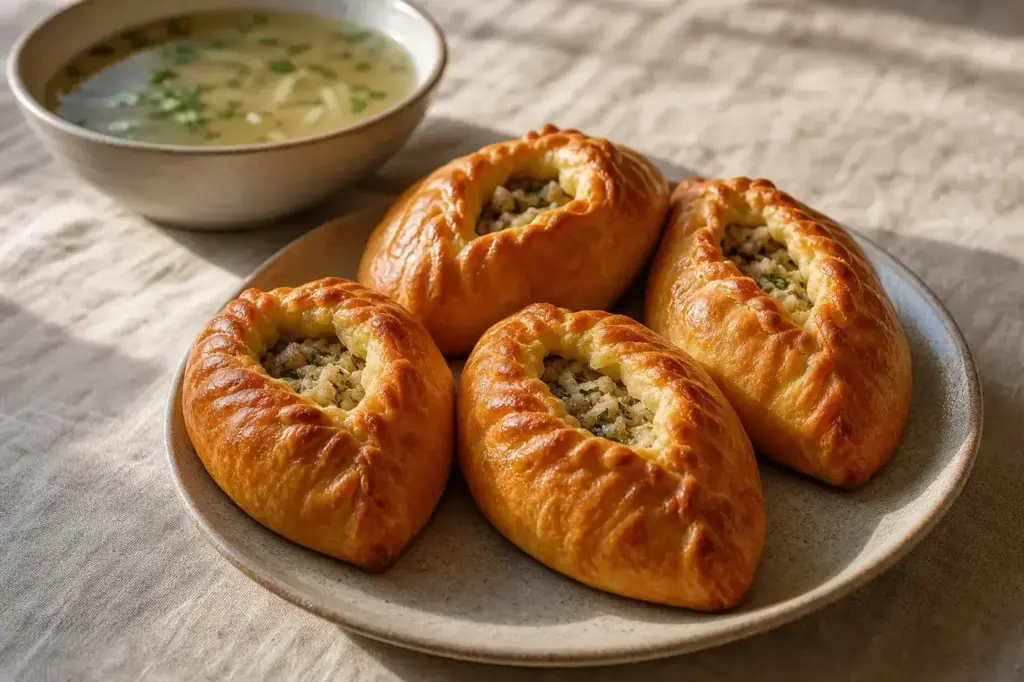
If you’re trying authentic Russian food, rasstegai is essential—it appears in Russian literature and was a staple in Moscow taverns during the 19th century. This how-to guide teaches you to make rasstegai, the traditional open-topped pastry that remains popular today in Moscow bakeries and markets.
The recommended approach is a yeast-based dough with a simple fish or meat filling, shaped into a boat and baked until golden, leaving the center hole open. Total time is roughly two hours. You can also find ready-made rasstegai in bakeries and metro shops across Moscow.
Quick answer: Make a yeast dough, let it rise for an hour, prepare your filling (fish or meat), shape each piece into an oval with pinched edges, leave the center open, and bake at 175°C for 20–25 minutes. Total time: approximately 2 hours.
At a Glance
| Type | Dishes |
|---|---|
| Local name | Расстегай |
| Origin | Rasstegai in the sense of filled pastry first appears in the 19th century, in a description of St. Petersburg cuisine of the 1830s. Moscow rasstegai looked different—they were round. Vladimir Gilyarovsky wrote about them in his stories 'Moscow and Muscovites'. The word rasstegai comes from an old Russian garment term meaning 'open, unbuttoned, loose shift,' used to describe the deliberately unsealed filled pastries. |
| Servings | makes 10–12 individual pastries |
| Total time | approximately 2 hours (including rising and baking) |
| Difficulty | Medium |
History and Story of Rasstegai (Расстегай)
Rasstegai first appears in written records in the 19th century in a description of 1830s St. Petersburg cuisine, where they were noted as special pastries baked during Lent. The dish was very popular in Tsarist Russia. At the end of the 19th century and the beginning of the 20th century, the rasstegai of Moscow were by far the most popular: they were even frozen and taken to St. Petersburg. In Moscow during that era, the Prague restaurant, owned by merchant Semyon Tararykin, was especially proud of its ‘Rasstegai half-and-half’, which contained equal parts of two types of sturgeon. The dish appears in Russian literature, including works by Nikolai Gogol and Vladimir Gilyarovsky.
Ingredients
- 400 grams all-purpose flour
- 170 millilitres milk (warm)
- 1 tablespoon fresh yeast or 2 teaspoons dry yeast
- 2 tablespoons butter (softened) plus extra for brushing
- 2 tablespoons sugar
- 2 eggs (1 whole egg, 1 for egg wash)
- 500 grams fish fillet (salmon traditional) or minced meat
- 1 onion, finely chopped
- 2 tablespoons cream or milk
- 1 small bunch fresh parsley
- Salt and pepper to taste
How Rasstegai (Расстегай) Is Made
Step 1: Activate the yeast
Gently heat the milk and dissolve the yeast in it, add the sugar and 100 grams of flour, stir and leave to sit in a warm place for 30 minutes. The mixture should look frothy and active.
Tip: If using fresh yeast, crumble it into warm milk and stir until dissolved. For dry yeast, whisk it in thoroughly.
Step 2: Build the dough
Add the egg, salt and softened butter to the resulting mixture and mix well. Sift the remaining flour, make a well in it and put the dough in the indentation. Then, carefully knead the dough, roll it into a ball, place into a bowl, cover it with cling film or a linen towel and leave it for an hour in a warm place.
Tip: Knead until the dough is smooth and elastic. After about 30 minutes of rising, gently push the dough down to release excess air, then let it finish rising.
Step 3: Prepare the filling
While the dough is rising, prepare the stuffing. Cut the fish into small cubes or thin strips. Finely chop the onion and fry it in butter until golden brown. Mix the fish with the onions, add the milk, finely chopped parsley and the salt and pepper. Let cool slightly before using.
Tip: For meat rasstegai, use minced meat instead of fish; fry with the onions until cooked through.
Step 4: Shape the rasstegai
Form the dough into balls and then roll them into flat rounds (the size can vary according to your preference). Place the stuffing into the center. Pinch the edges of the pastry together, making a boat shape. Do not forget to leave a small hole in the middle. Each pastry should be oval-shaped with distinctive pinched sides.
Tip: The hole is crucial—it's the defining feature of rasstegai and where broth will be added later. Don't pinch the edges completely closed.
Step 5: Proof and egg wash
Cover a baking sheet with parchment and brush butter over it. Place the rasstegai on the sheet and brush with beaten egg. Let them rest for 10–15 minutes before baking; they will puff up slightly.
Tip: Use a pastry brush to coat the pastry evenly with egg wash for a golden finish. Avoid getting egg wash in the central hole.
Step 6: Bake until golden
Bake for 25 minutes at 175 degrees celsius (350 fahrenheit). The pastry should be deep golden brown and firm, not pale.
Tip: If the edges brown too quickly, loosely cover the baking sheet with foil for the last few minutes.
Variants
- Salmon, sturgeon and burbot liver are the most traditional fillings
- Meat and onion rasstegai
- Mushroom and cabbage rasstegai
- Liver, rice or mushrooms
- Egg and herb rasstegai with spinach and pickled cucumber
Common Mistakes to Avoid
- Closing the center hole completely: rasstegai must have an open middle to pour broth through. If you seal it, it loses its essential character and becomes an ordinary pie.
- Using warm dough: the dough must rise fully, but if it's too warm during shaping, it becomes sticky and difficult to work with. Let it cool to room temperature before shaping.
- Oversalting the fish filling: the fish is the star; oversalting masks its flavor. Taste the filling as you go and remember that broth will add saltiness when served.
- Overbaking: watch the timer carefully. Overbaked rasstegai dry out. The pastry should be light golden, not dark brown.
- Forgetting the broth: rasstegai is meant to be served with hot fish broth (ukha) for fish versions, or meat broth. A spoonful is poured through the hole before eating. Without it, the pastry is incomplete.
- Using the wrong broth temperature: the broth must be hot when poured into the rasstegai, but not boiling so hard that it spills over the sides.
How to Order and Eat It
Rasstegai is a small pastry pie that has an opening down the center. Just before serving, a spoonful or two of broth is poured in the opening. Serve your rasstegai with fish broth, pouring the broth into the hole in the middle of the pie right before eating. Rasstegai are often served with soup. Traditionally a fish rasstegai is served with ukha (fish broth) and a meat rasstegai with a meat soup, while rasstegai with rice, carrots and egg may be served with any soup. The pastry is eaten by hand, and the opening lets the broth soak into the filling as you eat.
Diet and Allergens
- Contains gluten
- Contains eggs
- Contains dairy
Moscow Vibes Tips
- Nowadays, rasstegai is often sold in small bakeries as well as small shops which are located in the metro stations (underground). If you want to try them quickly without cooking, stop at any bakery near a metro station—they are usually warm and affordable.
- When you live in a metropolitan city like Moscow, rasstegai can save your day, providing you with a delicious grab-and-go snack when you don't have much time. Buy one fresh from a baker's display for a proper Moscow street-food experience.
- The dough benefits from a long, slow rise. If your kitchen is cool, the dough may take longer than an hour to rise—give it the full time until it has roughly doubled in size, even if it takes 90 minutes.
- Traditional Moscow rasstegai were made with multiple types of sturgeon and their roe (caviar), which gave them a luxurious, slightly briny taste. While modern versions are simpler, you can elevate the filling by adding a tiny spoonful of caviar or diced smoked fish if you want to recreate that old Moscow tavern tradition.
- Shape the rasstegai quickly after rolling out the dough; if the dough sits rolled out for too long, it becomes sticky and difficult to seal at the edges. Work in batches if needed.
- The leftover dough can be frozen for up to three months. Thaw it overnight in the refrigerator, then shape and bake as usual. This lets you make fresh rasstegai whenever you want.
Explore Nearby Rasstegai (Расстегай)
Related guides
 10 Best Food Markets and Food Halls in Moscow: Where to Eat Indoors
Main image: AI-generated illustration. It may not show the place exactly as it looks.
 10 Best Places to Try Russian Food in Moscow: Classics and Canteens
Main image: AI-generated illustration. It may not show the place exactly as it looks.
 Moscow Food Tour: Russian Cuisine and Local Specialties: One-Day Route
Main image: AI-generated illustration. It may not show the place exactly as it looks.
Browse more: All Food & Drink · All Other
FAQ
What is the name 'rasstegai' supposed to mean?
The name sounds like the imperative of the word 'unbutton,' which is why people joke: Rasstegai is not a command, it's a pastry. Rasstegai is an 'open, unbuttoned, loose shift,' used to describe these filled pastries that are deliberately left unsealed.
Is the hole in the center really essential?
Yes. Rasstegai is a small pastry pie that has an opening down the center. Just before serving, a spoonful or two of broth is poured in the opening. Without the hole, it becomes a regular pie, not a rasstegai.
What broth should I use for serving?
Rasstegai are often served with soup. Traditionally a fish rasstegai is served with ukha (fish broth) and a meat rasstegai with a meat soup, while rasstegai with rice, carrots and egg may be served with any soup.
Can I make rasstegai with fillings other than fish?
The filling usually contains fish, but may also contain meat, liver, rice or mushrooms. Cabbage and mushroom is another popular combination.
How do I know the dough has risen enough?
The dough should roughly double in size and feel soft and pillowy when you gently press it. In a warm kitchen, this takes about an hour. If you are unsure, let it rise a few extra minutes—overproofing is less common than underperfection.
Can I prepare rasstegai ahead and freeze them?
Yes. Shape the rasstegai, place them on a baking tray, cover loosely with cling film, and freeze. When ready to bake, place them directly in a preheated oven without thawing—add 5 minutes to the baking time.
What is the difference between rasstegai and pirozhki?
Pirozhki are small pies with the filling completely enclosed in dough. Rasstegai have an open center so broth can be poured in before eating. They are related but distinctly different shapes and serving methods.
Where can I buy ready-made rasstegai in Moscow?
Rasstegai is often sold in small bakeries as well as small shops which are located in the metro stations (underground). You can also find them at Danilovsky Market and other food markets.
Discover More of Moscow with Our Travel Tips
Get practical Moscow travel tips, new destination guides and useful updates on attractions, opening hours and prices. Plan your visit with clear, helpful information delivered to your inbox.
Moscow Vibes is a one-person project. A coffee keeps it going
Looking for more on this? Ukha: How to Make Traditional Russian Fish Soup (Russia Vibes)

Take this guide with you
Get a free PDF of this guide to print or read offline: key facts, tips and a map link on a few clean pages.
Report an issue on this page
Paying for your trip: please read
Payments and bookings between Russia and many other countries are currently restricted. In practice, cards issued in the EU, the UK, the US and several other countries often cannot be used in Russia, Russian cards usually cannot be used abroad, and some booking platforms, airlines and payment providers limit or pause their services for Russia. The situation changes frequently.
We do not give legal or financial advice, and this site does not encourage anyone to break any rule that applies to them. Whatever you plan, you are responsible for following the laws and regulations that apply to you, including those of your country of residence and citizenship.
Many travelers still organise their stay without problems. It is worth asking your bank or payment provider what is currently possible, contacting hotels, tour operators and carriers directly about the payment methods they accept, and checking which services are open to customers from your country. Clarify payment, cancellation and refund terms before you commit to a booking, and keep your plans flexible.
Partner links on this site may not be available in every country, and prices, availability and rules in our guides can differ from what you see when you book.
How we research and update our guides
About this guide: AI assistance and accuracy
This guide is created with the help of AI and is based on official sources where available. Mistakes can still happen. Opening hours, prices, rules and other details are given to the best of our knowledge as of the date shown and can change without notice. It offers general recommendations only, not professional, legal or travel advice. Please confirm important details with the official source before you travel; you are responsible for your own plans and decisions.
* Affiliate link: as an Amazon Associate we earn from qualifying purchases at no extra cost to you.