
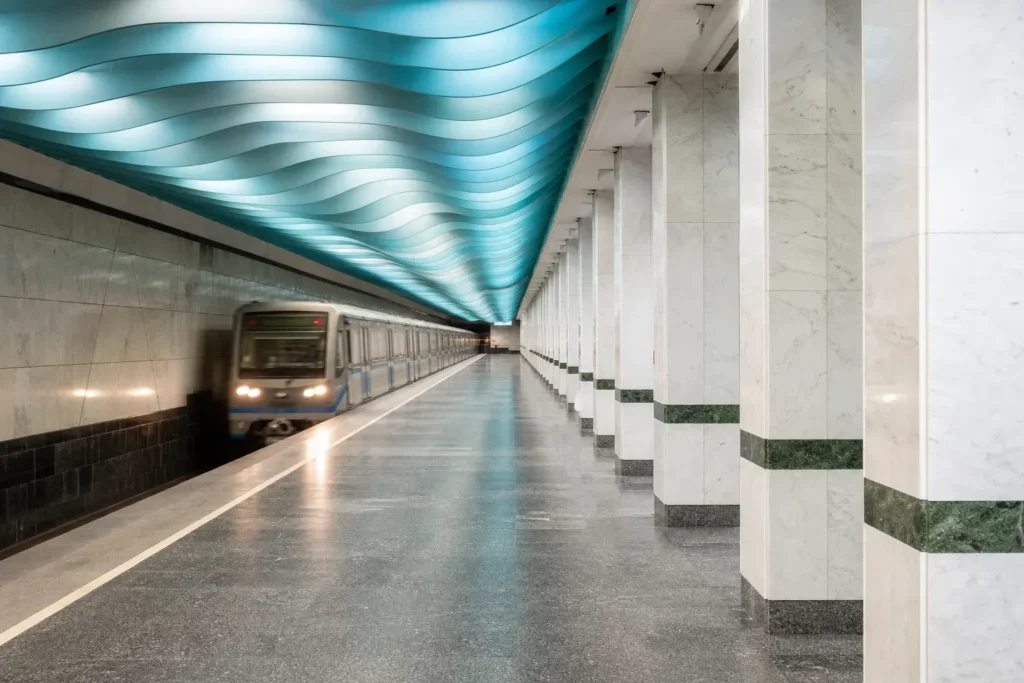
Belomorskaya Metro Station is on the green Zamoskvoretskaya Line in the north of Moscow, between Rechnoy Vokzal and the Khovrino terminus. It opened on 20 December 2018 as the 260th station of the Moscow Metro and serves the Levoberezhny and Khovrino districts.
The design draws on the Russian North: white marble columns and walls evoke snowy hills, and a sea-wave coloured suspended ceiling recalls the White Sea. The name comes from Belomorskaya Street, which refers to the White Sea and the White Sea–Baltic Canal. It is a modern, compact station with one underground vestibule and a clear theme, worth a stop if you are riding to the far north of the line or exploring the new districts.
Quick Facts
| Russian name | Беломорская |
|---|---|
| Built / opened | 2018 |
| Address | Belomorskaya Street at Smolnaya Street, Levoberezhny District, Moscow (Беломорская улица, пересечение со Смольной улицей, район Левобережный, Москва) OpenStreetMap · Google Maps |
| District | Levoberezhny |
| Interchanges | Belomorskaya (Zamoskvoretskaya Line (Line 2), One underground vestibule with two exits at the Belomorskaya and Smolnaya street crossing) |
| Opening hours | The Moscow Metro normally runs from early morning until around 1:00 at night, and the station is open to passengers during those hours. Exact first and last train times vary by direction (as of October 2026 – check the official site). |
| Best time to visit | The station suits any season because the visit is indoors. For a calm look at the hall, choose weekday mid-morning or early afternoon.
Morning and early evening rush hours are the busiest, as most passengers are local residents travelling to and from the centre. |
| Last updated | October 17, 2026 |
Why Visit Belomorskaya Metro Station?
Belomorskaya is one of the few stations in the metro to be built on an already working line. The tunnels were opened years earlier, and the station was added afterwards using a top-down construction method that limited disruption in a densely built area.
The design is coherent and easy to read. White marble, sea-wave ceilings, grey granite floors and bands of green Ural serpentinite all point to the White Sea region, and the station’s colours are different from the neighbouring stations.
It also serves a purpose: it brought the metro within walking distance of about 140,000 residents in Levoberezhny and Khovrino and eased the load on Rechnoy Vokzal.
Highlights of Belomorskaya Metro Station
White marble columns and walls
The main material of the platform hall is white marble, used for the columns and for parts of the walls. The idea is snow-covered hills and plains of the Russian North, and the result is a bright, cool hall. Stripes of green Ural serpentinite run across the white stone, which adds a second northern colour. The station is a shallow column-type design, with a row of columns along the platform. It is easy to read at a glance.
Tip: Walk along the platform to see how the green serpentinite bands change the look of the white marble.
The sea-wave ceiling
The suspended ceiling is sea-wave coloured, a reference to the White Sea after which the nearby street is named. It runs along the platform above the columns and is the station's main colour accent against the white marble below. The effect is of cold water and light, and the ceiling is the first thing many passengers notice when they come down from the vestibule.
Tip: Look up as you step onto the platform; the ceiling is the best place to see the theme as a whole.
Granite floor and northern materials
The floor is grey Siberian granite, which grounds the pale marble and teal ceiling. Together with the white marble and the Ural serpentinite, the materials all come from the north and east of Russia, and they follow the theme of the station: snow, stone and sea. The result is restrained and practical, designed to stay clean and hard-wearing in a busy commuter station.
Tip: Notice the contrast between the dark granite floor and the white columns when you stand at the platform edge.
Aurora and starry-sky motifs
The design concept added two more northern motifs: the polar lights in the ceilings of the vestibule, and a starry northern sky pattern on the track walls. Mosaic panels with landscapes of the White Sea region were also planned. These details turn the station into a small story about the northern coast. Details of the final execution may differ from the concept, so look for them on arrival.
Tip: Look at the vestibule ceiling and the track walls; those are the places where the aurora and sky motifs were meant to appear.
One vestibule, two exits
Belomorskaya has a single underground vestibule with two exits at the crossing of Belomorskaya and Smolnaya streets. The exterior facades are green, the colour of the Zamoskvoretskaya Line. The compact layout makes the station easy to use, and the exits lead directly into the residential streets of Levoberezhny and Khovrino, where most passengers live.
Tip: Check which exit is closer to your destination before you leave the vestibule.
A station built over a working line
Belomorskaya sits between Rechnoy Vokzal and Khovrino on tunnels that were already open. It was built with a top-down method, which the city described as unusual for Russia, to keep disruption low in a dense residential area. Passengers rode past the unbuilt station for a year before it opened. That history explains why the station seems tucked between two much older neighbours.
Tip: If you ride toward Khovrino, notice how the station fits into the line between two stops with different designs.
Atmosphere
Belomorskaya has the look of a new station: bright white stone, a teal ceiling and clean granite floors. The hall is compact, and the single row of columns keeps the platform open and easy to read.
The passengers are mostly residents of Levoberezhny and Khovrino, riding toward the centre in the morning and returning in the evening. Rush hours are the busiest, while midday is calm. The station feels like a neighbourhood stop rather than an attraction, with a clear theme and little decoration beyond it.
History of Belomorskaya Metro Station
The idea of a station on Belomorskaya Street goes back to the late 1950s, when it appeared in plans for extending the line north under the project name Belomorskaya Ulitsa. In 1959 the extension was confirmed, but the end of the Gorkovsko-Zamoskvoretskaya Line was set at Rechnoy Vokzal. The line was extended north in 1964 with three stations: Voykovskaya, Vodny Stadion and Rechnoy Vokzal.
In 2007 the city announced that the line would be extended into the Khovrino and Levoberezhny districts, and in 2011 the city government decided to extend the line from Rechnoy Vokzal to Khovrino. Construction of the 2.9-kilometre extension began in August 2013.
Belomorskaya had a troubled start. In April 2014 the city dropped the station from the plans, citing the cost and the discontent of local residents. The stretch to Khovrino was built without it, and after public requests the station was brought back into the project.
In August 2016 the city said Belomorskaya would be built with a top-down method, a technique used for stations on existing tunnels. It limited the impact on the surrounding area, which was densely built up. The station was to lie about 25 metres below the surface according to the city’s statement at the time.
Khovrino opened in December 2017 and trains ran through the unbuilt Belomorskaya site. The extension of the line, with the new station, was planned to open at the end of that year, but the station was completed later.
In October 2018 the city published the design project for the station, with its theme of the White Sea region. The main colours were sea-wave and white, the first for the ceiling and the second for the marble columns and walls. On 15 and 16 December 2018 Khovrino was closed to connect the new station to the network. Belomorskaya opened on 20 December 2018, and it became the 260th station of the Moscow Metro and the 16th to open that year.
The city said the station would bring the metro within walking distance of the Levoberezhny and Khovrino districts, where about 140,000 people live, and it would relieve Rechnoy Vokzal. Reports soon after the opening spoke of more than 25,000 passengers entering on weekdays, and the number later rose to about 32,000. Belomorskaya remains the last station on the line to open before Khovrino, the terminus.
Tickets and Booking for Belomorskaya Metro Station
The Moscow Metro charges per ride, so you pay on entry. Check the official site, mosmetro.ru, for current fares and rules (as of October 2026).
- Paper tickets: single or two-ride tickets are sold at ticket offices and machines and are open to any visitor.
- Troika card: a reloadable transport card sold and topped up at stations; a virtual version can be issued through the Metro Moskvy app.
- QR code, bank card or phone, and biometrics: available at suitably marked turnstiles, but these depend on your phone, your card and, for biometric payment, advance setup in the app.
The sanctions rules of your own country may restrict the use of Russian payment services, so check this yourself before you travel. Weekday mornings and early evenings are the busiest rush hours; mid-morning and late evening are calmer.
Plan and Book
How to Get to Belomorskaya Metro Station
By metro: take the green Zamoskvoretskaya Line (Line 2) to Belomorskaya. It lies between Rechnoy Vokzal (toward the centre and Alma-Atinskaya) and Khovrino, the northern terminus.
From the station: the single underground vestibule has two exits at the crossing of Belomorskaya and Smolnaya streets. From there the residential streets of Levoberezhny and Khovrino are within walking distance.
Other transport: local buses serve the district; check a current map app for routes. A taxi from the centre is possible, but the metro is far simpler.
Accessibility
Belomorskaya is a shallow column-type station with one island platform and a single underground vestibule with two exits. Lifts and step-free routes vary, so check the operator's accessibility information on its official site and in the Metro Moskvy app before you travel with a wheelchair or a stroller.
Food Nearby
There are no landmark restaurants at the station. Everyday cafes, bakeries and shops are in the residential streets around Belomorskaya and Smolnaya streets and in the Khovrino and Levoberezhny districts. For a sit-down meal many visitors prefer to eat in the centre. Check what is open on the day.
What to Bring
Comfortable shoes if you plan to walk around Levoberezhny, and a layer in cold months. Travel light, as security staff at metro entrances can ask to check bags.
Best Views and Photo Spots of Belomorskaya Metro Station
Platform along the column row
A long view down the platform with white marble columns and the teal ceiling above, the station's signature image.
Best time: Mid-morning on a weekday, when fewer people are in the frame
Vestibule ceiling
The vestibule's ceiling, which carries the aurora motif in the design concept; look up to see the northern theme begin.
Best time: Off-peak, when you can stop without blocking passengers
Track wall at the platform
The track wall with the starry northern sky pattern, seen from the platform with the columns in the foreground.
Best time: Between trains at quiet times
Green exterior at the street exit
The station's exterior facades are green, the line's colour, and stand out among the apartment blocks of Levoberezhny.
Best time: Morning light on a clear day
Photography Rules
Handheld photos for personal use are common in the Moscow Metro, but keep clear of the platform edge and do not block passengers. Professional shoots and tripods need permission from the metro operator, so check the rules on its official site before you plan them.
Family Suitability
The station is an easy stop for families: a compact hall, a single vestibule and a short visit. Check lift access at your exit before you travel with a stroller. Children may enjoy the colourful ceiling and the bright white hall.
Moscow Vibes Tips
- Ride one stop south to Rechnoy Vokzal, which is the neighbouring station and the stop for the Northern River Station on the Khimki Reservoir.
- Ride one stop north to Khovrino, the terminus, to compare the station's design with Belomorskaya; both opened within a year of each other.
- Look for the colour contrast: the white marble stands for snow and the teal ceiling for the White Sea, so the design reads best if you look at both at once.
- Do not expect a famous landmark outside; the area is residential, and the station is the sight.
- Check your exit on the way out: the single vestibule has two exits, and the right one saves a street crossing.
Explore Nearby Belomorskaya Metro Station
Metro stations near Belomorskaya Metro Station
 Rechnoy Vokzal Metro Stationabout 1.2 km away (~20 min walk)
Main image: AI-generated illustration. It may not show the place exactly as it looks.
Train stations and river piers near Belomorskaya Metro Station
 Northern River Stationabout 1.3 km away (~21 min walk)
Main image: AI-generated illustration. It may not show the place exactly as it looks.
Related guides
 Moscow Metro Tour: Most Beautiful Stations Itinerary: 5 Stations
Main image: AI-generated illustration. It may not show the place exactly as it looks.
Browse more: More in Levoberezhny · All Metro Stations · All Other Hubs
FAQ: Belomorskaya Metro Station
Where does the name Belomorskaya come from?
It comes from Belomorskaya Street, whose name refers to the White Sea and the White Sea–Baltic Canal. The station's design follows that theme with white marble and sea-wave colours.
When did Belomorskaya Metro Station open?
It opened on 20 December 2018 as the 260th station of the Moscow Metro and the 16th to open that year. It lies between Rechnoy Vokzal and Khovrino on the Zamoskvoretskaya Line.
Is Belomorskaya a terminus?
No. Khovrino is the terminus of the line. Belomorskaya is the second-to-last station in the north, before Khovrino.
Which districts does the station serve?
It serves the Levoberezhny and Khovrino districts, where about 140,000 people live, and it takes some of the load from Rechnoy Vokzal.
What does the station look like inside?
It is a shallow column station with white marble columns and walls, a sea-wave coloured suspended ceiling, a grey granite floor and bands of green Ural serpentinite. The theme is the Russian North.
Is Belomorskaya worth a visit?
It is a modern station with a clear theme and is worth a stop if you are riding to the north of the line. It is not a standalone sight like the central halls.
How was the station built?
It was built on an operating line with a top-down method, which the city described as unusual for Russia, so that work caused less disruption in a dense residential area.
How does it compare with the stations in the centre?
It is simpler and newer than the decorated halls of the old lines, but it has a consistent theme and good materials. For richer decoration, see the Moscow Metro Tour itinerary.
Discover More of Moscow with Our Travel Tips
Get practical Moscow travel tips, new destination guides and useful updates on attractions, opening hours and prices. Plan your visit with clear, helpful information delivered to your inbox.
Moscow Vibes is a one-person project. A coffee keeps it going
Last updated: October 17, 2026.
How we research and update our guides
About this guide: AI assistance and accuracy
This guide is created with the help of AI and is based on official sources where available. Mistakes can still happen. Opening hours, prices, rules and other details are given to the best of our knowledge as of the date shown and can change without notice. It offers general recommendations only, not professional, legal or travel advice. Please confirm important details with the official source before you travel; you are responsible for your own plans and decisions.
International sanctions affect payments between Russia and many other countries. In practice, cards issued in the EU, the UK, the US and several other countries often do not work in Russia, Russian cards usually do not work abroad, and some booking platforms, airlines and payment providers limit or suspend their services for Russia. The situation changes frequently. We do not give legal or financial advice, and this site does not encourage anyone to break or circumvent sanctions. Whatever you plan, you are responsible for following the laws and regulations that apply to you, including those of your country of residence and citizenship. Many travelers still organise their stay lawfully. It is worth asking your bank or payment provider what is currently permitted, contacting hotels, tour operators and carriers directly about the payment methods they accept, and checking which services are open to customers from your country. Clarify payment, cancellation and refund terms before you commit to a booking, and keep your plans flexible. Partner links on this site may not be available in every country, and prices, availability and rules in our guides can differ from what you see when you book.Paying for your trip: please read
* Affiliate link: as an Amazon Associate we earn from qualifying purchases at no extra cost to you.
Report an issue on this page

Take this guide with you
Get a free PDF of this guide to print or read offline: key facts, tips and a map link on a few clean pages.