
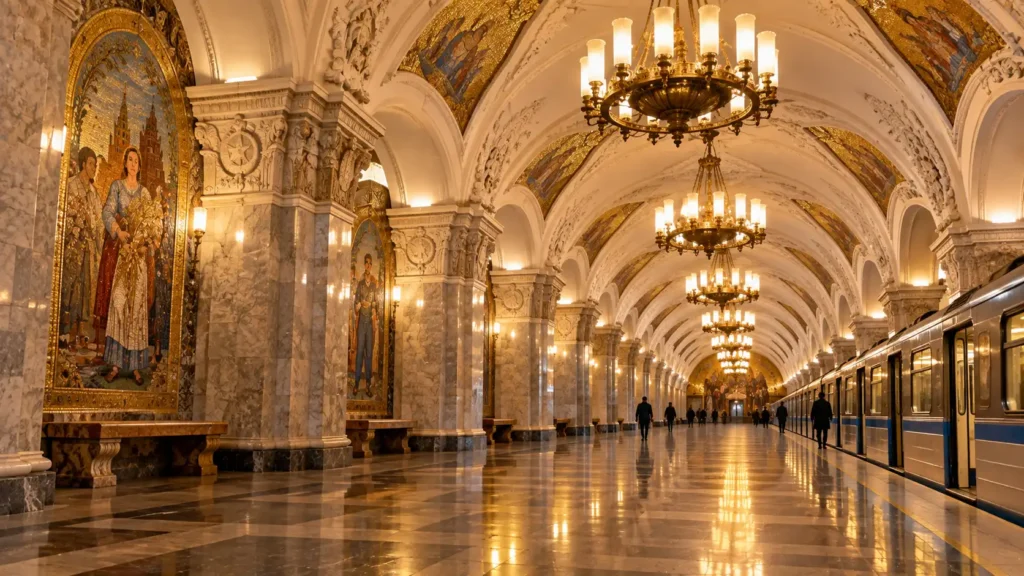
The Moscow Metro is the fastest way around the city and also one of its main sights. The best Moscow Metro stations, mostly from the 1930s and 1950s, have marble columns, mosaics and bronze sculptures, and many are used every day by commuters.
Visitors usually ask two things: which stations to see and how to pay. There are no zones, only a flat fare per ride, but foreign bank cards are reported not to work at turnstiles. This guide covers the showcase stations, a simple route and the practical details of fares and hours.
Quick Facts
| Russian name | Московский метрополитен |
|---|---|
| Built / opened | 1935 |
| Metro | Komsomolskaya (Line 5 (Koltsevaya, brown), station hall with arched ceiling mosaics) Mayakovskaya (Line 2 (Zamoskvoretskaya, green), central hall with steel arches) Ploshchad Revolyutsii (Line 3 (Arbatsko-Pokrovskaya, dark blue), bronze sculptures along the arches) Kievskaya (Line 5 (Koltsevaya, brown), mosaic panels in the hall) |
| Opening hours | Most metro stations are open for entry and transfers from about 05:30 to 01:00 daily. The Moscow Central Circle runs from about 06:00 to 01:00.
Trains pass every couple of minutes at busy times. Individual stations can close temporarily for works (as of October 2026 – check the operator's official site, mosmetro.ru). |
| Admission | There is no free entry to the system; you pay a fare for each ride. A ride with a Troika card is inexpensive (₽) in the central zone as of the newest source found; paper tickets cost more. Fares change, so check the operator's site. |
| Best time to visit | The best time to see the stations is between about 10:00 and 15:00 on a weekday, when the halls are quieter. Peak hours are roughly 8:00 to 10:00 and 17:00 to 20:00.
The metro is open all year and is warm in winter, which makes a station tour a good choice for cold or wet days. |
| Recommended duration | 1.5–3 hours for a tour of showcase stations |
| Website | mosmetro.ru |
| Last updated | October 6, 2026 |
What Is (and Isn't) Part of a Visit to Moscow Metro?
| Part | Status | Notes |
|---|---|---|
| Metro lines and showcase stations | Included in the standard ticket | Covered by the fare for each ride; no extra charge to see the stations once you are inside. |
| Moscow Central Circle (MCC) | Included in the standard ticket | Uses the same fare and payment cards, with free transfers within 90 minutes using a Troika card. |
| Moscow Central Diameters, central zone | Included in the standard ticket | The central zone fare matches the metro fare. |
| Monorail | Included in the standard ticket | Integrated with the metro fare system, with transfers to nearby metro stations. |
| Surface transport | Included in the standard ticket | Buses, trams and trolleybuses accept the same Troika card. |
| Face Pay | Not open to visitors | Requires registration in Moscow with a linked MIR card, so it is not available to most visitors. |
| Organized metro tours | Separate ticket or institution | Guided tours of stations are offered by operators and cost extra; check current availability. |
| Suburban lines outside the central zone | Separate ticket or institution | Fares depend on the number of zones crossed. |
Why Visit Moscow Metro?
The metro shows what Soviet planners meant by public space. The Koltsevaya Line stations from the 1950s and Mayakovskaya from 1938 have chandeliers, ceiling mosaics and polished stone that look closer to palaces than transit stops.
It also costs very little to see them. Once you enter, you can ride between stations on a single fare and take as many photographs as you wish within the rules.
Because most central sights are within a few minutes of a station, learning the system also makes the rest of your trip easier. The same Troika card works on the Central Circle, suburban lines in the central zone and city buses.
How Moscow Metro Is Laid Out
The metro has 15 lines, each with a number, a name and a color, and a circular line that links the radial ones. The Koltsevaya Line (Line 5, brown) forms a ring around the center, and most of the showcase stations are on it or on the lines that cross the center.
The Moscow Central Circle (MCC) is a second, larger ring on the surface and is integrated into the same fare system, as are the radial Moscow Central Diameters lines in the central zone.
To orient yourself, find your line color and number, then follow the direction by the name of the last station. Transfers are signposted with the line color. Large stations have many exits, so check the exit number before you surface, since the wrong exit can mean a long walk.
Highlights of Moscow Metro
Komsomolskaya
On the Koltsevaya Line (Line 5, brown), Komsomolskaya opened in 1952 and is among the most ornate stations, with a high arched ceiling and mosaic panels in a baroque style. It sits under a busy square with three railway stations.
Walk the full length of the hall to see the chandeliers and mosaics, then look back from the far end. It is crowded at commuting hours, so midday is calmer.
Tip: Go in the middle of the day, when the platform is quieter and the mosaics are easier to see.
Mayakovskaya
Opened in 1938 on Line 2 (Zamoskvoretskaya, green), Mayakovskaya is known for slender steel arches and ceiling mosaics in the central hall. It was built deep and later served as an air-raid shelter during the Second World War.
The design drew international attention in the late 1930s and the hall still feels light despite the depth.
Tip: Stand in the central hall rather than on the platform edge to see the arches in perspective.
Ploshchad Revolyutsii
On Line 3 (Arbatsko-Pokrovskaya, dark blue), the station has bronze sculptures of workers, soldiers, farmers and students in the arches between the platforms. Passengers touch some of them for luck, and the dog's nose is polished from rubbing.
It is a short walk from Red Square, which makes it easy to include in a day in the center.
Tip: Look for the bronze dog; students traditionally rub its nose before exams.
Kievskaya
On the Koltsevaya Line (Line 5, brown), Kievskaya has large mosaic panels in the hall and a decorative style that links it with the other ring stations. It is also a transfer point to other lines.
The mosaics and bright lighting make it one of the better stations for photographs when it is not crowded.
Tip: Check the exits; the station has several, and some lead to different sides of a large interchange.
Novoslobodskaya
On the Koltsevaya Line (Line 5, brown), Novoslobodskaya is known for its stained-glass panels, lit from behind and set between the arches. The panels give the station a very different look from the stone and mosaic stations.
The lit panels stand out most when the platform is not busy.
Tip: Walk slowly along the central hall and look at each panel in turn.
Park Pobedy
Opened in 2003 on Lines 3 and 8, Park Pobedy is a modern station and one of the deepest in the system, with very long escalators. The hall has a large mural and polished stone in a more contemporary style.
It is worth including if you want to see how newer stations compare with the Stalin-era ones.
Tip: Allow a few minutes for the ride up and down on the escalators.
The Moscow Central Circle
The MCC is a surface ring line integrated into the metro fare system and opened in 2016. Free transfers with the metro are possible within 90 minutes with a Troika card, and a full loop takes about 87 minutes.
It is less ornate than the Stalin-era stations, but it gives a view of the city from above and links well with the radial lines.
Tip: Use it as a connector between districts, not as a sightseeing line.
Atmosphere
In the central stations, the sound is a constant roll of trains, escalators and footsteps. The air is warm and slightly dry, and the light from the chandeliers is yellow against marble and stone.
People move fast and stand on the right of the escalator, leaving the left free for walking. The halls look best in the early afternoon, when commuters have thinned out and there is room to stand and look up.
In the morning and evening peaks, the platforms are packed, and trains arrive every minute or two. At night, after the late-evening crowds, the stations are quieter and the lines shut around one.
History of Moscow Metro
The first line opened in 1935, linking Sokolniki and Park Kultury, and the system grew quickly through the 1930s. The early stations were planned as grand public spaces, with expensive materials and designs by well-known architects.
Mayakovskaya, opened in 1938, was built deep underground. During the Second World War, several stations were used as air-raid shelters, and Mayakovskaya hosted official events during the war.
In the 1950s, the Koltsevaya Line was built as a ring around the center, with highly decorated stations such as Komsomolskaya and Kievskaya. In 1955 the metro was named after Lenin, a name it kept for decades.
The network kept growing through the Soviet period and after, with newer stations in a simpler style, among them Park Pobedy, opened in 2003. In 2016, the Moscow Central Circle opened as a surface ring line, integrated into the metro fare system.
In the late 2010s, the metro became easier for foreign visitors, helped by the 2018 football World Cup. The Central Diameters suburban lines were integrated in 2019, and in 2021 the metro launched Face Pay, a biometric payment system.
Today the Moscow Metro has about 250 stations and 15 lines and is both a daily transport system and a set of Stalin-era showpieces.
Legends and Myths about Moscow Metro
Metro-2, the secret second metro
Legend – historically unreliable. A well-known story says that a secret second metro, sometimes called Metro-2, runs deep under the city for use by the state, linking government buildings and bunkers.
There is no reliable public evidence of a full network of that kind, though deep shelters and special-purpose facilities are known to exist.
Rubbing the bronze dog's nose brings luck
Legend – historically unreliable. At Ploshchad Revolyutsii, passengers rub the nose of a bronze dog beside a border guard sculpture, and students are said to do it for luck before exams.
The custom is a popular superstition, not a documented historical tradition, but the polished nose shows how widely it is followed.
Tickets and Booking for Moscow Metro
| Ticket | Price | Includes |
|---|---|---|
| Single ride, Troika wallet | ₽ | One ride on the metro, MCC or central-zone MCD; fares change, so check the operator's site. |
| Single ride, paper ticket | Higher than Troika | One ride, bought at a station ticket office or machine; slightly more expensive than a Troika ride according to the newest source found. |
| Troika card deposit | Refundable | A reusable card for the metro and other transport; sources report a small refundable deposit (₽). |
There is nothing to book. Buy a ticket or a Troika card at the station ticket offices or vending machines, and top it up with cash. The card can be returned for a refund of the deposit.
- Payment: foreign bank cards, Apple Pay, Google Pay and Samsung Pay are reported not to work, so cash is the reliable option.
- Face Pay and QR payments: these need registration in Russia and are not practical for visitors.
- Transfers: with a Troika card, transfers between the metro and the Moscow Central Circle are free within 90 minutes.
Fares for Russian citizens and concession groups differ, and prices change often. Check the operator’s official site, mosmetro.ru, for all fare categories.
Plan and Book
Suggested Itineraries for Moscow Metro
1.5–2 hours
Start at Ploshchad Revolyutsii (Line 3) to see the bronze sculptures. Transfer to Teatralnaya (Line 2), ride to Mayakovskaya for the central hall, and finish by walking out toward Tverskaya Street.
3 hours
Ride the Koltsevaya Line (Line 5, brown) from Komsomolskaya to Prospekt Mira, Novoslobodskaya, Belorusskaya and Kievskaya, stepping out at each for the hall. Allow time for photographs and slow walks.
Half day
Combine both routes: the Koltsevaya stations in the morning, a lunch break, then Ploshchad Revolyutsii and Mayakovskaya in the afternoon. Finish near Red Square for a walk.
How to Get to Moscow Metro
Metro entrances are marked by a red letter M and stand all over the city. In the center, the main stations for sightseeing are close to each other.
- Line colors: each line has a number and a color; follow the color and the name of the end station for direction.
- Komsomolskaya (Line 5, Koltsevaya, brown, and Line 1, Sokolnicheskaya, red): reached from Komsomolskaya Square, beside three railway stations.
- Ploshchad Revolyutsii (Line 3, Arbatsko-Pokrovskaya, dark blue): about 5 minutes on foot from Red Square.
- Mayakovskaya (Line 2, Zamoskvoretskaya, green): on Tverskaya Street.
Many central stations have help desks, and some staff speak English, though this varies.
Accessibility
Many stations are deep, with long escalators, and not every station has a lift. Detailed accessibility information was not confirmed, so check the operator's site and plan routes through stations that have lifts if you need step-free access. Staff at ticket offices and help desks can advise on the day.
Food Nearby
There are kiosks and cafes at some station exits and in underground passages, but few inside the stations. Near the central stations, the streets around Tverskaya, Red Square and Kievsky railway station have many cafes and restaurants at different price levels. Check opening hours, as some venues close earlier.
What to Bring
Bring cash, since foreign bank cards are reported not to work at the turnstiles, and comfortable shoes for long escalators and walks. Large bags may be checked at some stations.
Best Views and Photo Spots of Moscow Metro
Komsomolskaya central hall
A long view down the hall with chandeliers and the arched ceiling mosaics in perspective.
Best time: Midday on a weekday
Mayakovskaya central hall
The slender steel arches and ceiling mosaics, best seen from the middle of the hall.
Best time: Mid-morning or early afternoon
Ploshchad Revolyutsii sculptures
Bronze figures in the arches between the platforms, with the long line of arches behind.
Best time: Off-peak, when fewer passengers are in the frame
Novoslobodskaya stained glass
Backlit stained-glass panels between the arches, glowing against the dark stone.
Best time: Quiet times, when the platform is clear
Kievskaya mosaics
Large mosaic panels in the hall with warm lighting and a wide perspective.
Best time: Early afternoon
Photography Rules
Photography rules were not confirmed. Photographing the halls is common, but tripods and commercial shooting may need permission, and staff can ask you to stop. Avoid blocking the platform or the escalators, and follow any posted signs.
Family Suitability
The metro is practical for families, and the showcase stations are quick stops that children often enjoy. Escalators are long and fast, so keep children close and hold hands. Platforms and trains are crowded at peak hours, which makes strollers difficult. A stop of ten minutes at each station suits most children better than a long tour.
Moscow Vibes Tips
- Stand on the right of the escalator and keep the left free for people walking.
- Check the exit number before you go up at a big interchange; the wrong exit can add a long walk above ground.
- A station tour works best on a weekday around midday, when the halls are free of commuters.
- Do not rely on the 24-hour clock of other cities; plan your last ride before about 01:00.
- Use the Moscow Central Circle when you need to cross the city without going through the center.
- Keep your Troika card in a pocket you can reach easily; the turnstiles are fast and queues build up behind slow passengers.
Where to Find Moscow Metro in Moscow
Moscow Metro has branches across the city, so there is no single address to list. To find the closest one, search on Yandex Maps or Google Maps from your hotel or metro station.
Related guides
 Red Square Moscow: What to See and Which Sights Cost Extra
Main image: AI-generated illustration. It may not show the place exactly as it looks.
 Bolshoi Theatre Moscow: Tickets, Tours and What to Expect
Main image: AI-generated illustration. It may not show the place exactly as it looks.
 VDNKh Moscow: Pavilions, Fountains and Space Museum Guide
Main image: AI-generated illustration. It may not show the place exactly as it looks.
 Moscow Kremlin: Cathedrals, Armoury Chamber and Tickets
Main image: AI-generated illustration. It may not show the place exactly as it looks.
 How to use the Moscow Central Circle (MCC): Fares, Hours and Transfers
Main image: AI-generated illustration. It may not show the place exactly as it looks.
Browse more: All Sightseeing · All Soviet Moscow
FAQ: Moscow Metro
Can I pay for the Moscow Metro with a foreign bank card?
Reports say foreign Visa and Mastercard do not work at turnstiles, and mobile payment services are also reported unavailable. Cash and a Troika card loaded with cash are the reliable options.
Can I enter a station just to look at it?
No. You need to pay a fare to pass the turnstiles, and you can then move between stations on the same ride. See the booking section for payment.
Which line has the most beautiful stations?
The Koltsevaya Line (Line 5, brown) has several of the most ornate stations, including Komsomolskaya, Kievskaya and Novoslobodskaya. Mayakovskaya on Line 2 is also a top choice.
What is Face Pay?
A biometric payment system launched in 2021. Registration needs a visit to a service center in Moscow with a linked MIR card, so it is not practical for most visitors.
Is the Moscow Central Circle part of the metro?
It is a separate surface ring line, but it is integrated into the metro fare system. A Troika card allows free transfers within 90 minutes.
Do I need to speak Russian?
Not for the basics. Lines have numbers and colors, and some central stations have help desks with English-speaking staff, though this varies. A map app helps.
How deep are the stations?
Many are deep, with long escalators, and Park Pobedy is among the deepest. Allow extra time for the ride up and down.
Is there a day pass?
Unlimited passes exist for set periods, but prices change, and a pass pays off only with many rides in a day. Check the operator's site for current options.
Discover More of Moscow with Our Travel Tips
Get practical Moscow travel tips, new destination guides and useful updates on attractions, opening hours and prices. Plan your visit with clear, helpful information delivered to your inbox.
Moscow Vibes is a one-person project. A coffee keeps it going
Last updated: October 6, 2026. Found an error or something out of date? Report it and we will check and fix it.
How we research and update our guides
About this guide: AI assistance and accuracy
This guide is created with the help of AI and is based on official sources where available. Mistakes can still happen. Opening hours, prices, rules and other details are given to the best of our knowledge as of the date shown and can change without notice. It offers general recommendations only, not professional, legal or travel advice. Please confirm important details with the official source before you travel; you are responsible for your own plans and decisions.
International sanctions affect payments between Russia and many other countries. In practice, cards issued in the EU, the UK, the US and several other countries often do not work in Russia, Russian cards usually do not work abroad, and some booking platforms, airlines and payment providers limit or suspend their services for Russia. The situation changes frequently. We do not give legal or financial advice, and this site does not encourage anyone to break or circumvent sanctions. Whatever you plan, you are responsible for following the laws and regulations that apply to you, including those of your country of residence and citizenship. Many travelers still organise their stay lawfully. It is worth asking your bank or payment provider what is currently permitted, contacting hotels, tour operators and carriers directly about the payment methods they accept, and checking which services are open to customers from your country. Clarify payment, cancellation and refund terms before you commit to a booking, and keep your plans flexible. Partner links on this site may not be available in every country, and prices, availability and rules in our guides can differ from what you see when you book.Paying for your trip: please read
Report an issue on this page
* Affiliate link: as an Amazon Associate we earn from qualifying purchases at no extra cost to you.
 Ask Masha