

The Moscow Kremlin is the oldest part of the city, a triangle of red-brick walls and twenty towers above the Moskva River. Most of it is a government compound and closed to the public. Moscow Kremlin tickets cover a much smaller area: Cathedral Square with its gold-domed cathedrals, the open-air grounds and, on a separate ticket, the Armoury Chamber.
First-time visitors often expect to walk everywhere inside the walls, or to find Red Square, St Basil’s and the Mausoleum within the same ticket. They are outside it. Planning around two entrances, two ticket types and a Thursday closing day saves most of the confusion.
Quick Facts
| Russian name | Московский Кремль |
|---|---|
| Built / opened | Present walls and towers built 1485–1495 |
| Architect(s) | Aristotele Fioravanti, Pietro Antonio Solari, Marco Ruffo, Aloisio da Milano, Konstantin Thon |
| Address | Moscow Kremlin, Kremlin, Moscow, Russia OpenStreetMap · Google Maps |
| District | Tverskoy |
| Metro | Alexandrovsky Sad (Line 4 (Filyovskaya, light blue), about 3 min walk to Kutafya Tower, the grounds entrance) Borovitskaya (Line 9 (Serpukhovsko-Timiryazevskaya, gray), about 3 min walk to Borovitskaya Tower, the Armoury entrance) Biblioteka imeni Lenina (Line 1 (Sokolnicheskaya, red), about 5 min walk) Arbatskaya (Line 3 (Arbatsko-Pokrovskaya, dark blue), about 7 min walk) |
| Opening hours | Cathedral Square and Kremlin grounds: 10:00–17:00 from 1 October to 14 May; 09:30–18:00 from 15 May to 30 September. Ticket offices close earlier than the grounds.
Armoury Chamber: 10:00–18:00, timed sessions at 10:00, 12:00, 14:30 and 16:30. Closed every Thursday. Access can be limited at short notice for state events or services (as of October 2026 – check the official site). |
| Admission | Cathedral Square and grounds: upscale (₽₽₽) standard adult ticket. Armoury Chamber: upscale (₽₽₽) standard adult ticket. Children under 7 are free on exhibition tickets; concessions and free categories differ and require documents on the day. Single cathedral tickets and temporary exhibitions are priced separately. |
| Best time to visit | Visit on a weekday morning, when the grounds are quietest. Weekends and public holidays are busy, and the warmer months bring the most visitors.
Summer is the easiest season for walking the open grounds, but there is little shade. Winter is quieter and the squares look striking in snow, though the grounds close earlier in the day. |
| Recommended duration | 3–5 hours for Cathedral Square plus the Armoury Chamber |
| Website | kreml.ru/en |
| Last updated | October 6, 2026 |
What Is (and Isn't) Part of a Visit to Moscow Kremlin?
| Part | Status | Notes |
|---|---|---|
| Cathedral Square cathedrals | Included in the standard ticket | The Assumption, Archangel and Annunciation cathedrals are covered by the standard grounds ticket, though services can limit access. |
| Kremlin grounds, Tsar Cannon and Tsar Bell | Included in the standard ticket | The open-air areas open to the public are covered by the same ticket, entered through Kutafya Tower. |
| Armoury Chamber | Separate ticket or institution | Own ticket, own timed session and own entrance through the Borovitskaya Tower. |
| Ivan the Great Bell Tower climb | Separate ticket or institution | Needs its own ticket and has been reported as temporarily closed; check the official site. |
| Temporary exhibitions in the Assumption Belfry and Patriarch's Palace | Separate ticket or institution | Priced individually, with half-hourly entry. |
| Grand Kremlin Palace and government buildings | Not open to visitors | These are working offices and residences, visible from a distance only. |
| Red Square, St Basil's Cathedral and GUM | Outside / not part of it | They stand just beyond the eastern wall and have their own admission, or are free to walk around. |
| Alexander Garden | Outside / not part of it | A free public park along the western wall, where the ticket office stands. |
Why Visit Moscow Kremlin?
Cathedral Square holds the churches where Russian rulers were crowned, married and buried, standing a few steps apart in a space you can take in at a glance.
The Armoury Chamber is Russia’s oldest museum collection, with imperial thrones, coronation carriages, vast silver services and Fabergé eggs.
The grounds also give you things you cannot see from Red Square: the view from inside the walls, the enormous Tsar Cannon and Tsar Bell, and the Patriarch’s Palace with its 17th-century rooms.
Few places in Russia compress so much of the country’s story into a few hundred meters.
How Moscow Kremlin Is Laid Out
Think of the Kremlin as three zones. Along the eastern wall runs Red Square, outside the ticketed area. In the middle of the grounds is Cathedral Square, the core of any visit. To the southwest, the Armoury Chamber has its own entrance.
Visitors to the grounds enter through the Kutafya Tower, reached by a ramp from Alexander Garden, then pass through the Trinity Tower gate and climb to the open ground. Cathedral Square lies ahead, with the Ivan the Great Bell Tower at its center, the Assumption Cathedral on one side and the Annunciation and Archangel cathedrals on the others.
Beyond it stand the Tsar Cannon and the Patriarch’s Palace. The Grand Kremlin Palace and the government buildings are visible from fenced-off paths but not open.
The Armoury Chamber is a separate visit through the Borovitskaya Tower. Book its fixed session first, then use the time before or after for the grounds.
Highlights of Moscow Kremlin
Cathedral Square
The ceremonial center of the old Kremlin, a small paved square ringed by cathedrals, the Patriarch's Palace and the Ivan the Great Bell Tower. Most of it dates from the late 15th and early 16th centuries, when Italian and Pskov builders worked side by side.
What it gives you is perspective: white stone, gold domes and a very large sky. Stand near the Assumption Belfry and turn slowly, because each cathedral has a different shape and decoration.
Tip: Arrive at opening time; the square is calm for the first hour and fills fast after tour groups come in.
Assumption Cathedral
The largest and most important church in the Kremlin, built 1475–79 by the Italian architect Aristotele Fioravanti. Russian tsars and emperors were crowned here, and the Orthodox metropolitans and patriarchs are buried inside.
Inside, look up at the painted pillars and the huge iconostasis, then check the tsars' wooden throne beside the south wall. The church is still used for services, so access is sometimes limited.
Tip: Walk in with your eyes up first; the light is best on the main dome in the middle of the day.
Archangel Cathedral
Built in the early 16th century by Aloisio the New, an Italian architect, as the burial church of Moscow's rulers. The tombs of grand princes and tsars, including Ivan Kalita and Ivan the Terrible, line the walls under painted columns.
The outside is a mix of Russian church shapes and Venetian decoration, which is why it looks different from the other two cathedrals. Look for the scallop-shell gables on the facade.
Tip: The painted faces of the buried rulers on the pillars reward a slow walk around the tombs.
Annunciation Cathedral
A smaller church with nine gilded domes, built in the 1480s by Pskov craftsmen as the private chapel of the grand princes and tsars. The floor of patterned agate and jasper is worth looking down at, and the icons on the iconostasis include works traditionally linked with Theophanes the Greek and Andrei Rublev.
The basement holds the Treasures and Antiquities of the Moscow Kremlin exposition, covered by the Cathedral Square ticket.
Tip: Do not skip the basement exhibition; it is often empty while the church above has a queue.
Armoury Chamber
The Kremlin's treasure house, in a building by Konstantin Thon from the mid-19th century. It holds the regalia and gifts of Russian rulers: thrones, coronation carriages, gold and silver plate, jewelled costumes and Fabergé eggs.
Entry is by timed session through the Borovitskaya Tower, a separate ticket from Cathedral Square. Photography and video are prohibited inside.
Look for the coronation carriages on the ground floor and the Monomakh's Cap among the regalia.
Tip: Book the 10:00 or 12:00 session; the afternoon sessions feel more crowded around the main cases.
Tsar Cannon and Tsar Bell
Two oversized monuments stand in the open air, covered by the grounds ticket. The Tsar Cannon was cast in 1586 by Andrey Chokhov and is decorated with a relief of Tsar Fyodor; there is no proof that it was ever fired.
The Tsar Bell was cast in the 1730s and cracked before it was ever hung, so it has never rung. It rests on a stone plinth near the Ivan the Great Bell Tower, with its broken piece beside it.
Tip: Stand close to the bell's base for a sense of scale; the broken piece shows the thickness of the bronze.
Patriarch's Palace and Twelve Apostles' Church
A 17th-century palace of the Russian patriarchs, built under Patriarch Nikon. It houses an exhibition on Russian culture up to the 17th century in the Cross Chamber, the front anteroom and the refectory.
The rooms with painted ceilings and tiled stoves give a good sense of how Moscow's church leaders lived. The Twelve Apostles' Church, with five small domes, is the quiet highlight. It is part of Cathedral Square, and temporary exhibition halls here may require a separate ticket.
Tip: This is the best place to rest on the grounds, with benches nearby and restrooms next door.
Walls and towers
The red-brick walls and towers date mostly from the 1480s and 1490s, built by Italian architects. The best-known tower is Spasskaya, facing Red Square, with its clock and ruby star. The stars on five towers replaced the double-headed eagles in 1935.
The walls are not open for walking, but you can see them from several places: Alexander Garden, Red Square and the embankments. The swallowtail battlements are a legacy of Italian fortress design.
Tip: The best close-up of the wall and towers is from Alexander Garden, before you enter the Kutafya Tower.
Atmosphere
Inside the walls the Kremlin is quieter than Red Square next door. The ground is paved and clean, uniformed guards stand at the gates, and tour groups follow guides with small flags between the cathedrals.
On Cathedral Square the white stone is bright, the gold domes catch the sun, and the sound of the city drops away behind the walls. Inside the churches the air smells of wax and incense, and the painted walls look dark and warm. Church bells and clocks carry across the whole compound.
The first hour after opening is calm. By midday, queues build at the cathedral doors, and in summer the open grounds have little shade. In winter, the same square can look stark and beautiful under snow.
History of Moscow Kremlin
The Kremlin began as a wooden fortress on Borovitsky Hill. The traditional date for the first settlement is 1156, under Prince Yuri Dolgoruky. In the 14th century the walls were rebuilt in white stone under Dmitry Donskoy, which gave Moscow the nickname ‘white-stone Moscow’ in later chronicles.
The fortress took its present look under Ivan III in the late 15th century. He hired Italian architects, among them Aristotele Fioravanti, who built the Assumption Cathedral in 1475–79. From 1485 to about 1495, the walls and towers were rebuilt in red brick by Pietro Antonio Solari, Marco Ruffo and others. The Palace of Facets, the Annunciation Cathedral and the Archangel Cathedral followed.
In the 16th and 17th centuries the Kremlin was the center of the tsars’ power. Ivan the Great Bell Tower was raised to its present height in 1600 under Boris Godunov. The Tsar Cannon was cast in 1586 and the Tsar Bell in the 1730s. The Patriarch’s Palace was built in the mid-17th century.
When Peter the Great moved the capital to St Petersburg in 1712, the Kremlin lost its role as the seat of government, though coronations continued here. The Armoury Chamber was founded as a museum in 1806. In 1812, French troops occupied Moscow and damaged parts of the Kremlin during their retreat. In the 1830s and 1840s, Konstantin Thon built the Grand Kremlin Palace and the Armoury building.
In 1918 the Soviet government moved from Petrograd to Moscow and into the Kremlin. Churches were closed, and some buildings were demolished. In 1935 ruby stars replaced the old double-headed eagles on five towers. The Palace of Congresses, now the State Kremlin Palace, was added in 1961.
After the end of the USSR, cathedrals reopened for services and museum visits. In 1990, UNESCO listed the Kremlin and Red Square as a World Heritage Site. Today the Kremlin is both the working residence of the President and a museum complex.
Legends and Myths about Moscow Kremlin
The Tsar Bell cracked in a fire
Disputed by historians. A popular version says the Tsar Bell cracked after cold water hit the hot metal during a Kremlin fire in 1737. Historians say the bell was damaged while it was still in its casting pit, though the exact cause is debated.
The broken piece beside it is real; the fire story is the part that is not settled.
Ivan the Terrible's lost library
Legend – historically unreliable. Stories say that Ivan the Terrible, or earlier Byzantine-linked rulers, hid a huge library of rare books in the Kremlin cellars. Treasure hunters have searched for it for centuries.
There is no proof that such a collection existed in the form told in the legend, and excavations have not found it.
Napoleon and the cross of Ivan the Great
Disputed by historians. A story goes that French troops removed the gilded cross from the Ivan the Great Bell Tower in 1812, hoping to take it as a trophy, and that it was lost during the retreat.
The damage the occupation did to the Kremlin is documented, but the details of this story vary between accounts.
Tickets and Booking for Moscow Kremlin
| Ticket | Price | Includes |
|---|---|---|
| Cathedral Square and grounds, standard adult | ₽ | The cathedrals, permanent expositions and the open Kremlin grounds. |
| Armoury Chamber, standard adult | ₽ | One timed session in the Armoury Chamber. |
| Single cathedral ticket | ₽₽₽ | Either the Archangel Cathedral or the Annunciation Cathedral with its basement exposition, bought at a terminal on the grounds. |
| Temporary exhibition halls | ₽₽₽₽ | Exhibitions in the Assumption Belfry and Patriarch's Palace. |
| Children under 7 | Free | Free entry on exhibition tickets; check the official page for the grounds and Armoury. |
₽ budget · ₽₽ moderate · ₽₽₽ upscale · ₽₽₽₽ splurge. Price levels are estimates compared with typical prices for visitors.
Buy tickets on the official museum site, kreml.ru, or at the ticket office in Alexander Garden. Online sales open about 17 days ahead according to the official page; if a date does not show yet, sales have not started for it.
- Same-day tickets: terminals and windows at the Alexander Garden ticket office sell full-price tickets.
- Exchange: online tickets must be exchanged for paper tickets at the ticket office, at least 45 minutes before an Armoury session.
- Entrances: Kutafya Tower for the grounds, Borovitskaya Tower for the Armoury Chamber.
- Queues: allow 30–40 minutes at the ticket office and security checkpoint.
Rates for Russian citizens and concessions differ. Late arrivals are not guaranteed entry to a timed session. All ticket categories are listed at kreml.ru.
Plan and Book
Suggested Itineraries for Moscow Kremlin
2 hours
Enter through Kutafya Tower and go straight to Cathedral Square. Visit the Assumption Cathedral, then the Annunciation Cathedral and the Archangel Cathedral. Finish at the Tsar Cannon and Tsar Bell before leaving.
3 hours
Start in Alexander Garden to see the wall and towers from outside. Enter the grounds and visit the three cathedrals, then the Patriarch's Palace. Walk past the Tsar Cannon and Tsar Bell on the way out.
Half day
Book an Armoury Chamber session at 10:00 or 12:00 and arrive through Borovitskaya Tower. Spend about 90 minutes inside, then walk to Kutafya Tower for Cathedral Square, the Patriarch's Palace and the Tsar Cannon and Bell.
How to Get to Moscow Kremlin
The Kremlin sits in the middle of Moscow, with four metro stations within a few minutes’ walk.
- Alexandrovsky Sad (Line 4, Filyovskaya, light blue): the closest station to Kutafya Tower, about 3 minutes on foot through Alexander Garden.
- Borovitskaya (Line 9, Serpukhovsko-Timiryazevskaya, gray): the best choice for the Armoury Chamber, about 3 minutes to the Borovitskaya Tower.
- Biblioteka imeni Lenina (Line 1, Sokolnicheskaya, red): about 5 minutes.
- Arbatskaya (Line 3, Arbatsko-Pokrovskaya, dark blue): about 7 minutes.
Okhotny Ryad on Line 1 leaves you at the north end of Red Square, about 7 minutes from the grounds ticket office. Streets around the Kremlin often close for events, so a taxi may drop you a few blocks away.
Accessibility
The Moscow Kremlin Museums publish a dedicated accessibility page for visitors with disabilities and health limitations, and a free admission category exists. Cathedral Square and the approaches to it are paved with uneven historic stone, and the cathedrals have thresholds and steps. Check the official page, and contact the museums beforehand if you need specific help with the Armoury Chamber or the cathedrals.
Food Nearby
There are no full-service restaurants inside the visitor area, so plan to eat outside. Near Alexander Garden and Manezhnaya Square, the underground Okhotny Ryad mall has food courts and cafes. On Red Square, GUM has cafes and a well-known canteen-style restaurant, Stolovaya No. 57. Check opening hours before you go.
What to Bring
Bring comfortable shoes for the stone paving and a layer for cool churches, and sun protection in summer. Large bags and bulky items are not allowed in, so travel light or use the left luggage service.
Best Views and Photo Spots of Moscow Kremlin
Alexander Garden along the western wall
A long view of the red wall with the Kutafya and Trinity towers framed by trees. It works well for the wall and towers without crowds.
Best time: Morning light from the east in autumn, or a snowy winter day
Cathedral Square from the Assumption Belfry side
All three cathedrals and the Ivan the Great Bell Tower fit in one frame, with gold domes against the sky.
Best time: Mid-morning, before tour groups fill the square
Bolshoy Kamenny Bridge
The classic view across the Moskva River, with the Kremlin walls, towers and domes rising behind the water.
Best time: Late afternoon in summer or just after sunset, when the towers are lit
Sofiyskaya Embankment
A wide view of the Kremlin and the Grand Kremlin Palace from across the river, with the water in front.
Best time: Golden hour in clear weather
Zaryadye Park
An elevated view of the Kremlin, with the Spasskaya Tower and domes seen from a modern park.
Best time: Evening, when the lights come on
Photography Rules
Amateur photography is allowed in the cathedrals, exhibitions and on the grounds without flash or additional equipment. Video recording is prohibited in the cathedrals. Photography and video are not allowed in the Armoury Chamber.
Family Suitability
The Kremlin works for families with children old enough to enjoy open spaces and big objects such as the Tsar Cannon and Tsar Bell. Children under 7 enter free on exhibition tickets. Strollers are allowed on the grounds, but the cobbled and uneven surfaces make them tiring to push. The cathedrals are dim and quiet, so younger children may get restless; the Armoury, with its crowns, carriages and Fabergé eggs, usually holds the attention of older children best.
Moscow Vibes Tips
- Do the Armoury Chamber first, even if it means an early start, then spend the rest of the day on the grounds; sessions are fixed, and the grounds are flexible.
- The Annunciation Cathedral basement exposition is easy to miss and usually has no queue.
- Look at the Kremlin walls from outside, in Alexander Garden, before entering. You get a better view of the towers than from inside.
- On the way out of Cathedral Square, walk past the Tsar Cannon rather than back the way you came; the route gives views of the government buildings and the river side.
- For the best evening view, skip the grounds and walk to Bolshoy Kamenny Bridge or Zaryadye Park after sunset.
- Check the museums' main page the week you travel; short-notice closures for state events or church services are routine.
Explore Nearby Moscow Kremlin
Sights near Moscow Kremlin
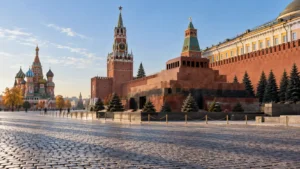 Red Square Moscow – about 300 m away (~5 min walk) · typical visit: 1–2 hours for the square, 3–5 hours with St Basil's and one museum
 St. Basil’s Cathedral Moscowabout 350 m away (~6 min walk) · typical visit: 45–90 minutes inside
 Zaryadye Park Moscowabout 700 m away (~11 min walk) · typical visit: 1–2 hours; 3 hours with the pavilions
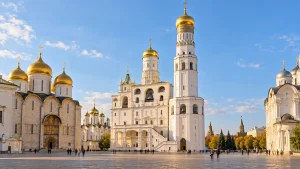 Ivan the Great Bell Tower Moscowabout 150 m away (~2 min walk) · typical visit: 1–1.5 hours for the tower
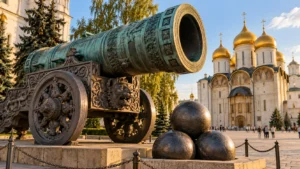 Tsar Cannon Moscowabout 150 m away (~2 min walk) · typical visit: 10–20 minutes
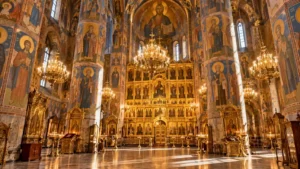 Assumption Cathedral Moscowabout 150 m away (~3 min walk) · typical visit: 30–45 minutes
Metro stations near Moscow Kremlin
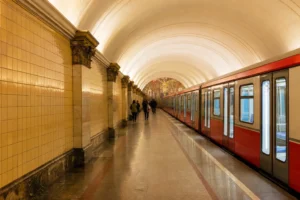 Biblioteka Imeni Lenina Metro Stationabout 450 m away (~8 min walk)
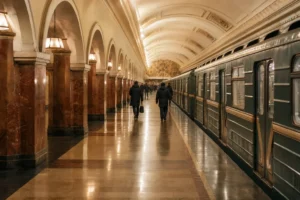 Alexandrovsky Sad Metro Stationabout 550 m away (~9 min walk)
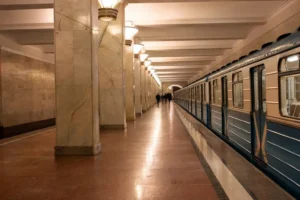 Aleksandrovsky Sad Metro Stationabout 550 m away (~9 min walk)
Restaurants and cafes near Moscow Kremlin
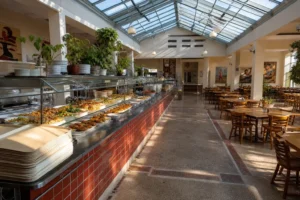 Stolovaya 57about 400 m away (~6 min walk)
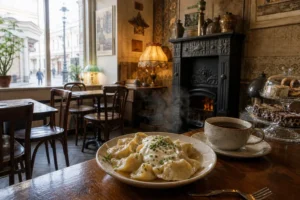 Varenichnaya No. 1about 550 m away (~9 min walk)
 Belugaabout 550 m away (~9 min walk)
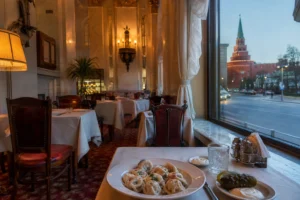 Grand Cafe Dr. Zhivagoabout 550 m away (~9 min walk)
Nightlife near Moscow Kremlin
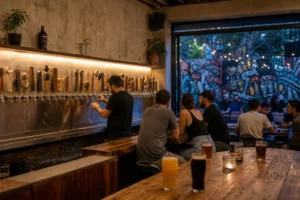 Rule Taproomabout 650 m away (~11 min walk)
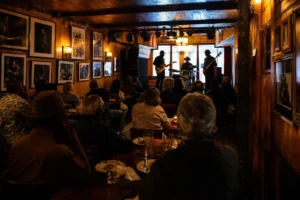 Rhythm & Blues Cafeabout 700 m away (~11 min walk)
Hotels near Moscow Kremlin
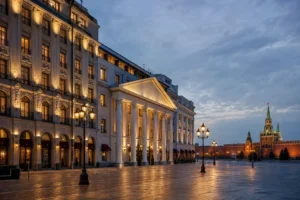 Four Seasons Hotel Moscowabout 550 m away (~9 min walk)
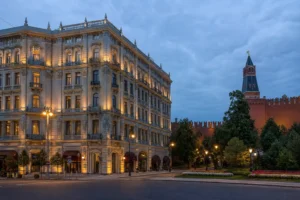 Hotel National Moscowabout 600 m away (~9 min walk)
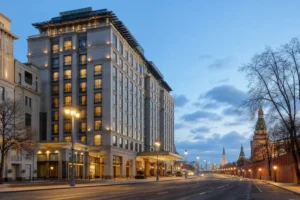 The Carlton Moscowabout 650 m away (~11 min walk)
Events and traditions near Moscow Kremlin
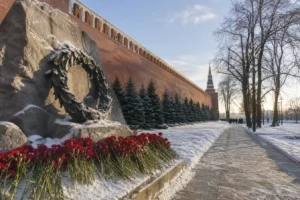 Defender of the Fatherland Day in Moscowabout 250 m away (~4 min walk)
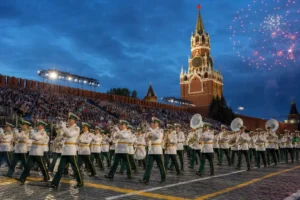 Spasskaya Tower Military Music Festivalabout 300 m away (~5 min walk)
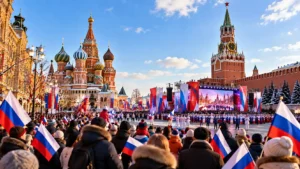 National Unity Day in Moscowabout 300 m away (~5 min walk)
Related guides
 Non/fiction Book Fair in Moscow: Gostiny Dvor, Dates and Tickets
 InterContinental Moscow Tverskaya: Now Hotel Continental on Tverskaya
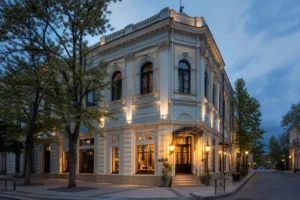 Stella Di Mosca Hotel: Italian-Designed Boutique Hotel near Red Square
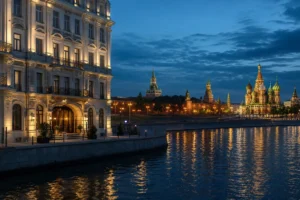 Hotel Baltschug Kempinski Moscow: Kremlin Views Across the River
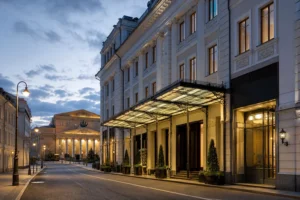 Ararat Park Hotel Moscow: Five-Star Hotel near the Bolshoi Theatre
Browse more: More in Tverskoy · All Landmarks · All Sightseeing
FAQ: Moscow Kremlin
Is Red Square part of the Moscow Kremlin?
No. Red Square runs along the outside of the eastern wall and has its own sights. St Basil's Cathedral and GUM have separate admission or are free to enter, and the square itself is free to walk through.
Is the Armoury Chamber included in the Cathedral Square ticket?
No. The Armoury Chamber is a separate museum visit with its own ticket, timed session and entrance through the Borovitskaya Tower. See the scope and booking sections.
Can you walk anywhere inside the Kremlin walls?
No. Visitors can see Cathedral Square and some open areas of the grounds. The government buildings and the Grand Kremlin Palace are not open, though you can see them from a distance.
Which ticket should I buy for a first visit?
Buy the Cathedral Square and grounds ticket first. Add the Armoury Chamber if you want to see the regalia, thrones and carriages; allow about 90 minutes for it.
How long does a visit take?
Allow 2–3 hours for Cathedral Square and the grounds, and about 90 minutes for the Armoury Chamber. Doing both comfortably takes most of a day.
Do I need a guide?
Not for a first visit. Signs and the museum's printed materials cover the main sights. A guide helps with the icons, tombs and history, and the museums offer tours in English; contact the guided tours office in advance.
Can you climb the Ivan the Great Bell Tower?
The climb needs its own ticket and has been reported as temporarily closed. Check the official site for the current status before planning around it.
Is it worth visiting in winter?
Yes. The grounds are quieter, the churches are warm inside and the snow gives the square a very different look. Daylight is short, so start early.
Discover More of Moscow with Our Travel Tips
Get practical Moscow travel tips, new destination guides and useful updates on attractions, opening hours and prices. Plan your visit with clear, helpful information delivered to your inbox.
Moscow Vibes is a one-person project. A coffee keeps it going
Last updated: October 6, 2026. Found an error or something out of date? Report it and we will check and fix it.
How we research and update our guides
About this guide: AI assistance and accuracy
This guide is created with the help of AI and is based on official sources where available. Mistakes can still happen. Opening hours, prices, rules and other details are given to the best of our knowledge as of the date shown and can change without notice. It offers general recommendations only, not professional, legal or travel advice. Please confirm important details with the official source before you travel; you are responsible for your own plans and decisions.
International sanctions affect payments between Russia and many other countries. In practice, cards issued in the EU, the UK, the US and several other countries often do not work in Russia, Russian cards usually do not work abroad, and some booking platforms, airlines and payment providers limit or suspend their services for Russia. The situation changes frequently. We do not give legal or financial advice, and this site does not encourage anyone to break or circumvent sanctions. Whatever you plan, you are responsible for following the laws and regulations that apply to you, including those of your country of residence and citizenship. Many travelers still organise their stay lawfully. It is worth asking your bank or payment provider what is currently permitted, contacting hotels, tour operators and carriers directly about the payment methods they accept, and checking which services are open to customers from your country. Clarify payment, cancellation and refund terms before you commit to a booking, and keep your plans flexible. Partner links on this site may not be available in every country, and prices, availability and rules in our guides can differ from what you see when you book.Paying for your trip: please read
Report an issue on this page
* Affiliate link: as an Amazon Associate we earn from qualifying purchases at no extra cost to you.
 Ask Masha