
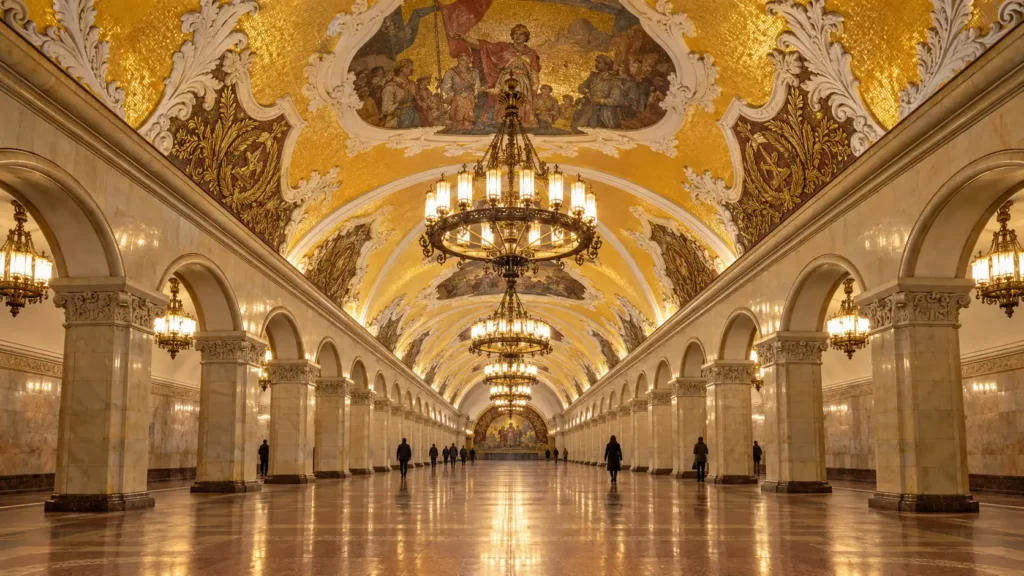
Komsomolskaya Metro Station on the Circle Line is one of the most lavish stations of the Moscow Metro, opened in 1952 under the square of the three railway terminals. Komsomolskaya Metro Station mosaics by Pavel Korin line the yellow and gold ceiling of a long hall lit by bronze chandeliers.
The architect was Alexey Shchusev, who also designed Lenin’s Mausoleum, and the station was meant as a grand gateway for people arriving in the capital. It is also one of the busiest stations, so a visit takes patience. This guide explains what to look for, where to look and how the fares work.
Quick Facts
| Russian name | Комсомольская |
|---|---|
| Built / opened | 1952 |
| Architect(s) | Alexey Shchusev (completed by Viktor Kokorin and A. Velikoretsky; mosaics by Pavel Korin) |
| Address | Komsomolskaya Square, Moscow, Russia OpenStreetMap · Google Maps |
| District | Krasnoselsky |
| Interchanges | Komsomolskaya (Line 5 (Koltsevaya, brown), the decorated station itself, under Komsomolskaya Square) Komsomolskaya (Line 1 (Sokolnicheskaya, red), the station of the same name, linked by a transfer; details were not verified) |
| Opening hours | The Moscow Metro normally runs from early morning until around 1:00 at night, and the station is open to passengers during those hours.
Exact first and last train times were not confirmed, so check the Metro's official information (as of October 2026 – check the official site, mosmetro.ru). |
| Best time to visit | Mid-morning and early afternoon on weekdays are calmer, and late evening is quiet. The morning and evening rush hours and train departure times are the busiest, when the hall is crowded with travelers and luggage.
The station works in every season, so it is a good stop on a cold or wet day. |
| Last updated | October 6, 2026 |
Why Visit Komsomolskaya Metro Station?
The station was built as a gateway to Moscow for travelers from the three railway terminals above it, and it still has that effect. The long hall has two rows of massive columns, vaults decorated with gold smalt and large bronze chandeliers believed to be modeled on church panikadilo chandeliers.
Eight large ceiling mosaics by Pavel Korin show figures from Russian military history, including Alexander Nevsky, Dmitry Donskoy, Minin and Pozharsky, Suvorov and Kutuzov, and Soviet soldiers at the Reichstag.
Because the station sits under Komsomolskaya Square, it is easy to combine with a stop at one of the railway terminals, and the platform is open late in the evening.
How Komsomolskaya Metro Station Is Laid Out
The station is a deep column station under Komsomolskaya Square, with a long central hall and a train platform on each side.
The central hall has the vaulted ceiling with the eight large mosaics, the chandeliers and the rose granite floor. A bust of Lenin stands at the end of the hall. At the escalator hall, a large fluorescent mosaic of the Order of Victory faces the escalator.
The station connects to the Line 1 station of the same name and to the exits on the square, with the three railway terminals above. Walk the length of the hall first, then go to the escalator hall and the exits.
Highlights of Komsomolskaya Metro Station
Korin's ceiling mosaics
Eight large mosaics by Pavel Korin, set in the yellow Baroque ceiling, show Russian heroes. They include Alexander Nevsky after the Battle on the Ice in 1242, Dmitry Donskoy after Kulikovo in 1380, Minin and Pozharsky in 1612 and Alexander Suvorov in 1799.
The Suvorov mosaic has more than 300,000 tiles, covers 31.5 square meters and weighs more than three tonnes.
Tip: Walk slowly along the hall and look at each panel in order, from Nevsky to the later scenes.
Gold smalt and bronze chandeliers
The vaults are covered with gold smalt, which shines under the light of large bronze chandeliers and ceiling lamps. The chandeliers are believed to be modeled on the multi-tiered panikadilo chandeliers of Orthodox churches.
Bas-reliefs and mosaic panels add to the effect.
Tip: Look up at the chandeliers from the middle of the hall, where all of them are in view.
The Baroque ceiling and columns
The hall is an arcade with two rows of massive columns, and a Baroque ceiling with friezes painted yellow. Alexey Shchusev designed it as a grand gateway for people arriving by rail.
The rose granite floor adds warmth.
Tip: Look at the friezes along the top of the walls, which many passengers miss.
The replaced mosaics
Two mosaics that once showed Stalin were replaced after 1963, according to one source, by Lenin addressing Red Guards and the Spasskaya Tower of the Kremlin with the Mother Russia Calls monument behind it.
They show how the station's decoration changed over time.
Tip: Look for these two panels near the end of the hall.
The Order of Victory mosaic
On the wall opposite the escalator, a large fluorescent mosaic by Pavel Korin shows the Order of Victory, surrounded by red and green banners.
It is seen as you leave the escalator hall.
Tip: Look at it before you go up, since it is easy to miss as you step off the escalator.
The station as a gateway
The station sits under Komsomolskaya Square, also called Three Stations Square, which serves the Leningradsky, Yaroslavsky and Kazansky railway terminals. It is one of the busiest transport hubs in Moscow.
The design was meant to impress arriving travelers.
Tip: Combine the station with a look at one of the terminals on the square above.
Atmosphere
The hall is long and high, and the gold and yellow ceiling seems to glow under the bronze chandeliers. The mosaics sit above in their panels, dark and colorful, and the rose granite floor shines.
This is one of the busiest stations in the city, and the platform is full of travelers with suitcases coming from and going to the trains. The sound is announcements, rolling luggage and the rumble of trains.
It is most crowded in the morning and evening rush hours and on departure days. Late in the evening and in the middle of the day, the hall is calmer and easier to look around.
History of Komsomolskaya Metro Station
Komsomolskaya was planned as part of the Circle Line of the Moscow Metro. The stations of the southern part of the line were dedicated to the victory over Nazi Germany, and those of the northern part, ending at Komsomolskaya, to the theme of post-war labor. Earlier drafts of 1944 were discarded after the war, and the stations were completed in the late Stalinist style of the period.
The architect was Alexey Shchusev, who also designed Lenin’s Mausoleum. Komsomolskaya remained his first and only metro station. He designed it as an illustration of a speech given by Stalin on 7 November 1941, in which he evoked the memory of Alexander Nevsky, Dmitry Donskoy and other military leaders of the past.
The station was completed after Shchusev’s death by the architects Viktor Kokorin and A. Velikoretsky, with the mosaics designed by Pavel Korin. In 1951, Korin and Shchusev were awarded the Stalin Prize for their work on the station.
Komsomolskaya was opened to the public on 30 January 1952 as the first station of the second stage of the Circle Line. It is a deep column station, with a long hall lined by two rows of massive columns, a Baroque ceiling with yellow friezes and vaults covered with gold smalt.
The eight ceiling mosaics show Russian heroes in chronological order, from Alexander Nevsky in 1242 to Soviet soldiers at the walls of the Reichstag. Two mosaics that once showed Stalin were replaced after 1963, according to one source, with Lenin addressing Red Guards and the Spasskaya Tower of the Kremlin.
The station lies under Komsomolskaya Square, known as Three Stations Square, where the Leningradsky, Yaroslavsky and Kazansky terminals stand. It has always been one of the busiest stations of the Metro, and today it serves travelers arriving from across Russia.
Tickets and Booking for Komsomolskaya Metro Station
There is no ticket for the station itself; entering needs a Metro fare. Reports on 2026 fares differ: a budget-level fare (₽) for a single ride with a Troika card, a slightly higher budget fare (₽) by contactless bank card and a higher budget fare (₽) for a 90-minute fare, while some sources still give lower budget fares (₽). Check the current fare on the official Moscow Metro site, mosmetro.ru.
- Troika card: a reusable card sold at ticket windows and top-up machines in station halls and through the official Metro app; the deposit is reported to be small (₽), so check the price.
- Foreign cards: reports conflict on whether foreign Visa or Mastercard cards and phone payments work at the turnstiles, so carry rubles in cash and buy a ticket or card at a ticket window.
- Rush hours: the station is especially busy in the morning and evening, and around train departure times.
Rates for Russian citizens and concessions differ. All fares and payment methods are listed on the official site, mosmetro.ru.
Plan and Book
How to Get to Komsomolskaya Metro Station
Komsomolskaya station is on the Circle Line, under Komsomolskaya Square, in the northeast of the center of Moscow.
- Metro: Komsomolskaya (Line 5, Koltsevaya, brown), between Prospekt Mira and Kurskaya. The station of the same name on Line 1 (Sokolnicheskaya, red) is linked by a transfer; details were not verified.
- On foot: the exits open onto Komsomolskaya Square, where the Leningradsky, Yaroslavsky and Kazansky railway terminals stand.
A taxi can drop you at the square. Follow the signs for the Circle Line to reach the decorated hall.
Accessibility
Accessibility details were not confirmed. The station is deep and is reached by long escalators, and lift availability and step-free access were not verified. With luggage and crowds, allow extra time. Contact the Metro or check mosmetro.ru before traveling if you need step-free access or assistance.
Food Nearby
The three railway terminals and the streets around Komsomolskaya Square have many cafes, fast food outlets and shops. Specific venues were not verified, so check opening hours before you go.
What to Bring
Bring a camera and keep your luggage close, since the station is crowded. Have some rubles in cash for a ticket or a Troika card.
Best Views and Photo Spots of Komsomolskaya Metro Station
Middle of the central hall
The long hall with its chandeliers, golden vaults and mosaics receding into the distance.
Best time: Late evening or mid-morning, when the hall is quieter
Suvorov mosaic
The large mosaic of Alexander Suvorov after crossing the Alps, in fine detail.
Best time: Between trains, with the platform clear
Chandeliers from below
The bronze chandeliers hanging beneath the gold vaults, a strong view looking straight up.
Best time: Any time, with the hall lit
Escalator hall mosaic
The fluorescent Order of Victory mosaic opposite the escalator, framed by banners.
Best time: Quiet moments, as you step off the escalator
Photography Rules
Photography rules in the station were not confirmed. Taking photographs on the platform is common, but tripods and flash can be restricted, and the station is busy, so stand clear of the platform edge and the crowds. Drone rules in Moscow are strict and change.
Family Suitability
The station is a short stop that suits families, with chandeliers and golden ceilings that children can look for. It is very busy, with crowds and luggage, so keep children close and away from the platform edge. Strollers need the escalator or a lift, and lift access was not confirmed.
Moscow Vibes Tips
- Look up as soon as you step off the train; the mosaics and chandeliers are above the usual line of sight.
- Make sure you are on the Circle Line (Line 5, brown); the Line 1 station of the same name is not the decorated one.
- Walk the hall from end to end, since the mosaics are in chronological order and the best view of the chandeliers is from the middle.
- Avoid the morning and evening rush hours and train departure times if you want room to photograph.
- Look at the fluorescent Order of Victory mosaic opposite the escalator before you leave.
- Combine the visit with one of the railway terminals on the square, which are worth a look from outside.
Explore Nearby Komsomolskaya Metro Station
Sights near Komsomolskaya Metro Station
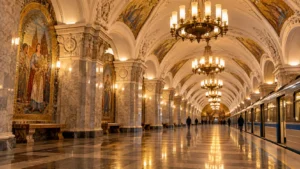 Moscow Metro · typical visit: 1.5–3 hours for a tour of showcase stations
 Moscow Transport Museumabout 800 m away (~13 min walk) · typical visit: About 2 to 3 hours
 Bauman Garden Moscowabout 950 m away (~15 min walk) · typical visit: About 1 to 1.5 hours
 Apothecary Garden Moscowabout 1.4 km away (~23 min walk) · typical visit: About 1.5 to 2.5 hours
Metro stations near Komsomolskaya Metro Station
 Krasnye Vorota Metro Stationabout 850 m away (~14 min walk)
 Krasnoselskaya Metro Stationabout 900 m away (~15 min walk)
Train stations and river piers near Komsomolskaya Metro Station
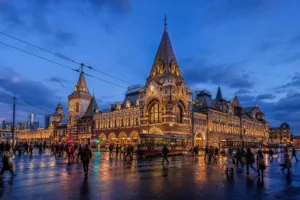 Yaroslavsky Railway Terminalabout 200 m away (~3 min walk)
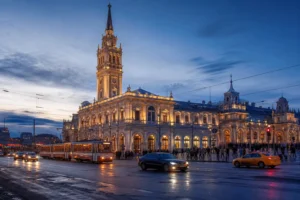 Kazansky Railway Terminalabout 200 m away (~3 min walk)
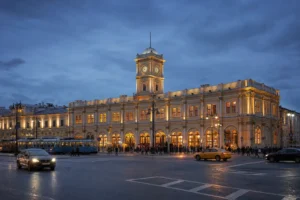 Leningradsky Railway Terminalabout 100 m away (~2 min walk)
Restaurants and cafes near Komsomolskaya Metro Station
 +39 Trattoria & Pizzeriaabout 750 m away (~12 min walk)
Hotels near Komsomolskaya Metro Station
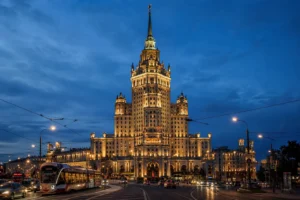 Hilton Moscow Leningradskayaabout 300 m away (~5 min walk)
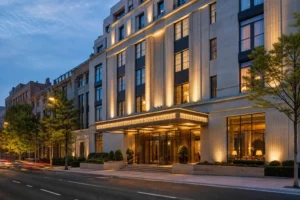 Imperial Plaza Moscowabout 400 m away (~6 min walk)
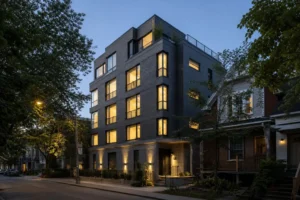 Jackpot Energy Hotelabout 800 m away (~13 min walk)
Related guides
 Mu-Mu: Self-Service Russian Food Chain with Cheap Lunches
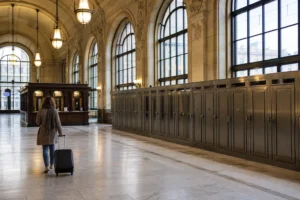 How to store luggage in Moscow: Stations, Airports, Lockers and Prices
 How to see the most beautiful Moscow Metro stations in one route: Tips
 How to get from Moscow to Kolomna: Train from Kazansky Station
 How to get from Moscow to Sergiev Posad: Express Train, Bus and Taxi
Browse more: More in Krasnoselsky · All Metro Stations
FAQ: Komsomolskaya Metro Station
Who designed Komsomolskaya station?
Alexey Shchusev, who also designed Lenin's Mausoleum, with the station completed after his death. It opened on 30 January 1952.
Who made the mosaics?
Pavel Korin designed the eight large ceiling mosaics, which show heroes of Russian history.
Which Komsomolskaya station is the decorated one?
The one on the Circle Line (Line 5, brown). The Line 1 station of the same name is a separate station.
Why is the station so busy?
It lies under Komsomolskaya Square, which serves the Leningradsky, Yaroslavsky and Kazansky railway terminals.
Do I need a ticket to see it?
Yes, a Metro fare is needed to enter. See the fares and payment section.
What are the chandeliers modeled on?
They are believed to be modeled on the multi-tiered panikadilo chandeliers of Orthodox churches.
How long do I need?
About 10 to 15 minutes to walk the hall and look at the mosaics.
Which railway terminals are nearby?
Leningradsky, Yaroslavsky and Kazansky, all on Komsomolskaya Square.
Discover More of Moscow with Our Travel Tips
Get practical Moscow travel tips, new destination guides and useful updates on attractions, opening hours and prices. Plan your visit with clear, helpful information delivered to your inbox.
Moscow Vibes is a one-person project. A coffee keeps it going
Last updated: October 6, 2026. Found an error or something out of date? Report it and we will check and fix it.
How we research and update our guides
About this guide: AI assistance and accuracy
This guide is created with the help of AI and is based on official sources where available. Mistakes can still happen. Opening hours, prices, rules and other details are given to the best of our knowledge as of the date shown and can change without notice. It offers general recommendations only, not professional, legal or travel advice. Please confirm important details with the official source before you travel; you are responsible for your own plans and decisions.
International sanctions affect payments between Russia and many other countries. In practice, cards issued in the EU, the UK, the US and several other countries often do not work in Russia, Russian cards usually do not work abroad, and some booking platforms, airlines and payment providers limit or suspend their services for Russia. The situation changes frequently. We do not give legal or financial advice, and this site does not encourage anyone to break or circumvent sanctions. Whatever you plan, you are responsible for following the laws and regulations that apply to you, including those of your country of residence and citizenship. Many travelers still organise their stay lawfully. It is worth asking your bank or payment provider what is currently permitted, contacting hotels, tour operators and carriers directly about the payment methods they accept, and checking which services are open to customers from your country. Clarify payment, cancellation and refund terms before you commit to a booking, and keep your plans flexible. Partner links on this site may not be available in every country, and prices, availability and rules in our guides can differ from what you see when you book.Paying for your trip: please read
Report an issue on this page
* Affiliate link: as an Amazon Associate we earn from qualifying purchases at no extra cost to you.
 Ask Masha