
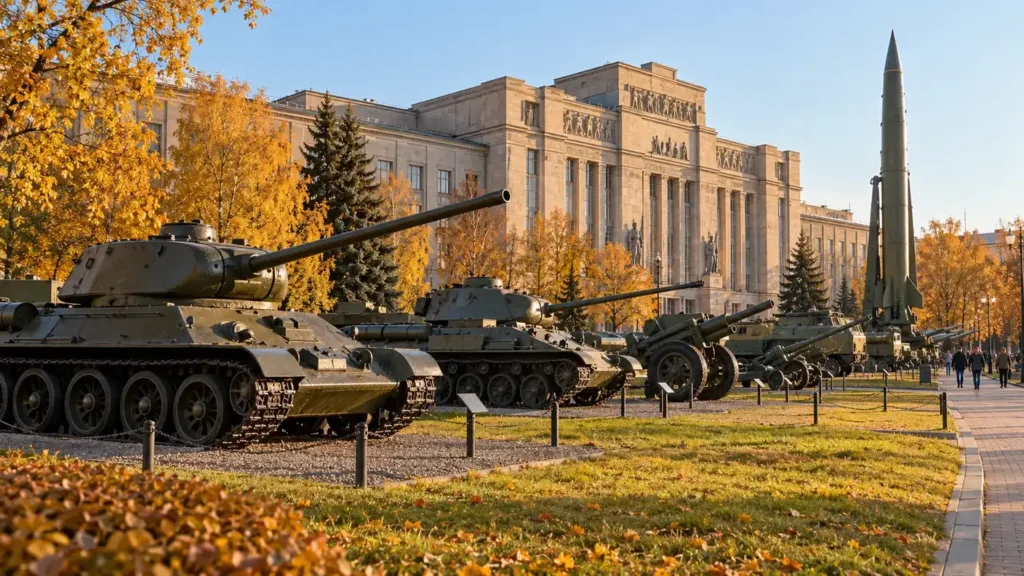
Central Armed Forces Museum Moscow is a large military history museum in the north of Moscow, next to the Russian Army Theatre. The museum’s collection is split between indoor halls on Russian and Soviet military history and an open-air exhibition with major equipment outdoors.
It traces its institutional beginnings to 1919, moved into its present purpose-built building in 1965, and uses its present name from 1993.
Quick Facts
| Russian name | Центральный музей Вооружённых Сил |
|---|---|
| Built / opened | 1919 |
| Address | Sovetskoy Armii Street 2, building 1, Moscow, Russia OpenStreetMap · Google Maps |
| District | Meshchansky |
| Metro | Dostoevskaya (Line 10 (Lyublinsko-Dmitrovskaya, light green), about 5 min walk past the Russian Army Theatre) |
| Opening hours | The museum is open Wednesday to Sunday from 10:00 to 17:00 and closed on Mondays and Tuesdays, according to several listings.
The open-air exhibition near Yekaterininsky Park may follow different hours (as of October 2026 – check the official site, cmaf.ru). |
| Admission | The ticket is described as inexpensive, but the current price was not confirmed. Check the museum's official site for prices and for whether individual visitors can buy tickets on site. |
| Best time to visit | Weekday mornings are calmer, and the open-air exhibition is best in dry weather from spring to early autumn. The indoor halls work in any season.
The museum is closed on Mondays and Tuesdays, so plan the visit from Wednesday to Sunday. |
| Recommended duration | 2–3 hours |
| Website | cmaf.ru |
| Last updated | October 7, 2026 |
What Is (and Isn't) Part of a Visit to Central Armed Forces Museum Moscow?
| Part | Status | Notes |
|---|---|---|
| Indoor exhibition halls | Included in the standard ticket | Covered by the museum ticket; about 23 to 24 halls. |
| Open-air exhibition | Included in the standard ticket | Tanks, aircraft and missiles around the building; check whether it needs a ticket or has different hours. |
| Audio guide | Separate ticket or institution | Advised for non-Russian speakers; availability in English was not confirmed. |
| Russian Army Theatre | Outside / not part of it | A separate theatre next door with its own performances and tickets. |
| Victory Museum Moscow | Outside / not part of it | A different museum at Victory Park; see its article. |
| Yekaterininsky Park | Outside / not part of it | A public park next to the open-air exhibition. |
Why Visit Central Armed Forces Museum Moscow?
If you want a single place that connects Russian and Soviet military history—from early decades through the Second World War and later conflicts—this museum’s indoor galleries do the storytelling, while the open-air exhibition lets you see the hardware up close.
For many visitors, the outdoor collection is the fastest “wow” moment: tanks, aircraft, artillery, and missiles are placed in a way that’s easy to photograph and explore without needing to read every label first.
How Central Armed Forces Museum Moscow Is Laid Out
The museum sits beside the Russian Army Theatre on Sovetskoy Armii Street, with Yekaterininsky Park nearby.
Main building: indoor galleries are arranged roughly in a chronological path, moving from earlier military history through the Civil War, the Second World War, and later conflicts. A central space highlights end-of-war material.
Open-air exhibition: the outdoor area sits around the building near the park and includes large equipment displays (tanks, aircraft, missiles, and more). A practical route is to start outdoors in good weather, then move inside for the longer indoor galleries.
Highlights of Central Armed Forces Museum Moscow
Open-air exhibition of tanks, aircraft, and missiles
Around the building, the museum’s open-air exhibition displays about 150 pieces of military equipment—tanks, artillery, missiles, aircraft, and naval items—set on paths and grass near Yekaterininsky Park.
Tip: If the weather is good, start outdoors first so the walk feels easier before the indoor halls.
The main hall with end-of-war material
A main hall presents high-profile items connected to the end of the Second World War, making it one of the spaces visitors quickly recognize.
Tip: Give yourself a slower pace here; the museum is large and the indoor exhibits reward time.
Second World War galleries
The Second World War coverage is extensive, spanning multiple galleries that mix uniforms, weapons, documents, and equipment.
Tip: If reading Russian labels is part of the plan, audio support helps—especially in the larger WWII rooms.
Civil War and early Soviet history
The earlier sections trace military history from the early Russian state through the Civil War and early Soviet period, aligning with the museum’s overall chronological layout.
Tip: Starting with these halls makes the later conflicts easier to follow.
Cold War and later conflicts
Later galleries cover the Cold War and subsequent conflicts, including the Soviet-Afghan war and the wars in Chechnya.
Tip: Ask at the desk whether any audio guide options cover these later halls effectively.
Atmosphere
The museum’s indoor spaces feel substantial and serious, with large halls where uniforms, weapons, and flags are displayed behind glass. Visitors usually move steadily and many spend time reading.
Outside, the open-air exhibition is calmer and more approachable: you can walk among the machines, with the sounds of footsteps on paths and occasional voices from nearby visitors.
The area around the museum is dominated by nearby landmarks, including the Russian Army Theatre and Yekaterininsky Park, so it stays pleasantly grounded even when the museum is busy.
History of Central Armed Forces Museum Moscow
The museum’s roots go back to 1919. It opened its first exhibition in 1920, originally focused on the life of the Red Army and Navy, and it was renamed several times over the decades.
It reached its current purpose-built building in 1965. The museum’s present name dates to 1993.
Today, the collection follows the story of Russian and Soviet armed forces across major turning points: the Civil War era, the Second World War, the Cold War, and later conflicts, with some of the most visually memorable material shown outdoors in the open-air exhibition.
Tickets and Booking for Central Armed Forces Museum Moscow
| Ticket | Price | Includes |
|---|---|---|
| Museum ticket | See the official page | The indoor halls; the ticket is described as inexpensive, and the current price was not confirmed. |
| Open-air exhibition | See the official page | Whether the outdoor area has a separate ticket was not confirmed. |
₽ budget · ₽₽ moderate · ₽₽₽ upscale · ₽₽₽₽ splurge. Price levels are estimates compared with typical prices for visitors.
Hours listed online are Wednesday to Sunday, 10:00–17:00, with Mondays and Tuesdays closed. As of October 2026, double-check the current schedule on the official website (the open-air exhibition may have different hours).
Tickets: the ticketing approach and current prices must be confirmed on the official website. The museum’s official website is the best place to check whether individual visitors (including foreign nationals) can buy tickets on the day and whether the outdoor exhibition has separate terms.
Plan and Book
Suggested Itineraries for Central Armed Forces Museum Moscow
2 hours
Walk from Dostoevskaya metro station past the Army Theatre, tour the open-air exhibition and then the main hall and the Second World War halls.
3 hours
Follow the indoor halls in chronological order with an audio guide, then spend the last hour in the open-air area among the tanks and aircraft.
Half day
See the museum in the morning, then walk to Yekaterininsky Park and the Armenian Cathedral of Moscow. Finish with the Jewish Museum and Tolerance Center.
How to Get to Central Armed Forces Museum Moscow
Central Armed Forces Museum Moscow is in northern Moscow, near the Russian Army Theatre, about a 5-minute walk from Dostoevskaya metro station (Line 10, Lyublinsko-Dmitrovskaya, light green).
- Walking route: from Dostoevskaya, head past the Russian Army Theatre, then follow Sovetskoy Armii Street north toward the museum.
A taxi drop-off near the entrance is also straightforward, but the walk from the metro is short.
Accessibility
Accessibility details were not confirmed. The museum is a large building with many halls and likely lifts, but this was not verified, and the open-air area has gravel and grass. Contact the museum before visiting if you need step-free access or assistance.
Food Nearby
Food options are easiest around Dostoevskaya metro station and along nearby streets. The museum area itself is more focused on landmarks than restaurants, so it helps to plan a stop before or after the visit.
What to Bring
Wear comfortable shoes for long indoor halls and uneven outdoor paths. Bring a light layer for weather changes outside. Since most labels are in Russian, an audio guide or a translation app is helpful for understanding what you’re looking at.
Best Views and Photo Spots of Central Armed Forces Museum Moscow
Open-air exhibition area (around the museum near Yekaterininsky Park)
Tanks, artillery, and missile stands laid out around the building give strong, graphic silhouettes.
Best time: Morning or late afternoon light
Front of the museum building
The museum entrance and nearby monuments look cleanest when the light is even.
Best time: Midday
Russian Army Theatre on the walk from Dostoevskaya
The Russian Army Theatre’s large facade is a recognizable landmark on the approach from the metro.
Best time: Afternoon light
Photography Rules
In general, photography rules can differ by gallery. Stick to the posted signs and instructions from staff, and avoid flash where it’s prohibited. For drones: regulations in Moscow are strict and can change—check the latest rules before any attempt to fly.
Family Suitability
Best for school-age children and older, especially if they’re interested in history. The open-air exhibition is easier for younger visitors because it’s visually direct. Indoors, labels are mainly in Russian and the subject matter is war-related, so it may suit families who are comfortable with that tone. Strollers may work in the outdoor area, but the museum building is large and practical access details should be confirmed.
Moscow Vibes Tips
- Plan your visit from Wednesday to Sunday—Mondays and Tuesdays are the listed closed days.
- Keep your first hour flexible: if the open-air equipment is your priority, spend more time outdoors, then switch to the indoor galleries in chronological order.
- Don’t confuse this museum with the Victory Museum at Victory Park; they are in different parts of Moscow and cover different scopes.
- If you want context, audio support matters more than it might for small museums—this one is large and the label language is mainly Russian.
Explore Nearby Central Armed Forces Museum Moscow
Sights near Central Armed Forces Museum Moscow
 Moscow Metro · typical visit: 1.5–3 hours for a tour of showcase stations
 Moscow Cathedral Mosqueabout 900 m away (~14 min walk) · typical visit: About 30 minutes to 1 hour
 Jewish Museum and Tolerance Center Moscowabout 1.1 km away (~19 min walk) · typical visit: 2–3 hours
 Apothecary Garden Moscowabout 1.2 km away (~20 min walk) · typical visit: About 1.5 to 2.5 hours
 State Museum of Decorative Arts Moscowabout 1.3 km away (~21 min walk) · typical visit: About 1.5 to 2 hours
 Gulag History Museum Moscowabout 1.3 km away (~21 min walk)
Metro stations near Central Armed Forces Museum Moscow
 Dostoevskaya Metro Stationabout 550 m away (~9 min walk)
 Prospekt Mira Metro Stationabout 1.1 km away (~17 min walk)
 Maryina Roshcha Metro Stationabout 1.1 km away (~18 min walk)
Nightlife near Central Armed Forces Museum Moscow
 Molodezh Nightclubabout 1.2 km away (~20 min walk)
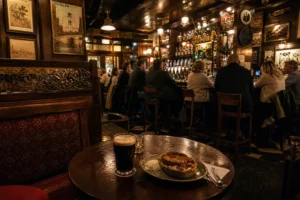 Katie O'Shea'sabout 1.4 km away (~22 min walk)
Hotels near Central Armed Forces Museum Moscow
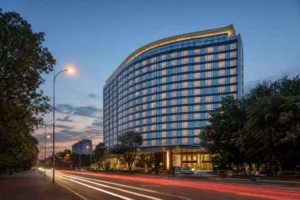 Azimut Hotel Olympic Moscowabout 400 m away (~6 min walk)
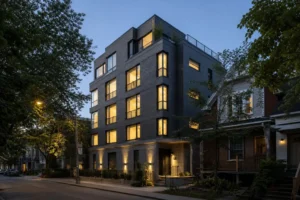 Jackpot Energy Hotelabout 1.8 km away (~29 min walk)
 Golden Apple Boutique Hotelabout 2.0 km away (~32 min walk)
Train stations and river piers near Central Armed Forces Museum Moscow
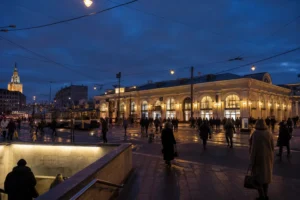 Rizhsky Railway Terminalabout 1.4 km away (~23 min walk)
Related guides
 Novoslobodskaya Metro Station: Stained Glass Panels and Visit Tips
 EUROSPAR: Supermarkets in Central Moscow, 24-Hour Stores and Payment
 Insider Bar: Sretenka’s Cocktail Lab, Hours and Entry Tips
 Jam Club Music: Live Jazz and Blues on Sretenka Street
 Nikulin Moscow Circus on Tsvetnoy Boulevard: Shows, History and Tips
Browse more: More in Meshchansky · All Museums · All Sightseeing
FAQ: Central Armed Forces Museum Moscow
Is this the same museum as the Victory Museum at Victory Park?
No. The Victory Museum is at Victory Park and focuses on the Great Patriotic War. Central Armed Forces Museum Moscow covers a wider span of Russian and Soviet military history.
When is it open?
As listed online, it is open Wednesday to Sunday from 10:00 to 17:00 and closed on Mondays and Tuesdays. The open-air area may have different hours—check the official website for the current schedule.
Is there English information inside?
Most labels are in Russian. An audio guide is advised for visitors who do not read Russian.
What’s outside the museum building?
An open-air exhibition around the museum with about 150 pieces of equipment, including tanks, artillery, missiles, aircraft, and naval items.
When was the museum founded?
The museum is dated to 1919, and it has been in its present building since 1965.
How long should I plan for?
Allow about 2–3 hours. The indoor halls are often larger than first-time visitors expect, especially if you read labels.
Discover More of Moscow with Our Travel Tips
Get practical Moscow travel tips, new destination guides and useful updates on attractions, opening hours and prices. Plan your visit with clear, helpful information delivered to your inbox.
Moscow Vibes is a one-person project. A coffee keeps it going
Last updated: October 7, 2026. Found an error or something out of date? Report it and we will check and fix it.
How we research and update our guides
About this guide: AI assistance and accuracy
This guide is created with the help of AI and is based on official sources where available. Mistakes can still happen. Opening hours, prices, rules and other details are given to the best of our knowledge as of the date shown and can change without notice. It offers general recommendations only, not professional, legal or travel advice. Please confirm important details with the official source before you travel; you are responsible for your own plans and decisions.
International sanctions affect payments between Russia and many other countries. In practice, cards issued in the EU, the UK, the US and several other countries often do not work in Russia, Russian cards usually do not work abroad, and some booking platforms, airlines and payment providers limit or suspend their services for Russia. The situation changes frequently. We do not give legal or financial advice, and this site does not encourage anyone to break or circumvent sanctions. Whatever you plan, you are responsible for following the laws and regulations that apply to you, including those of your country of residence and citizenship. Many travelers still organise their stay lawfully. It is worth asking your bank or payment provider what is currently permitted, contacting hotels, tour operators and carriers directly about the payment methods they accept, and checking which services are open to customers from your country. Clarify payment, cancellation and refund terms before you commit to a booking, and keep your plans flexible. Partner links on this site may not be available in every country, and prices, availability and rules in our guides can differ from what you see when you book.Paying for your trip: please read
Report an issue on this page
* Affiliate link: as an Amazon Associate we earn from qualifying purchases at no extra cost to you.
 Ask Masha