
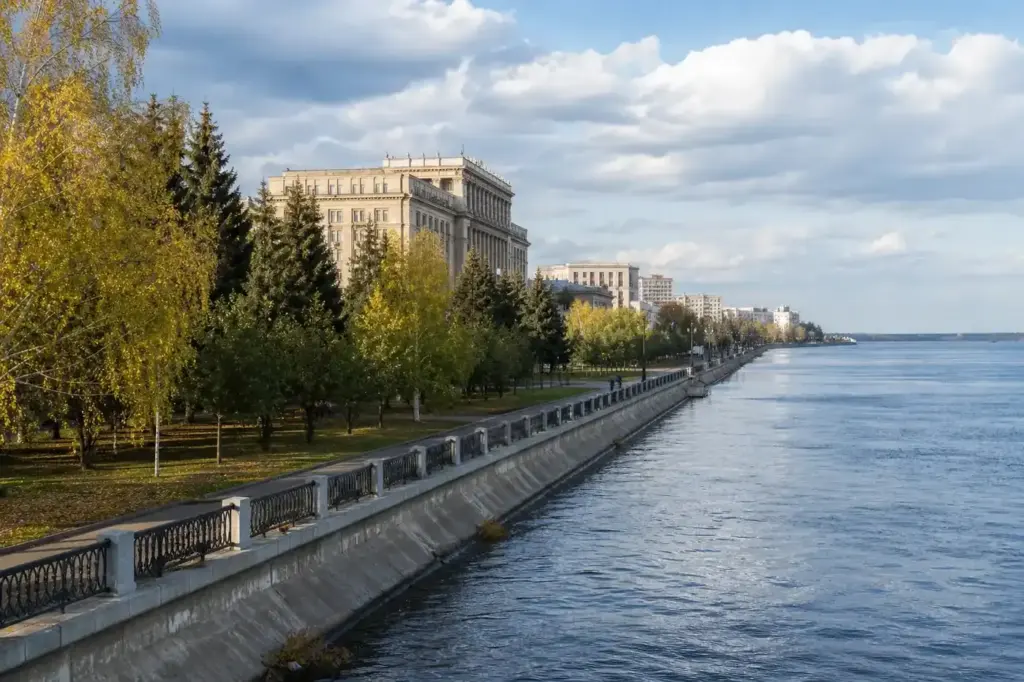
Dubna Day Trip from Moscow takes you to a purpose-built science city 130 km north, nestled where the Moscow Canal meets the Volga River. Known as the “Science City,” Dubna was founded in the 1950s as a centre for nuclear physics research and remains the home of the Joint Institute for Nuclear Research (JINR), a multinational scientific facility. The city feels frozen in a quieter era—wide squares, Soviet-era monuments, and low-rise housing dominate—yet it draws visitors interested in Cold War science, Soviet architecture, and the human scale of a town built for a single purpose.
Most visitors spend a morning exploring JINR’s museum of science and technology, then walk the Mendeleev Embankment along the Volga, visit the Museum of Winged Rockets (also called the Museum of the History of Cruise Missiles), and perhaps see the Giant Chair—a beloved local landmark—before heading back to Moscow by evening train.
Quick Facts
| Russian name | Дубна |
|---|---|
| Distance from Moscow | 130 km (81 miles) |
| Travel time from Moscow | 1 hour 50 minutes by car; 3 hours 46 minutes by train (with transfers) |
| Address | Dubna, Moscow Oblast, Russia Google MapsApple MapsYandex Maps2GIS |
| Best time to visit | Spring (May–June) and early autumn (September–October) offer the most pleasant weather, with temperatures 15–22°C and comfortable for walking. The Mendeleev Embankment is at its best in these seasons. Summer (July–August) is warm (20–26°C) and popular with locals, so expect slightly more crowds on weekends, though the city remains quiet overall. Winter (November–March) is cold (−5 to 0°C) and often snowy; embankment walks are less appealing, though the city has a stark beauty. Weekdays are quieter than weekends. Mid-week visits (Tuesday–Thursday) offer the fewest tourists. Early morning or late afternoon visits to outdoor sites avoid midday crowds and offer better light for photography. |
What Is (and Isn't) Part of a Visit to Dubna Day Trip from Moscow?
| Part | Status | Notes |
|---|---|---|
| Joint Institute for Nuclear Research (JINR) and its museum | Included in the standard ticket | The main draw; museum accessible by prior arrangement during weekday business hours. Scientific equipment and history displays on-site. |
| Museum of Winged Rockets (Museum of the History of Cruise Missiles) | Included in the standard ticket | Separate museum in the city; small but focused on Soviet missile engineering. Open during regular hours; small admission fee. |
| Museum of Dubna (Museum of Archaeology and Local History) | Included in the standard ticket | Covers pre-Soviet history, Moscow Canal, and Soviet-era Dubna. Open during regular hours; modest admission. |
| Mendeleev Embankment and Vysotskogo Alley | Included in the standard ticket | Free outdoor walking areas; accessible year-round during daylight hours. |
| Soviet monuments and memorials (Lenin, Kurchatov, Pontekorvo, etc.) | Included in the standard ticket | Scattered throughout the city; free to view. Part of a self-guided walking tour. |
| Giant Chair landmark | Included in the standard ticket | Public art on a main street; free; always accessible. |
| Ivankovskaya Reservoir and Dam | Separate ticket or institution | Requires 10 km taxi ride or car from city centre; scenic but not a must-see; some areas may have access restrictions. |
| House of Culture Mir | Separate ticket or institution | Cultural venue hosting exhibitions and concerts; only worth a visit if an event is scheduled during your trip. Check ahead. |
| Family Leisure Park | Outside / not part of it | Amusement park; separate facility; mainly for families with children; not part of a typical cultural or scientific itinerary. |
| Nearby town of Dmitrov | Outside / not part of it | A separate historic town 30 km south; requires a second trip or extended day; not part of a single-day Dubna visit. |
How to Get from Moscow to Dubna Day Trip from Moscow
| Option | Duration | Price | Notes |
|---|---|---|---|
| Train from Moscow Savelovsky Station (Savelovskaya metro) | 3 hours 46 minutes (including 10–15 minute walk from metro to platform) | ₽ | Departs from Moscow Savelovsky Railway Station (accessible via Savelovskaya metro station). Trains are operated by Central PPK. Services run to Bolshaya Volga station (the Dubna railway stop). Frequent daytime departures; check schedules online or at the station. Return trains depart throughout the day, with several evening options. Most convenient for budget travellers; experience local commuter culture. Book tickets online at the Russian Railways site (eng.rzd.ru) or at the station. |
| Car rental or hired driver from Moscow | 1 hour 50 minutes each way | ₽₽ | Most flexible option. Allows you to visit the Ivankovskaya Reservoir and explore at your own pace. Hire through major car rental companies or arrange a private driver through your hotel. Roads are in reasonable condition but can be congested during rush hours. Parking in Dubna is generally free and available. |
| Rideshare (Yandex Taxi, Uber, BlaBlaCar) | 2 hours 15–30 minutes each way | ₽₽ | Door-to-door convenience; fares vary by demand and time of day. Best booked via Yandex Taxi app, which works throughout the region. Carpooling services like BlaBlaCar offer long-distance sharing at lower cost but less schedule flexibility. Useful if you prefer not to drive or take a train. |
| Guided day tour from Moscow (coach or minibus) | 10–12 hours total (including 2 hours drive each way) | ₽₽₽ | Some Moscow tour operators offer group day trips to Dubna. Usually includes hotel pickup, entrance to JINR museum or local museums, a guide, and lunch. Book in advance through your hotel concierge or major tour operators. Convenient if you prefer structured itineraries but less flexibility for independent exploration. |
| Bus from Moscow | 3–4 hours | ₽ | Long-distance buses run from Moscow coach stations, but frequency is lower and journey time longer than train or car. Departs from Novoyasnevskaya Coach Station. Useful only if other options are unavailable or you have a very tight budget. Check avtovokzaly.ru for schedules. |
₽ budget · ₽₽ moderate · ₽₽₽ upscale · ₽₽₽₽ splurge. Price levels are estimates compared with typical prices for visitors.
Why Visit Dubna Day Trip from Moscow?
Dubna rewards visitors who are curious about how the Soviet Union invested in science during the Cold War. The Joint Institute for Nuclear Research, still active today, represents one of the most prestigious international scientific collaborations of the post-war era. Its museum shows particle accelerators, scientific instruments, and the story of physicists from Russia, Romania, Poland and other nations working toward shared discoveries.
The city offers a rare, quiet contrast to Moscow—tree-lined streets, riverside walks, and a genuine sense of place unmarred by tourism. For architecture enthusiasts, the monumental Soviet town planning is readable at a glance: grand avenues, public squares, and functional modernist buildings. Nature lovers appreciate the Volga embankment and the nearby Ivankovskaya Reservoir.
Highlights of Dubna Day Trip from Moscow
Joint Institute for Nuclear Research (JINR)
Founded in 1956, JINR is a multinational scientific organization where physicists from dozens of countries collaborate on particle physics research. Its museum of science and technology occupies several rooms in the main complex and displays particle accelerators, experimental apparatus, and the history of Soviet-era physics. The institute remains active today and represents one of the Cold War's most successful international science partnerships. Visitors access the museum by prior arrangement; check online for current visiting procedures and any access restrictions for foreigners.
Tip: Phone ahead or check the official JINR website for museum hours and visitor requirements; many nuclear research facilities require advance notice.
Museum of Winged Rockets (Museum of the History of Cruise Missiles)
Housed in a modest building, this museum documents the Soviet history of cruise missile development. Displays include models and photographs of missile engineering, the role of Dubna's designers in Soviet military technology, and the lives of the engineers behind these projects. Open 10:00–18:00 (verify before visiting). The collection is small but gives insight into a lesser-known chapter of Soviet technical achievement and Cold War engineering.
Tip: Combine with a walk to nearby monuments dedicated to aircraft and missiles; several are scattered in the town centre and offer photo opportunities.
Mendeleev Embankment
Named after the Russian chemist, this riverside promenade runs along the Volga north of the city centre. It offers views across the water, access to the Volga's natural beauty, and several Soviet monuments and memorials. The walk is especially pleasant in warm months. The embankment is free and open year-round, making it a natural gathering place for locals and an easy way to understand the city's geography.
Tip: Walk here in late afternoon for soft light and fewer crowds; the embankment is where locals relax on weekends.
Museum of Dubna (Museum of Archaeology and Local History)
Opened in 1994 after 15 years of preparation, this local history museum covers Dubna's pre-Soviet past (villages and estates), the Soviet construction era, and the city's role in the Moscow Canal project of the 1930s–40s. Exhibits include archaeological finds, photographs, and objects from daily life. The museum is small but offers useful context for understanding the city's transformation. Hours are typically 10:00–17:00; confirm before visiting.
Tip: The Moscow Canal exhibits explain why Dubna was chosen as the site for a research city—its strategic location on the canal made infrastructure construction feasible.
Giant Chair
A beloved local landmark on a main street (Komsomolskaya), this oversized wooden chair serves no practical purpose but has become an Instagram-friendly meeting point and photo spot. It was created as a folk-art piece and exemplifies the quirky charm of Soviet-era public art. Locals bring visitors here for snapshots, and it attracts occasional wedding parties as well. Free to visit, always accessible.
Tip: It sits on a main road; visit early morning or during quieter hours to photograph it without traffic.
Vysotskogo Alley
A historic walking area lined with pine trees and wooden benches near the embankment, named after a local figure. The alley runs behind the House of Culture Mir, which hosts exhibitions and concerts. The shaded path feels like a slice of Soviet leisure design—functional, green, and communal. It is free and open to the public year-round.
Tip: Stop at the House of Culture Mir to check if any exhibitions or performances are on during your visit; cultural events are seasonal.
Kurchatov and Pontekorvo Monuments
Scattered around the city are monuments to Soviet physicists Igor Kurchatov and Bruno Pontekorvo, who played key roles in Soviet nuclear science. These outdoor sculptures and memorial plaques honour the scientists whose work shaped Dubna's identity. They can be visited as a self-guided walking tour; many are centrally located.
Tip: Ask locals for directions or collect photos of all monuments as a themed walking tour; it reinforces the city's identity as a science centre.
Ivankovskaya Reservoir and Hydroelectric Station
About 10 km south of Dubna (reachable by taxi or car), the Ivankovskaya Dam and reservoir offer scenic views and a sense of the Volga's scale. The dam was built in the 1930s as part of Stalin's industrialisation programme and supplies water and power to Moscow. The spillway and surrounding landscape are impressive, though access to the dam itself may be restricted. Check locally for access; it is worth a quick stop if you have a car or are willing to hire a taxi.
Tip: Best visited in warm months when the reservoir's beaches and picnic areas are accessible; winter visits are possible but less rewarding.
Atmosphere
Dubna feels like stepping into a preserved moment of Soviet city planning. Tree-lined avenues are quiet, even on weekdays, and the pace is noticeably slower than Moscow. The architecture is monumental but not oppressive—wide squares, public buildings with clear functions, and low-rise housing create an orderly, almost utopian aesthetic.
Mornings are peaceful; afternoons see more families and older residents using the parks and embankment. In warm months, the Volga embankment comes alive with locals on walks and fishermen by the water. Soviet memorials and monuments are embedded in the urban fabric, serving as historical markers rather than tourist attractions. There is little commercial tourism; most facilities are functional and practical. English is rarely spoken outside the JINR complex, so navigation requires maps or translation apps.
History of Dubna Day Trip from Moscow
Dubna’s history is inseparable from Soviet science and the post-war geopolitical competition over nuclear physics. Before the 1950s, the site was a small, unremarkable settlement in the Moscow region. The Moscow Canal (originally called the Moskva-Volga Canal), completed in 1937 as part of Stalin’s industrial ambition, made the area strategically important for infrastructure.
After World War II, as the Soviet Union emerged as a nuclear power, the Communist Party leadership decided to establish an international scientific institute in the region. In 1956, the Joint Institute for Nuclear Research was officially founded by agreement among Soviet, Polish, East German, Czechoslovak, Hungarian, Romanian, Bulgarian, and other socialist nations. The institute was designed as a showcase of Soviet scientific achievement and a mechanism to bind Eastern Bloc countries through shared research.
Throughout the 1950s and 1960s, Dubna grew rapidly as a purpose-built city to house scientists, engineers, and their families. Soviet architects designed wide streets, communal spaces, and housing blocks with the optimistic modernism typical of the era. The city attracted world-class physicists, including the Italian-American Bruno Pontekorvo, a defector to the Soviet Union, and many Soviet scientists such as Igor Kurchatov’s successors. The city became synonymous with Soviet nuclear physics and particle accelerator research.
During the Cold War, JINR remained a symbol of Soviet scientific prowess and of peaceful international cooperation in science (at least in rhetoric). Scientists from across the Eastern Bloc and later from Western countries collaborating with Soviet physicists worked side by side on experiments. The city’s isolation from the outside world and its monoculture as a research hub meant that Dubna developed a unique, tightly knit intellectual community.
After the collapse of the Soviet Union in 1991, JINR’s role and funding were uncertain for several years. However, the institute survived and has continued to operate, now with participation from Russia, Eastern European nations, and increasingly from other countries. Dubna itself has not undergone the rapid commercialisation of Moscow; it remains quieter and more Soviet in appearance, with new development limited. Today, it serves as both an active research facility and a living museum of Soviet-era planning and ambition.
Tickets and Booking for Dubna Day Trip from Moscow
| Ticket | Price | Includes |
|---|---|---|
| JINR Museum of Science and Technology (entry by group arrangement) | ₽ | Access to exhibits on particle physics, accelerators, and history of JINR. Usually requires advance reservation by phone or email and groups of 5 or more. Guided tour available in Russian (English tours may require special request). Typical visit 1–2 hours. |
| Museum of Winged Rockets | ₽ | Access to exhibits on Soviet cruise missile development and engineering. Open to individuals and small groups. Typical visit 45 minutes–1 hour. |
| Museum of Dubna (Museum of Archaeology and Local History) | ₽ | Access to local history, pre-Soviet artifacts, Moscow Canal exhibits, and Soviet-era photographs. Open to individuals; no reservation required. Typical visit 1–1.5 hours. |
₽ budget · ₽₽ moderate · ₽₽₽ upscale · ₽₽₽₽ splurge. Price levels are estimates compared with typical prices for visitors.
Museum access: The JINR Museum of Science and Technology requires advance booking; contact JINR directly by phone or email (consult the official JINR website for contact details). Groups of 5 or more are preferred, but individual visitors may be accommodated. Provide visitor names and passport details if requested, as the institute is a research facility. Allow at least 3–5 business days for confirmation.
Train tickets: Book online at eng.rzd.ru (Russian Railways) or buy at Moscow Savelovsky Railway Station ticket windows. Advance booking (3–7 days) offers better availability. Same-day tickets are usually available but may require queuing. Prices differ for Russian residents and foreign visitors; the system shows the correct fare based on your ticket type. No ID check on booking, but your passport may be requested at check-in.
Other museums: The Museum of Winged Rockets and Museum of Dubna accept walk-in visitors. No advance booking is strictly required, but confirming hours by phone before your trip is wise (details available through local tourism websites or on Google Maps).
All prices: Entrance fees are modest. Discounts for students, children, and pensioners are available but differ by museum. Check the official websites of individual museums for current rates and concession details, as these change seasonally.
Suggested itineraries Dubna Day Trip from Moscow
4 hours on site (half-day trip)
Take the early morning train from Moscow Savelovsky to Bolshaya Volga (arrive ~11:00). Taxi to city centre. Visit the Museum of Winged Rockets (1 hour). Walk the Mendeleev Embankment (1 hour). Stop at the Giant Chair for photos. Return to Bolshaya Volga station for an afternoon or early evening train back to Moscow. Rushed but covers the key sites; suitable if you have limited time.
6–7 hours on site (full day)
Depart Moscow by early train; arrive Bolshaya Volga ~10:00. Walk to city centre or take taxi (10 min). Visit JINR Museum (pre-booked, ~1.5 hours). Lunch at a local café (1 hour). Walk Mendeleev Embankment and Vysotskogo Alley (1.5 hours). Visit Museum of Archaeology and Local History (1 hour). Stop at Giant Chair and Soviet monuments. Taxi back to station for late afternoon/evening train. Comprehensive visit hitting all major sites with time for exploration.
8 hours (full day with Ivankovskaya)
Early train arrival ~10:00. Walk city centre, visit JINR Museum (1.5 hours). Lunch (1 hour). Hire a taxi for Ivankovskaya Reservoir and Dam (1.5 hours round trip, including 30 min at the site). Return and visit Museum of Archaeology (1 hour). Walk embankment (1 hour). Depart by evening train (~18:00–19:00). Most comprehensive day; requires good planning and willingness to coordinate taxi transportation.
Overnight or 2 days
Train or car arrival morning of Day 1. Afternoon: JINR Museum, embankment walk. Evening: dinner in Dubna, explore quieter areas. Day 2 morning: Museum of Archaeology, monuments, final walk. Afternoon train back to Moscow. Suitable if you want a more immersive experience and prefer a slower pace. Local guesthouses and hotels are basic but available.
How to Get to Dubna Day Trip from Moscow
By train (most popular): Go to Moscow Savelovsky Railway Station (Savelovskaya metro station, brown line). From the metro exit, follow signs to the railway station (5-minute walk). Buy a ticket to Bolshaya Volga (the Dubna railway stop). Trains depart roughly hourly from 7:00 to 23:00. The journey takes 2 hours 45 minutes to 3 hours 15 minutes depending on the train. Arrive at Bolshaya Volga station. From the station, walk 10–15 minutes into the city centre along Bereznyaka Street, or take a taxi (5 minutes, cheap).
By car: Rent a car from Moscow (available at airports and city rental agencies). Drive north-northwest via the M8 highway (Yaroslavskoye Shosse), following signs to Dmitrov and Taldom. Once on the highway, it is straightforward; drive approximately 1 hour 50 minutes. Parking in Dubna is free and widely available in the city centre. Satnav and Yandex Maps work well; download offline maps in case of poor signal.
By taxi or rideshare: Open Yandex Taxi, Uber (where available), or book a BlaBlaCar ride from any Moscow address. Yandex Taxi is most reliable and cheapest. Ride from city centre Moscow takes 1 hour 50 minutes to 2 hours 30 minutes depending on traffic.
Returning to Moscow: Take an evening train from Bolshaya Volga back to Savelovsky (departures throughout the evening; last train ~23:00). Or drive back if you hired a car (1 hour 50 minutes, mostly less traffic on the return journey in evening).
Accessibility
Doba has basic accessibility for wheelchair users. The city centre is relatively flat with some paved sidewalks, though surfaces are uneven in places. Public buildings such as museums have entrances accessible by ramp or low steps; confirm specific access details with each museum before visiting. Taxis are readily available and inexpensive. The Mendeleev Embankment is mostly paved but has some gravel sections. Public toilets are not well signposted; use facilities in museums, cafés, or the railway station. No dedicated accessible transport is advertised; private car or taxi hire is most practical for those with mobility limitations.
Food Nearby
Dubna has limited dining options compared to Moscow. Small cafés serving simple Russian food (soups, meat dishes, bread) are scattered around the city centre and near the railway station. A few Soviet-era canteens (stolovaya) remain open for lunch. No international chains or upmarket restaurants are prominent. Bring snacks or eat a substantial breakfast in Moscow before arriving. A packed lunch is advisable if you plan a full day of sightseeing. Small grocery shops (Pyaterochka, Magnit) sell sandwiches, dairy, and drinks; use these for budget meals.
What to Bring
Comfortable walking shoes; the city is best explored on foot, and terrain is uneven in places. Layers; spring and autumn weather is changeable. A hat and sunscreen in warm months. A translation app (Google Translate or Yandex.Translate offline mode); Russian is the only language spoken almost everywhere, and signs are in Cyrillic. Portable phone charger; you will be navigating by phone maps. Snacks and water if you plan a full day; local food options are limited. A light backpack or small bag; security and bag rules are standard (no large bags in government buildings); check ahead with JINR if visiting.
Best Views and Photo Spots of Dubna Day Trip from Moscow
Mendeleev Embankment, looking west across the Volga
Wide, peaceful river views with forested banks. Captures Dubna's relationship to the Volga and the sense of space. In early morning or late afternoon, soft light enhances the reflection on water. Best in warm months when water is visible; in winter, snow-covered banks are stark and beautiful.
Best time: Late afternoon (golden hour), spring through autumn; weekday mornings for isolation.
Giant Chair (Komsomolskaya Street)
Iconic oversized wooden chair framed by street and background buildings. An oddly charming Soviet-era public art piece. Good for quirky, playful shots; ideal for social media. Works best when the area is less busy.
Best time: Early morning or quiet afternoon; avoid midday when sunlight is harsh and occasional foot traffic may intrude.
Lenin Monument and central square
Soviet-era monument with wide plaza and orderly architecture in background. Captures the utopian planning and monumentality of the city. Useful for conveying the scale and ideology of Dubna's design.
Best time: Mid-morning or late afternoon for angled light; cloudy days reduce harsh shadows.
Vysotskogo Alley (pine-lined path near embankment)
Intimate alley of tall pine trees and wooden benches, creating a cool, shaded environment. Suggests the peaceful, almost utopian character of Soviet leisure spaces. Strong sense of place and history.
Best time: Late morning to early afternoon, when dappled light filters through pine canopy; spring and autumn when the alley is quieter.
Ivankovskaya Dam and reservoir spillway (10 km south, requires vehicle)
Monumental 1930s Soviet engineering: massive dam structure with water and landscape drama. Conveys Soviet-era ambition and industrial scale. Distant shot captures the dam's scale; closer shot shows engineering detail.
Best time: Warm months (May–September) when water level is visible and weather permits; afternoon light from the west.
Kurchatov or Pontekorvo monuments and surrounding street
Soviet-era public sculptures honouring physicists, surrounded by orderly Soviet architecture and quiet streets. Documents the scientific identity and Cold War history of the city.
Best time: Any time; monuments are outdoor and permanent. Early morning or dusk provide atmospheric light.
Photography Rules
No specific restrictions on outdoor photography in Dubna. The Giant Chair, monuments, and embankment are all photographable without restriction. Inside museums, photography may be restricted—ask staff at each venue. Do not use drones without permit; drone flights are not permitted in the vicinity of JINR or other research facilities. Tripods are generally permitted outdoors.
Family Suitability
Dubna is suitable for families with older children (10+) interested in science, history, or Soviet culture. The JINR Museum offers interactive exhibits and is accessible to curious kids, though heavy on physics concepts suitable for teenagers and adults. The Giant Chair and outdoor monuments appeal to younger children. The embankment walk is paved and easy for strollers, though many sidewalks are uneven. The Museum of Archaeology is family-friendly but requires reading skills and patience. Avoid very young children for a full day; 4–6 hours on site is reasonable for families with kids under 12. Limited child-specific facilities (no children's parks or entertainment venues of note) mean families should plan with independent exploration in mind.
Moscow Vibes Tips
- Book the JINR Museum well in advance (at least 1 week). It is the most important site and requires a group reservation. Email or call ahead, provide visitor names and passport details, and confirm a time. Do not assume you can simply show up; access is controlled.
- Take the early morning train from Moscow Savelovsky (around 07:30 or 08:00) to maximize daylight and time on site. Return trains depart regularly until late evening, so you have flexibility for departure.
- Download offline maps (Google Maps or Yandex Maps) of Dubna before departure. Internet in the city is adequate but not guaranteed everywhere, and many signs are in Cyrillic only. Offline maps help you navigate independently.
- Bring rubles in cash. ATMs are available but not ubiquitous. Cards are not widely accepted outside Moscow. Budget a modest amount (₽₽) for a day trip (entrance fees, snacks, taxi rides).
- Walk! The city is compact and pedestrian-friendly. Taxis are cheap (₽ for short rides) but walking allows you to observe the Soviet urbanism, monuments, and embankment on your own schedule. A walk from the railway station to the city centre takes 15 minutes and gives you a sense of arrival.
- Visit the Museum of Archaeology and Local History (smaller than JINR) without booking; it is more flexible for independent travellers and has consistent open hours. Its Moscow Canal exhibits provide crucial context for understanding why Dubna exists.
Explore Nearby Dubna Day Trip from Moscow
Related guides
 How to get from Moscow to Yaroslavl: Train, Timing and Practical Tips
Main image: AI-generated illustration. It may not show the place exactly as it looks.
 Dmitrov Day Trip from Moscow: Kremlin, Ramparts and Train
Main image: AI-generated illustration. It may not show the place exactly as it looks.
Browse more: All Day Trips
FAQ: Dubna Day Trip from Moscow
Do I need a visa to visit Dubna?
Visa requirements depend on your nationality. If you need a visa to enter Russia, you will need one for Dubna as well. Foreigners visiting Russia's interior (outside Moscow) are sometimes subject to registration rules; check Russian embassy guidance for your country. A day trip from Moscow does not normally trigger special requirements, but always confirm with official sources before travelling.
Can I visit the JINR particle accelerator or research facilities directly?
No, the active research facilities and particle accelerators are not open to the general public for security and safety reasons. The JINR Museum, accessible by reservation, displays photos, diagrams, and some equipment, but you cannot observe active experiments. The museum tour is the only public access to the institute.
Is English spoken in Dubna?
Very little. The city has few English-speaking staff outside JINR. Use a translation app, carry a phrasebook, or arrange a guide if you are uncomfortable with language barriers. Younger people in cafés may speak some English, but rely on apps for museum exhibits and signage, which are in Russian only.
How much time do I need in Dubna?
A half-day (4 hours on site) covers the Giant Chair, embankment, and one museum. A full day (6–8 hours on site) allows the JINR Museum, all city museums, a leisurely embankment walk, and Soviet monuments. An overnight stay offers a relaxed, immersive experience but is rarely necessary. Most visitors spend 6–7 hours and find it satisfying.
What if I cannot get into the JINR Museum?
The Museum of Winged Rockets and Museum of Archaeology and Local History are good alternatives. The embankment walk, monuments, and Giant Chair provide a sense of the city without museum entry. You will still experience Soviet urban planning and Cold War–era heritage.
Is Dubna safe for tourists?
Yes. Dubna is a quiet, orderly city with low crime. Standard travel precautions apply (avoid isolated areas after dark, keep valuables secure), but the city is considerably safer than central Moscow. The main risk is disorientation due to language; stay on main streets and use offline maps.
Can I buy souvenirs or gifts in Dubna?
Limited. Small shops sell basic goods, but Dubna lacks a tourist souvenir market. Postcards and books on Soviet history are occasionally available at museums. For meaningful gifts, consider visiting a museum gift shop or buying Russian crafts in Moscow before or after your trip.
What is the best time of year to visit?
May–June and September–October offer the best weather (15–22°C) and comfortable walking conditions. Summer is warm but busier on weekends. Winter is cold and snowy; embankment walks are less appealing, though the city has stark beauty. Avoid peak summer crowds (July–August weekends) if seeking quiet.
Discover More of Moscow with Our Travel Tips
Get practical Moscow travel tips, new destination guides and useful updates on attractions, opening hours and prices. Plan your visit with clear, helpful information delivered to your inbox.
Moscow Vibes is a one-person project. A coffee keeps it going

Take this guide with you
Get a free PDF of this guide to print or read offline: key facts, tips and a map link on a few clean pages.
Report an issue on this page
Paying for your trip: please read
Payments and bookings between Russia and many other countries are currently restricted. In practice, cards issued in the EU, the UK, the US and several other countries often cannot be used in Russia, Russian cards usually cannot be used abroad, and some booking platforms, airlines and payment providers limit or pause their services for Russia. The situation changes frequently.
We do not give legal or financial advice, and this site does not encourage anyone to break any rule that applies to them. Whatever you plan, you are responsible for following the laws and regulations that apply to you, including those of your country of residence and citizenship.
Many travelers still organise their stay without problems. It is worth asking your bank or payment provider what is currently possible, contacting hotels, tour operators and carriers directly about the payment methods they accept, and checking which services are open to customers from your country. Clarify payment, cancellation and refund terms before you commit to a booking, and keep your plans flexible.
Partner links on this site may not be available in every country, and prices, availability and rules in our guides can differ from what you see when you book.
How we research and update our guides
About this guide: AI assistance and accuracy
This guide is created with the help of AI and is based on official sources where available. Mistakes can still happen. Opening hours, prices, rules and other details are given to the best of our knowledge as of the date shown and can change without notice. It offers general recommendations only, not professional, legal or travel advice. Please confirm important details with the official source before you travel; you are responsible for your own plans and decisions.
* Affiliate link: as an Amazon Associate we earn from qualifying purchases at no extra cost to you.