
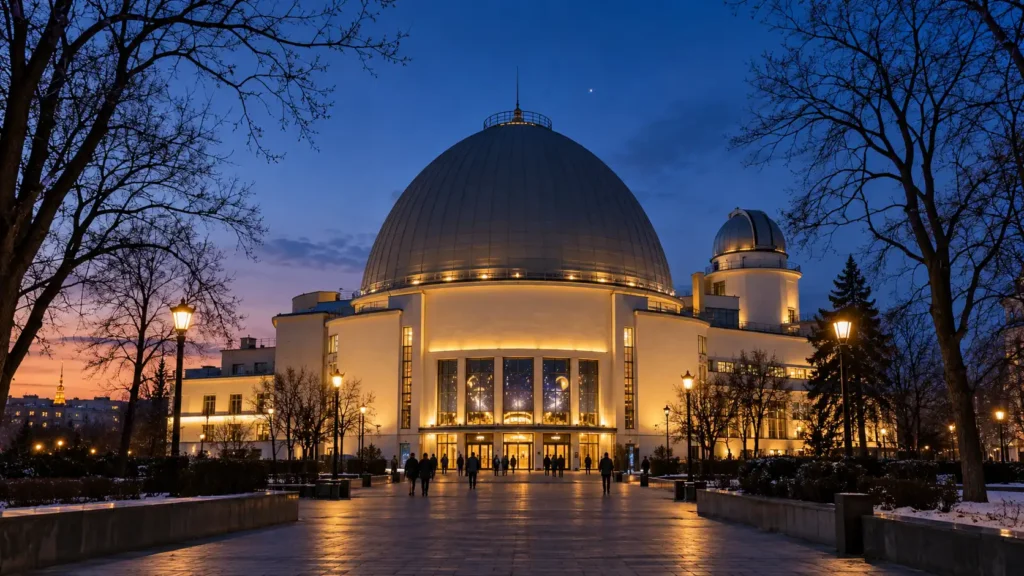
The Moscow Planetarium is the oldest in Russia, opened in 1929 near the Garden Ring and the Moscow Zoo. Moscow Planetarium tickets are sold separately for the Great Star Hall, the interactive Lunarium, the Small Star Hall and other attractions, so it helps to decide what you want before buying.
The main draw is the Great Star Hall, where a projector shows over 9,000 stars under a dome of about 25 meters. The Urania Museum is entered with the star hall ticket. This guide explains the halls, the ticket rules and how to reach it from Barrikadnaya metro station.
Quick Facts
| Russian name | Московский планетарий |
|---|---|
| Built / opened | 1929 |
| Architect(s) | M. O. Barshch and M. I. Siniavsky, with engineer G. A. Zundblat |
| Address | Sadovaya-Kudrinskaya Street 5, building 1, Moscow, Russia OpenStreetMap · Google Maps |
| District | Presnensky |
| Metro | Barrikadnaya (Line 7 (Tagansko-Krasnopresnenskaya, purple), about 3 min walk) Krasnopresnenskaya (Line 5 (Koltsevaya, brown), about 8–10 min walk) |
| Opening hours | The planetarium is open daily from 10:00 to 21:00 and closed on Tuesdays, according to most sources. An older page lists longer weekend hours.
Shows in the Great Star Hall run at set times, and the Lunarium, the 4D cinema and the observatory keep their own schedules (as of October 2026 – check the planetarium's official site, planetarium-moscow.ru). |
| Admission | Tickets are sold separately for each attraction. Older prices put the Great Star Hall, with the Urania Museum included, at about ₽₽, the Lunarium at ₽₽ and the Small Star Hall at about ₽; confirm the current prices on the official site. |
| Best time to visit | Weekday afternoons are calmer, and evenings are the busiest for the main shows. The planetarium is indoors and works in every season, which makes it a good choice for cold or wet days.
It is closed on Tuesdays. The Sky Park and the observatory depend on clear weather. |
| Recommended duration | 1.5–3 hours |
| Website | planetarium-moscow.ru |
| Last updated | October 6, 2026 |
What Is (and Isn't) Part of a Visit to Moscow Planetarium?
| Part | Status | Notes |
|---|---|---|
| Great Star Hall show | Separate ticket or institution | A timed show with its own ticket; the Urania Museum is free with it. |
| Urania Museum | Included in the standard ticket | Free for Great Star Hall ticket holders and visited before the show. |
| Lunarium interactive museum | Separate ticket or institution | A separate ticket for the hands-on museum. |
| Small Star Hall | Separate ticket or institution | A separate, lower-priced ticket for the underground dome. |
| Sky Park, open-air museum | Included in the standard ticket | Free with a Great Star Hall ticket, weather permitting. |
| Observatory and 4D cinema | Separate ticket or institution | Each has its own ticket and schedule. |
| Moscow Zoo | Outside / not part of it | The zoo's New Territory is next door; it has separate tickets and hours. |
Why Visit Moscow Planetarium?
The planetarium combines a historic building from 1929 with a thorough renovation that reopened in 2011. Its Great Star Hall has a dome of about 25 meters, among the largest in Europe, and a projector that shows over 9,000 celestial bodies and their movement through time.
The Lunarium is a hands-on museum where visitors can try experiments on astronomy and physics, and the Urania Museum has globes of the Moon, Mars and Venus, a solar system model and a collection of meteorites.
Outside, the Sky Park has an observatory and an open-air museum of ancient stargazing devices. It is a good indoor option for a wet or cold day and for families.
How Moscow Planetarium Is Laid Out
The planetarium is a round building near the Garden Ring, with several levels arranged around the central dome.
On the third level, directly under the dome, is the Great Star Hall with the main projector. Below it are the halls of the Urania Museum and part of the Lunarium, the interactive museum. On the lowest, underground level are the Small Star Hall, the 4D cinema and more Lunarium exhibits.
Outside, the Sky Park has an observatory and an open-air museum of ancient stargazing devices. A cafe and a gift shop are in the building.
A sensible plan is to arrive early, visit the Urania Museum and the Lunarium before your timed show in the Great Star Hall, and finish in the Sky Park if the weather is clear.
Highlights of Moscow Planetarium
The Great Star Hall
The main hall sits directly under the dome, and its Universarium M9 projector shows over 9,000 celestial bodies and their movement across the sky over time. The dome is about 25 meters across and is described as the biggest planetarium dome in Europe.
Shows include night-sky programs and full-dome films, and they run at set times.
Tip: Choose your seat toward the middle, since the dome fills the whole field of view.
The Lunarium
An interactive science museum where each exhibit works like a small laboratory. Visitors can launch the process of a black hole forming and try experiments on astronomy and physics.
Explanations are available in several languages, and English-speaking tours can be arranged in advance.
Tip: Allow at least an hour; the exhibits reward hands-on time.
The Urania Museum
Two halls with globes of the Earth, the Moon, Mars and Venus, a solar system model, a collection of meteorites and the history of the planetarium itself.
It is free for visitors with a Great Star Hall ticket and can be visited before the show.
Tip: Go in before your show begins, since visitors can enter it an hour before the session.
The Small Star Hall
An underground hall with a domed screen, dynamic seats and stereo projection, aimed especially at children. It shows shorter programs than the Great Star Hall.
It costs much less than the main hall and suits younger visitors.
Tip: Choose it for children under school age, who may find the main hall long.
The Sky Park and the observatory
Outside the building, the Sky Park has an observatory with telescopes and an open-air museum with modern versions of ancient stargazing devices.
The observatory has a separate ticket, while the rest of the park is free for visitors with a Great Star Hall ticket.
Tip: Check the weather and the observatory's hours before planning to use it.
The 4D cinema
A small cinema on the lower level shows science and entertainment films with added effects such as moving seats.
It has its own ticket and is a lighter alternative to the star shows.
Tip: Check the film schedule; programs change and not all are suited to young children.
Atmosphere
Inside, the planetarium is dim and cool, with a low hum from the projectors and the soft voice of the presenter filling the star hall. In the Great Star Hall the lights go down slowly, the dome turns dark blue and the stars appear one by one.
In the Lunarium and the Urania Museum the mood is more playful, with children pressing buttons, groups of students gathered around globes and the sound of explanations in several languages.
Evenings are the busiest, especially for the main shows, while weekday mornings are calmer. Outside, the Sky Park is quiet, with a view over the Garden Ring and the roofs of the neighborhood.
History of Moscow Planetarium
In 1927 a commission was set up to build a planetarium in Moscow. By then twelve planetariums had opened around the world, and Moscow’s became the thirteenth. The building was designed by the architects M. O. Barshch and M. I. Siniavsky, with the engineer G. A. Zundblat, and the foundation stone was laid on 23 September 1928, the day of the autumn equinox.
The planetarium opened to the public on 5 November 1929, with a small series of lectures that grew over the following years. In the 1930s its dome-screen could show twinkling stars, clouds, comets and the aurora, effects that were reported to be unavailable in any other planetarium until the end of the 1950s.
In 1977 the equipment was upgraded, but the building later fell into decline, and in 1994 it was closed. Years of disputes over ownership and reconstruction plans followed.
After a long and costly renovation, the planetarium reopened on 12 June 2011, Russia Day. It was visited by about one million people in its first year, and now has a Great Star Hall with the Universarium M9 projector, a Small Star Hall, the Lunarium interactive museum, the Urania Museum, a 4D cinema, a Sky Park with an observatory and a cafe.
Today the Moscow Planetarium is one of the largest and oldest in the world, and a place for both education and entertainment. Its mission is to popularize scientific knowledge, with programs in astronomy and space for children and adults.
Tickets and Booking for Moscow Planetarium
| Ticket | Price | Includes |
|---|---|---|
| Great Star Hall with the Urania Museum | About ₽₽ | A timed show under the dome, with the Urania Museum and the Sky Park; older prices, so check the current figure. |
| Lunarium | About ₽₽ | The interactive science museum; older prices, so check the current figure. |
| Small Star Hall | About ₽ | A shorter show on the domed screen on the underground level; an older price, so check the current figure. |
Buy tickets on the planetarium’s official site, planetarium-moscow.ru, or at the box office. Online sales open up to a month ahead, according to one guide, and booking in advance is advisable, especially for evening shows. If a date does not show, sales for it may not have opened yet. Tickets are non-refundable and non-exchangeable.
- Shows: entry to the Great Star Hall is by timed session.
- Urania Museum: free with a Great Star Hall ticket, visited before the show.
- English tours: guided tours of the Lunarium in English were offered with at least two weeks’ notice.
Payment options for foreign cards were not verified. Rates for Russian citizens and concessions differ. All categories are on the official site, planetarium-moscow.ru.
Plan and Book
Suggested itineraries Moscow Planetarium
1.5 hours
Arrive early and visit the Urania Museum, then watch a show in the Great Star Hall. Finish with the Sky Park if the weather is clear.
3 hours
Start in the Lunarium for about an hour, take the Great Star Hall show with the Urania Museum, then have a coffee in the cafe.
Half day
Combine the planetarium with the Moscow Zoo next door: do the Lunarium and a show in the morning, and spend the afternoon in the zoo.
How to Get to Moscow Planetarium
The planetarium stands on Sadovaya-Kudrinskaya Street, near the Garden Ring and the New Territory of the Moscow Zoo.
- Barrikadnaya (Line 7, Tagansko-Krasnopresnenskaya, purple): the closest station, about 3 minutes on foot. Leave by the last car in the direction from the center and walk past the zoo.
- Krasnopresnenskaya (Line 5, Koltsevaya, brown): about 8 to 10 minutes on foot.
A taxi can drop you at the entrance on Sadovaya-Kudrinskaya Street. Traffic on the Garden Ring is heavy at rush hour.
Accessibility
Accessibility details were not confirmed. The building has several levels, including an underground one, and the star halls have fixed seating. Contact the planetarium before visiting if you need step-free access or assistance, and check planetarium-moscow.ru for current information.
Food Nearby
The planetarium has a cafe and a gift shop. Around Barrikadnaya metro station, along Sadovaya-Kudrinskaya Street and near Tishinskaya Square there are cafes and restaurants, and the Moscow Zoo next door has food kiosks. Check opening hours before you go.
What to Bring
Bring a light layer, since the halls are cool, and a camera for the Sky Park. Large bags may need to be left in a cloakroom.
Best Views and Photo Spots of Moscow Planetarium
Planetarium building from Sadovaya-Kudrinskaya Street
The round building with its dome seen from the street, with the Garden Ring in the foreground.
Best time: Late afternoon light
Sky Park
Telescopes and ancient stargazing devices in the open air, with the dome behind them.
Best time: Clear evenings
Urania Museum globes
Globes of the Earth, the Moon, Mars and Venus under soft lighting.
Best time: Weekday mornings, when the halls are quiet
Photography Rules
Photography rules were not confirmed and often differ in the star halls, where the dark and the projection make flash and phone screens disruptive. Follow signs and staff instructions. The building and the Sky Park can be photographed from outside.
Family Suitability
The planetarium suits families, especially children from about seven, though the Small Star Hall is aimed at younger ones. The Lunarium is hands-on, and shows are timed, so arriving early helps. The halls are dark during shows, which can worry very young children. Stroller access was not confirmed.
Moscow Vibes Tips
- Visit the Urania Museum before your Great Star Hall show, when it is included and the halls are quiet.
- Choose the Lunarium for hands-on time and the Great Star Hall for the dome show; the two give very different experiences.
- Pair it with the Moscow Zoo next door for a family day, since both are a few minutes from Barrikadnaya.
- Check the sky before planning the observatory or the open-air museum, as they depend on clear weather.
- If you want an English-language tour of the Lunarium, contact the planetarium at least two weeks ahead, as older information suggests.
- Book evening shows early; they sell out first.
Explore Nearby Moscow Planetarium
Sights near Moscow Planetarium
 Moscow Zooabout 150 m away (~2 min walk) · typical visit: 2–4 hours
Main image: AI-generated illustration. It may not show the place exactly as it looks.
 Moscow Metro · typical visit: 1.5–3 hours for a tour of showcase stations
Main image: AI-generated illustration. It may not show the place exactly as it looks.
 Patriarch's Ponds Moscowabout 750 m away (~12 min walk) · typical visit: About 1 to 2 hours
Main image: AI-generated illustration. It may not show the place exactly as it looks.
 Immaculate Conception Cathedral Moscowabout 900 m away (~14 min walk) · typical visit: 1–2 hours
Main image: AI-generated illustration. It may not show the place exactly as it looks.
 Great Ascension Church Moscowabout 1.0 km away (~17 min walk) · typical visit: About 30 to 45 minutes
Main image: AI-generated illustration. It may not show the place exactly as it looks.
 Bulgakov Museum Moscowabout 1.0 km away (~17 min walk) · typical visit: About 1 hour
Main image: AI-generated illustration. It may not show the place exactly as it looks.
Metro stations near Moscow Planetarium
 Barrikadnaya Metro Stationabout 50 m away (~1 min walk)
Main image: AI-generated illustration. It may not show the place exactly as it looks.
 Krasnopresnenskaya Metro Stationabout 200 m away (~3 min walk)
Main image: AI-generated illustration. It may not show the place exactly as it looks.
Restaurants and cafes near Moscow Planetarium
 Selfieabout 400 m away (~6 min walk)
Main image: AI-generated illustration. It may not show the place exactly as it looks.
 Mr. Leeabout 500 m away (~8 min walk)
Main image: AI-generated illustration. It may not show the place exactly as it looks.
 Butlerabout 1.1 km away (~17 min walk)
Main image: AI-generated illustration. It may not show the place exactly as it looks.
 Matryoshka Restaurantabout 1.3 km away (~21 min walk)
Main image: AI-generated illustration. It may not show the place exactly as it looks.
Nightlife near Moscow Planetarium
 The Bix Barabout 1.0 km away (~17 min walk)
Main image: AI-generated illustration. It may not show the place exactly as it looks.
 16 Tons Clubabout 1.1 km away (~17 min walk)
Main image: AI-generated illustration. It may not show the place exactly as it looks.
Hotels near Moscow Planetarium
 Q-block Capsule Hotelabout 900 m away (~15 min walk)
Main image: AI-generated illustration. It may not show the place exactly as it looks.
 Arbat House Hotelabout 1.1 km away (~17 min walk)
Main image: AI-generated illustration. It may not show the place exactly as it looks.
 Hotel Pekin Moscowabout 1.1 km away (~18 min walk)
Main image: AI-generated illustration. It may not show the place exactly as it looks.
Train stations and river piers near Moscow Planetarium
 Kievsky River Pierabout 1.2 km away (~20 min walk)
Main image: AI-generated illustration. It may not show the place exactly as it looks.
 Belorussky Railway Terminalabout 1.8 km away (~30 min walk)
Main image: AI-generated illustration. It may not show the place exactly as it looks.
Events and traditions near Moscow Planetarium
 Pushkin Day and Russian Language Day in Moscowabout 1.5 km away (~25 min walk)
Main image: AI-generated illustration. It may not show the place exactly as it looks.
 Moscow Tea Party Festivalabout 1.8 km away (~29 min walk)
Main image: AI-generated illustration. It may not show the place exactly as it looks.
 Easter Gift Festival in Moscowabout 1.8 km away (~29 min walk)
Main image: AI-generated illustration. It may not show the place exactly as it looks.
Related guides
 Lotte Hotel Moscow: Five-Star Hotel by Smolenskaya and the Arbat
Main image: AI-generated illustration. It may not show the place exactly as it looks.
 Mayakovskaya Metro Station: Deyneka Mosaics and Stainless Steel Arches
Main image: AI-generated illustration. It may not show the place exactly as it looks.
 Only Love Is Above Observation Deck Moscow: Views and Tickets
Main image: AI-generated illustration. It may not show the place exactly as it looks.
 High Bar: Panoramic Cocktails on the 56th Floor of Imperia Tower
Main image: AI-generated illustration. It may not show the place exactly as it looks.
 Golden Apple: Beauty and Perfume Stores in Moscow, What to Know
Main image: AI-generated illustration. It may not show the place exactly as it looks.
Browse more: More in Presnensky · All Museums · All Sightseeing
FAQ: Moscow Planetarium
Is the Urania Museum included in the ticket?
Yes, with a Great Star Hall ticket it is free, and visitors can enter an hour before the show. See the booking section.
What is the Lunarium?
An interactive museum with hands-on exhibits on astronomy and physics, sold with its own ticket. English tours were offered with advance booking.
When was the planetarium built?
It opened on 5 November 1929 and reopened after renovation on 12 June 2011. It was the 13th planetarium in the world.
Is it closed on Tuesdays?
Most sources say it is open daily except Tuesday, from 10:00 to 21:00. Confirm on the official site before you go.
How long do I need?
At least about an hour and a half for one show and the Urania Museum, and up to three hours with the Lunarium.
Is it suitable for children?
Yes. The Small Star Hall is aimed at younger children and the Lunarium suits school-age children. A tip site suggests the planetarium is best from about age seven.
Is it near the Moscow Zoo?
Yes, it stands near the zoo's New Territory, a few minutes from Barrikadnaya metro station. See the Moscow Zoo article.
Do I need to book ahead?
It is advisable, especially for evening shows. Online sales open up to a month ahead according to one guide.
* Affiliate link: as an Amazon Associate we earn from qualifying purchases at no extra cost to you.
Discover More of Moscow with Our Travel Tips
Get practical Moscow travel tips, new destination guides and useful updates on attractions, opening hours and prices. Plan your visit with clear, helpful information delivered to your inbox.
Moscow Vibes is a one-person project. A coffee keeps it going
Last updated: October 6, 2026.
How we research and update our guides
About this guide: AI assistance and accuracy
This guide is created with the help of AI and is based on official sources where available. Mistakes can still happen. Opening hours, prices, rules and other details are given to the best of our knowledge as of the date shown and can change without notice. It offers general recommendations only, not professional, legal or travel advice. Please confirm important details with the official source before you travel; you are responsible for your own plans and decisions.
International sanctions affect payments between Russia and many other countries. In practice, cards issued in the EU, the UK, the US and several other countries often do not work in Russia, Russian cards usually do not work abroad, and some booking platforms, airlines and payment providers limit or suspend their services for Russia. The situation changes frequently. We do not give legal or financial advice, and this site does not encourage anyone to break or circumvent sanctions. Whatever you plan, you are responsible for following the laws and regulations that apply to you, including those of your country of residence and citizenship. Many travelers still organise their stay lawfully. It is worth asking your bank or payment provider what is currently permitted, contacting hotels, tour operators and carriers directly about the payment methods they accept, and checking which services are open to customers from your country. Clarify payment, cancellation and refund terms before you commit to a booking, and keep your plans flexible. Partner links on this site may not be available in every country, and prices, availability and rules in our guides can differ from what you see when you book.Paying for your trip: please read
Report an issue on this page

Take this guide with you
Get a free PDF of this guide to print or read offline: key facts, tips and a map link on a few clean pages.