
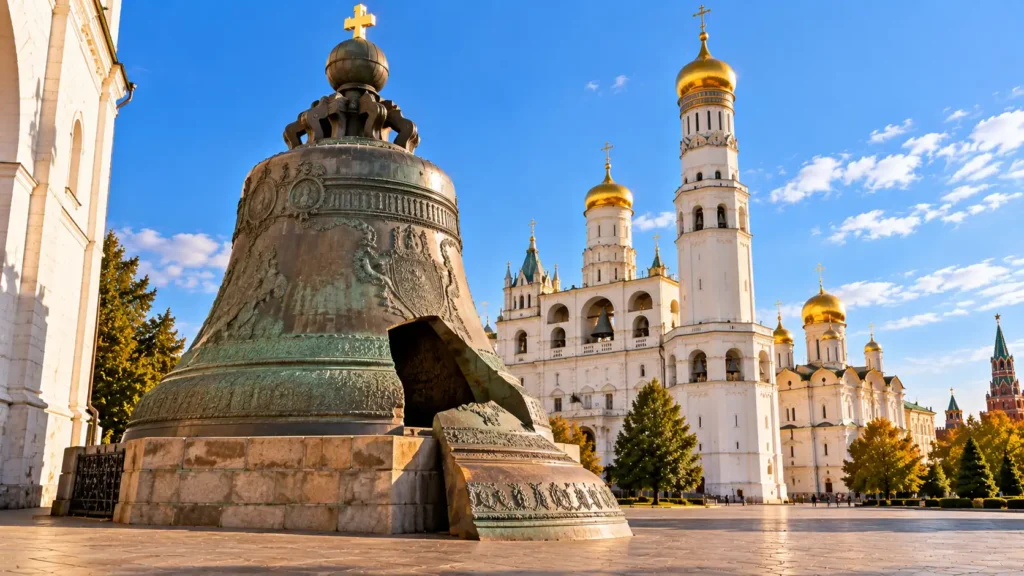
The Tsar Bell Moscow is the largest bell in the world, a bronze giant about 6 meters high that stands on a stone pedestal on Ivanovskaya Square in the Kremlin. It was cast in 1733–1735 and has never been rung, because a fire in 1737 broke a huge piece out of its side.
Visitors see it on the way to the Ivan the Great Bell Tower, with the Tsar Cannon nearby, and it is covered by the same Kremlin ticket as Cathedral Square. This guide explains the story of its casting, what to look for on its surface and where it stands.
Quick Facts
| Russian name | Царь-колокол |
|---|---|
| Built / opened | 1735 |
| Architect(s) | Ivan and Mikhail Motorin (casters); Auguste de Montferrand (pedestal and raising) |
| Address | Ivanovskaya Ploshchad, Moscow Kremlin, Moscow, Russia OpenStreetMap · Google Maps |
| District | Tverskoy |
| Metro | Alexandrovsky Sad (Line 4 (Filyovskaya, light blue), about 10 min walk including the way across the Kremlin from Kutafya Tower) Borovitskaya (Line 9 (Serpukhovsko-Timiryazevskaya, gray), about 8 min walk including the walk inside the Kremlin) Biblioteka imeni Lenina (Line 1 (Sokolnicheskaya, red), about 10 min walk including the walk inside the Kremlin) |
| Opening hours | The bell stands outdoors on Ivanovskaya Square inside the Kremlin and is seen during the opening hours of the Kremlin grounds. Cathedral Square is open daily from 9:30 to 18:00 from 15 May to 30 September and from 10:00 to 17:00 from 1 October to 14 May.
The Kremlin museums are closed on Thursdays (as of October 2026 – check the official site of the Kremlin museums, kreml.ru). |
| Admission | There is no separate ticket for the bell. It is seen with the Cathedral Square ticket of the Kremlin museums, which gives access to the grounds. Older figures for that ticket range from ₽–₽₽, so check the current price. |
| Best time to visit | The bell is an outdoor monument, so a clear day gives the best view and photographs. Weekday mornings are calmer in the Kremlin, and the square is often busiest around midday.
Summer hours are longer, from mid-May to the end of September. In winter, snow on the pedestal and the bell gives it a stark look. The Kremlin museums are closed on Thursdays. |
| Recommended duration | 10–20 minutes |
| Website | kremlin-architectural-ensemble.kreml.ru/en-Us/the-tsar-bell/view |
| Last updated | October 6, 2026 |
What Is (and Isn't) Part of a Visit to Tsar Bell Moscow?
| Part | Status | Notes |
|---|---|---|
| Tsar Bell on Ivanovskaya Square | Included in the standard ticket | An outdoor monument seen with the Cathedral Square ticket that gives access to the Kremlin grounds. |
| Broken piece of the bell | Included in the standard ticket | Lies on the ground beside the bell and can be seen from the same spot. |
| Cathedral Square and its cathedrals | Included in the standard ticket | Covered by the same ticket; see the Cathedral Square Moscow article. |
| Ivan the Great Bell Tower climb | Separate ticket or institution | A separate timed ticket, covered in its own article. |
| Armoury Chamber Moscow | Separate ticket or institution | A different museum in the Kremlin with its own ticket. |
| Tsar Cannon | Outside / not part of it | A separate monument nearby on the same square, also seen from the grounds. |
| Alexander Garden Moscow | Outside / not part of it | The free garden outside the walls where the ticket offices stand. |
Why Visit Tsar Bell Moscow?
It is a rare object that can be seen in full scale: about 202 tons, 6.14 meters high and 6.6 meters across, which is larger than most rooms.
The story is part of the attraction. The casters Ivan and Mikhail Motorin poured it in a pit on the square in 1735, and the fire of May 1737 cracked it, breaking off a piece of about 11.5 tons that now lies beside it. The bell then stayed in the pit for almost a century until it was raised in 1836.
The surface carries relief figures and decoration, and the broken piece lets you see the thickness of the bronze. It takes only a few minutes to see and is easy to combine with the rest of Cathedral Square.
Highlights of Tsar Bell Moscow
The size of the bell
The Tsar Bell is about 202 tons, 6.14 meters high and 6.6 meters across, and is considered the largest bell in the world. It was cast in 1733–1735 on the order of Empress Anna Ioannovna.
Standing next to it, visitors can judge its scale against the pedestal and the people around it.
Tip: Stand back across the square first to see the whole shape, then walk close to the pedestal.
The broken piece
In the fire of May 1737, cold water poured on the heated bell caused cracks, and a piece of about 11.5 tons broke off. The piece lies on the ground beside the bell, so you can see how thick the bronze is.
Because of the damage, the bell was never rung.
Tip: Look at the edge of the broken piece, which shows the thickness of the casting.
The relief decoration
The surface is decorated with reliefs, including, according to guides, figures of Empress Anna and Tsar Alexei Mikhailovich, as well as other images and inscriptions.
A ball-shaped decoration with a gilded cross, added by Montferrand, sits at the top.
Tip: Look at the details up close from the pedestal side, where the reliefs are easiest to see.
The pedestal
In 1836 the French-born architect Auguste de Montferrand designed a lifting structure and an octagonal sandstone pedestal. The first attempt to raise the bell failed, and an improved device finally lifted it from the pit.
Montferrand also designed Saint Isaac's Cathedral in Saint Petersburg.
Tip: Look at the octagonal shape of the pedestal, which is easy to miss when you look only at the bell.
The casting story
The bell was cast in a pit about 10 meters deep on Ivanovskaya Square, east of the bell tower. A fire during the preparation destroyed the wooden lifting structure, and Ivan Motorin died in August 1735, so his son Mikhail finished the work.
The bell was cast in November 1735 and stayed in the pit for almost a hundred years after the 1737 fire.
Tip: Imagine the pit on the open square where you are standing; it was close to the bell tower.
Next to the Ivan the Great Bell Tower
The bell stands on Ivanovskaya Square beside the Ivan the Great Bell Tower, which has the bells that do ring. The Tsar Cannon stands nearby, moved to the square in 1860.
The bell and the cannon are often described together as the Kremlin's two giants, a bell that was never rung and a cannon that was never fired.
Tip: Look for the Tsar Cannon on the same square, a short walk away.
Atmosphere
The bell is huge and calm, a dark green-bronze dome standing on a stone base in the open air. Visitors walk around it slowly, stopping to touch their hands to the air near the reliefs, and tilt their heads back to see the top.
The sound is footsteps on the paving and the voices of tour groups, with the bells of the nearby tower occasionally ringing over the square. The broken piece lies on the ground beside it like a section of a large wall.
At midday the square is crowded with groups taking photographs, and in the late afternoon it is quieter. In winter, snow gathers on the pedestal and on the bell’s rim.
History of Tsar Bell Moscow
The Tsar Bell is the third of its name. Earlier great bells hung in the wooden Ivan the Great Bell Tower, and they were destroyed by fires in the 17th and early 18th centuries. A bell cast in 1655 was shattered in the fire of 1701.
Empress Anna Ioannovna ordered a new, much larger bell cast from the remains, with an increased weight. The work was given to Russian specialists, the Moscow bell founders Ivan Motorin and his son Mikhail, after the idea of inviting a foreign master was put aside.
The bell was cast in a deep pit dug on Ivanovskaya Square, east of the Ivan the Great Bell Tower. At the end of 1734 the masters started heating the metal in specially built furnaces, but leaks were discovered, and a fire destroyed the wooden lifting structure above the bell.
The work was resumed, but Ivan Motorin died in August 1735, and his son was entrusted with it. The Tsar Bell was finally cast in November 1735, although it stayed in the pit, and its ornamentation was still being finished.
In May 1737 a major fire, known as the Trinity fire, broke out and spread to the Kremlin buildings. During the effort to put it out, cold water fell on the heated bell, and the difference in temperature caused it to crack. A piece of about 11.5 tons broke off.
Attempts to raise the bell were unsuccessful for almost a hundred years. One account says that Napoleon’s army tried to take it as a trophy in 1812 and could not, but this is not confirmed by the museum’s own account.
In 1836 the French-born architect Auguste de Montferrand designed a lifting structure and an octagonal sandstone pedestal. The first lifting failed, and an improved device finally pulled the bell out of the pit. Montferrand also designed the ball-shaped decoration with a cross at the top.
Today the Tsar Bell stands on its pedestal on Ivanovskaya Square beside the Ivan the Great Bell Tower, and the broken piece lies next to it. It has never been rung.
Legends and Myths about Tsar Bell Moscow
Napoleon tried to carry it off
Legend – historically unreliable. One account says that during his occupation of Moscow in 1812, Napoleon tried to take the bell home as a trophy but could not move it.
The story appears in travel sites but not in the Kremlin museums' own account, so it should be treated as a legend.
Voltaire's joke
Disputed by historians. A saying attributed to Voltaire calls the Kremlin's two greatest items a bell that was never rung and a cannon that was never fired.
The quotation is often repeated in guides, but its origin is uncertain, so it is treated as disputed.
Tickets and Booking for Tsar Bell Moscow
| Ticket | Price | Includes |
|---|---|---|
| Cathedral Square ticket | See the official page | Entry to the Kremlin grounds where the Tsar Bell stands, the cathedrals and the permanent exhibitions; older figures ranged from 500 to 1,100 RUB. |
₽ budget · ₽₽ moderate · ₽₽₽ upscale · ₽₽₽₽ splurge. Price levels are estimates compared with typical prices for visitors.
There is no ticket for the bell itself. Buy the Cathedral Square ticket on the official site of the Kremlin museums, tickets.kreml.ru, at the ticket offices in Alexander Garden or at the self-service terminal near the Assumption Belfry. The online booking window was not confirmed, so check the ticket page for your date; if a date does not show, sales for it may not have opened yet.
- Voucher: a voucher bought from a reseller must be exchanged for a ticket at the Kremlin museums’ offices in Alexander Garden.
- Separate tickets: the Armoury Chamber and the Bell Tower climb are sold separately.
- Entrance: the Kremlin is entered through Kutafya Tower, and the museums are closed on Thursdays.
Payment options for foreign cards were not verified, so carry some cash. Rates for Russian citizens and concessions differ. The only official ticket site is tickets.kreml.ru, and it lists all categories.
Plan and Book
Suggested Itineraries for Tsar Bell Moscow
20 minutes
Enter the Kremlin through Kutafya Tower, walk to Ivanovskaya Square and see the Tsar Bell and the broken piece. Look at the Tsar Cannon on the same square.
1.5 hours
See the Tsar Bell, then the cathedrals of Cathedral Square, starting with the Assumption Cathedral. Finish with a look at the bell tower from the middle of the square.
Half day
Combine the Tsar Bell and Cathedral Square with the Armoury Chamber at a timed session. Leave through Borovitskaya Tower and walk through Alexander Garden.
How to Get to Tsar Bell Moscow
The bell stands on Ivanovskaya Square, beside the Ivan the Great Bell Tower, in the middle of the Kremlin, which is entered through the Kutafya Tower beside Alexander Garden.
- Alexandrovsky Sad (Line 4, Filyovskaya, light blue): the exit leads directly to Alexander Garden, a 1 to 2 minute walk to the garden and about 10 minutes including the walk across the Kremlin.
- Borovitskaya (Line 9, Serpukhovsko-Timiryazevskaya, gray): about 3 minutes to the garden and the Borovitskaya Tower.
- Biblioteka imeni Lenina (Line 1, Sokolnicheskaya, red): about 3 minutes to the garden.
Buy tickets at the offices in Alexander Garden first, then enter through Kutafya Tower.
Accessibility
Accessibility details were not confirmed. The bell stands on a paved square, and the surrounding ground is mostly level, though the Kremlin has cobbles and slopes. Contact the Kremlin museums before visiting if you need step-free access or assistance, and check kreml.ru for current information.
Food Nearby
There are no restaurants on Ivanovskaya Square, and food options inside the Kremlin are limited. GUM on Red Square, a few minutes' walk from Alexander Garden, has cafes and a well-known canteen-style restaurant, and the Okhotny Ryad mall near Manezhnaya Square has food courts. Check opening hours before you go.
What to Bring
Bring a camera with a wide lens to fit the whole bell in the frame, and comfortable shoes for the cobbles. Large bags are usually not allowed in the Kremlin and may need to be left in a cloakroom.
Best Views and Photo Spots of Tsar Bell Moscow
In front of the pedestal
The whole bell on its octagonal pedestal with the broken piece beside it, a classic full-frame view.
Best time: Early in the day, before groups arrive
Bell with the bell tower behind
The dark bell in the foreground and the white shaft of the Ivan the Great Bell Tower rising behind it.
Best time: Late morning, when the sun lights the tower
Close-up of the reliefs
The figures and inscriptions on the bell's surface, shown in fine detail.
Best time: Overcast light, to reduce glare on the bronze
Bell and the Tsar Cannon
The two giants of the Kremlin in one frame on the same square.
Best time: Afternoon light
Photography Rules
Photography is allowed around the bell for personal use, and it is easy outdoors. Rules inside the cathedrals differ, so follow signs and staff instructions. Drone rules around the Kremlin are strict and change, so do not fly one here.
Family Suitability
The bell is a short, easy stop that suits families, with space for children to look and walk around. Children can compare its size with their own, and the broken piece is a good talking point. The ground is paved and suitable for strollers outdoors, though the Kremlin has cobbles and thresholds in its buildings.
Moscow Vibes Tips
- Stand well back first to see the whole bell, then walk close to the pedestal to read the details.
- Look for the 11.5-ton broken piece on the ground; it shows how thick the bronze is and is easy to overlook.
- Combine the bell with the Tsar Cannon on the same square, which makes a good pair for photographs.
- Do not look for the bell inside the Ivan the Great Bell Tower; it has never hung in it since its casting.
- Take a picture of the bell with the bell tower behind it, which gives the best sense of scale.
- Visit early in the day, since tour groups gather here around midday.
Explore Nearby Tsar Bell Moscow
Sights near Tsar Bell Moscow
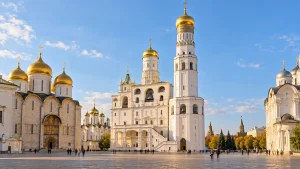 Ivan the Great Bell Tower Moscowabout 50 m away (~1 min walk) · typical visit: 1–1.5 hours for the tower
 Cathedral Square Moscowabout 50 m away (~1 min walk) · typical visit: 1.5–2.5 hours
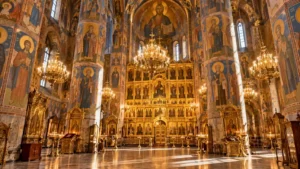 Assumption Cathedral Moscowabout 50 m away (~1 min walk) · typical visit: 30–45 minutes
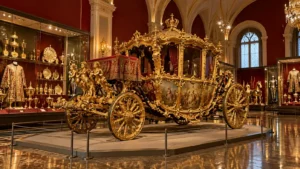 Armoury Chamber Moscowabout 350 m away (~6 min walk) · typical visit: 1.5–2 hours
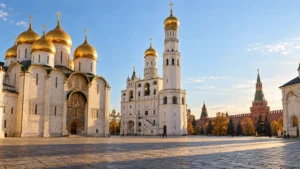 Moscow Kremlin – about 200 m away (~3 min walk) · typical visit: 3–5 hours for Cathedral Square plus the Armoury Chamber
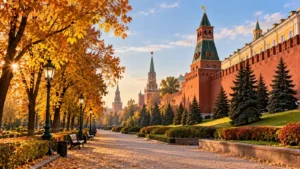 Alexander Garden Moscowabout 400 m away (~7 min walk) · typical visit: 30–60 minutes
Metro stations near Tsar Bell Moscow
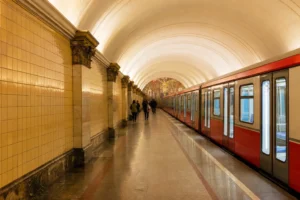 Biblioteka Imeni Lenina Metro Stationabout 550 m away (~9 min walk)
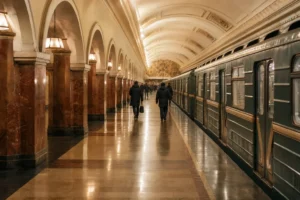 Alexandrovsky Sad Metro Stationabout 650 m away (~11 min walk)
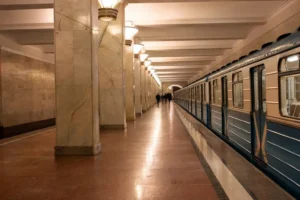 Aleksandrovsky Sad Metro Stationabout 650 m away (~11 min walk)
Restaurants and cafes near Tsar Bell Moscow
 Stolovaya 57about 500 m away (~8 min walk)
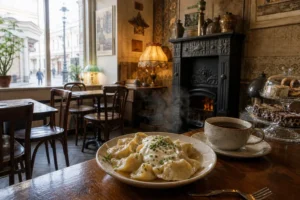 Varenichnaya No. 1about 700 m away (~11 min walk)
 WA Gardenabout 750 m away (~12 min walk)
 Krasotaabout 750 m away (~12 min walk)
Nightlife near Tsar Bell Moscow
 Rule Taproomabout 700 m away (~12 min walk)
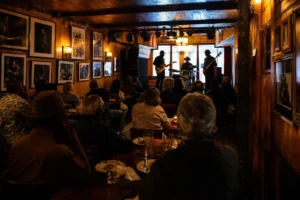 Rhythm & Blues Cafeabout 750 m away (~12 min walk)
Hotels near Tsar Bell Moscow
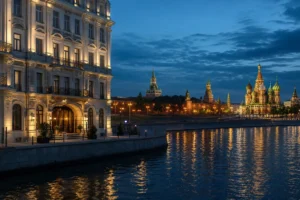 Hotel Baltschug Kempinski Moscowabout 550 m away (~9 min walk)
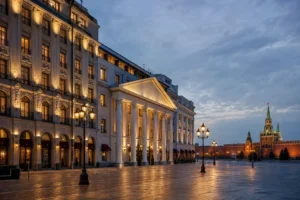 Four Seasons Hotel Moscowabout 750 m away (~12 min walk)
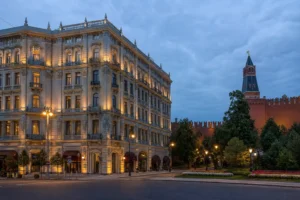 Hotel National Moscowabout 750 m away (~12 min walk)
Events and traditions near Tsar Bell Moscow
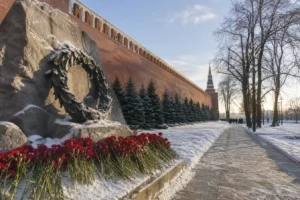 Defender of the Fatherland Day in Moscowabout 400 m away (~6 min walk)
 Spasskaya Tower Military Music Festivalabout 400 m away (~7 min walk)
 National Unity Day in Moscowabout 400 m away (~7 min walk)
Related guides
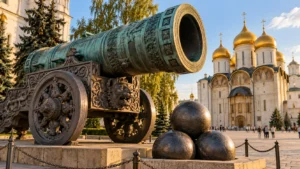 Tsar Cannon Moscow: The Kremlin’s Giant Bronze Bombard Explained
 Fasol: Franchise Convenience Stores in Moscow, Hours and Payment
 Ruki Vverh! Bar – Tverskaya: 90s Karaoke Club on Tverskaya Street
 Molodezh Nightclub: 24-Hour Bar and Club by Mendeleyevskaya
 Kadril Karaoke Club: Private Karaoke Halls Near Kuznetsky Most
Browse more: More in Tverskoy · All Landmarks · All Sightseeing
FAQ: Tsar Bell Moscow
Is the Tsar Bell the largest in the world?
Yes, it is considered the largest bell in the world, at about 202 tons, 6.14 meters high and 6.6 meters across.
Has it ever been rung?
No. It was cast in 1735 and cracked in the fire of 1737 before it could be hung, so it has never been rung.
Why is there a piece missing?
In the fire of May 1737, cold water poured on the hot bell caused cracks, and a piece of about 11.5 tons broke off. It lies beside the bell.
Do I need a separate ticket for the bell?
No. It stands on the Kremlin grounds and is seen with the Cathedral Square ticket. See the booking section.
Who made it?
The Moscow bell founders Ivan Motorin and his son Mikhail, who cast it in 1733–1735 on the order of Empress Anna Ioannovna.
Where exactly is it?
On Ivanovskaya Square, next to the Ivan the Great Bell Tower, inside the Kremlin.
How long do I need?
About 10 to 20 minutes for the bell and the cannon, longer with the rest of Cathedral Square.
When was it raised from the pit?
In 1836, by the architect Auguste de Montferrand, who placed it on an octagonal pedestal.
Discover More of Moscow with Our Travel Tips
Get practical Moscow travel tips, new destination guides and useful updates on attractions, opening hours and prices. Plan your visit with clear, helpful information delivered to your inbox.
Moscow Vibes is a one-person project. A coffee keeps it going
Last updated: October 6, 2026. Found an error or something out of date? Report it and we will check and fix it.
How we research and update our guides
About this guide: AI assistance and accuracy
This guide is created with the help of AI and is based on official sources where available. Mistakes can still happen. Opening hours, prices, rules and other details are given to the best of our knowledge as of the date shown and can change without notice. It offers general recommendations only, not professional, legal or travel advice. Please confirm important details with the official source before you travel; you are responsible for your own plans and decisions.
International sanctions affect payments between Russia and many other countries. In practice, cards issued in the EU, the UK, the US and several other countries often do not work in Russia, Russian cards usually do not work abroad, and some booking platforms, airlines and payment providers limit or suspend their services for Russia. The situation changes frequently. We do not give legal or financial advice, and this site does not encourage anyone to break or circumvent sanctions. Whatever you plan, you are responsible for following the laws and regulations that apply to you, including those of your country of residence and citizenship. Many travelers still organise their stay lawfully. It is worth asking your bank or payment provider what is currently permitted, contacting hotels, tour operators and carriers directly about the payment methods they accept, and checking which services are open to customers from your country. Clarify payment, cancellation and refund terms before you commit to a booking, and keep your plans flexible. Partner links on this site may not be available in every country, and prices, availability and rules in our guides can differ from what you see when you book.Paying for your trip: please read
Report an issue on this page
* Affiliate link: as an Amazon Associate we earn from qualifying purchases at no extra cost to you.
 Ask Masha