
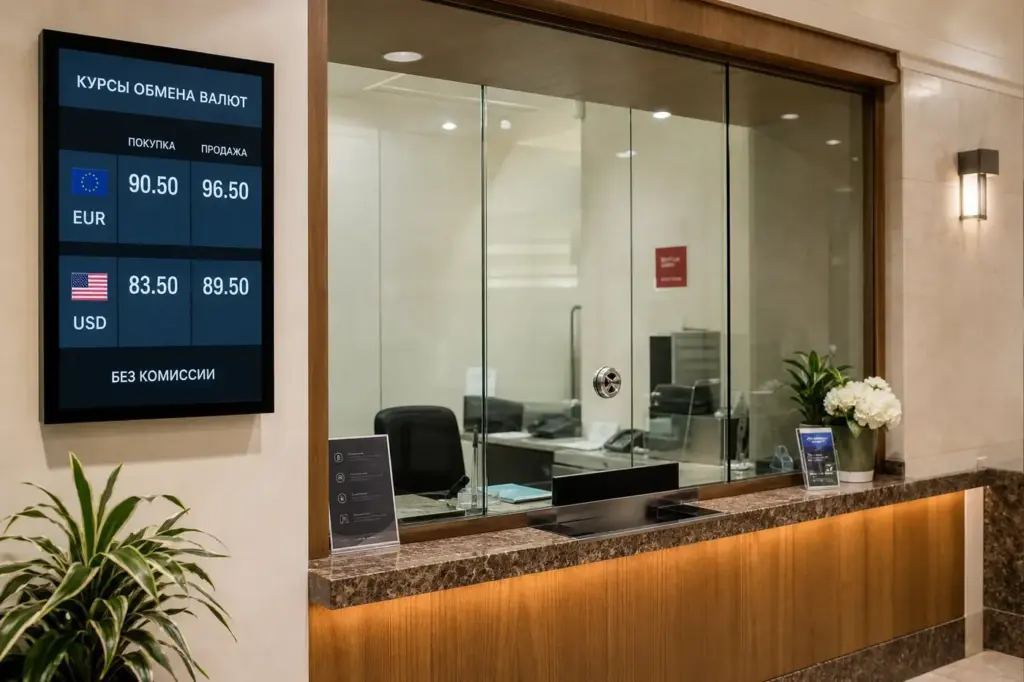
If you’re arriving in Moscow with a foreign Visa or Mastercard, your card won’t work at shops or ATMs—this changed in 2022 and remains in effect. How to pay and exchange money in Moscow requires a different approach than other cities.
This guide covers your three realistic options: bringing cash and exchanging it locally, ordering a prepaid Russian MIR card before you travel, or opening a Russian bank account on arrival. The recommended option for first-time visitors is to bring cash in crisp euros or dollars and exchange most of it at a bank in central Moscow once you arrive.
Quick answer: Bring cash in clean euro or dollar notes. Exchange a small amount at the airport and the rest at a bank branch in the city centre. The whole process takes 10–15 minutes per transaction. Cost depends on your spending; bring enough to cover your stay, typically budget to moderate pricing.
At a Glance
| Total time | 10–15 minutes per exchange at a bank; 5–10 minutes at a dedicated exchange office |
|---|---|
| Typical cost | ₽ |
What You Need Before You Start
- Cash in euros (EUR) or US dollars (USD) in good condition (no torn, worn or old-series notes)
- Valid passport (required at banks and exchange offices)
- Knowledge of your daily spending to estimate how much cash to exchange
- Phone number or email for receipts if needed
- Plan made in advance for payment methods (cash, Russian card, or hotel prepayment)
Compare Your Options
| Option | Duration | Price | Notes |
|---|---|---|---|
| Cash (euros or dollars) exchanged at banks or exchange offices | 10–15 minutes at a bank; 5–10 minutes at an exchange office | ₽ | Recommended for first-time visitors. Rates are fair in central Moscow. Avoid airports. Banks open 09:00–18:00 weekdays; exchange offices stay open later. No commission for most transactions. Requires clean banknotes and a passport. |
| YooMoney instant MIR card (ordered online before arrival) | Registration 10 minutes online before departure; card pickup 5 minutes at Sheremetyevo airport on arrival | Free | Free debit card issued to foreign tourists at airports and city offices. Load it with euros or dollars at bank ATMs and spend via card. Allows online payments and taxi apps. Requires internet access to register before travel. Some visitors find registration complex from abroad. |
| T-Bank (formerly Tinkoff) MIR card opened in Moscow on arrival | 20–30 minutes in a branch or online once you have a Russian phone number | Free | Open a Russian bank account in person with passport and phone number. Receive a MIR debit card immediately and transfer rubles to it. Takes longer than other options but useful if staying over a week. Requires a local phone number or local phone purchase first. |
| Prepay hotels, transport and tours before arrival | Varies (advance booking) | depends on bookings | Reduce cash needs by paying in advance from home. Hotels, trains, and tours accept foreign cards when booked from outside Russia. Lower daily cash needs if you prepay lodging and transport. |
| ATM withdrawal with foreign card | N/A | N/A | NOT RECOMMENDED. Foreign Visa and Mastercard issued outside Russia no longer work at Russian ATMs since 2022. Some UnionPay cards may work in limited cases; check with your bank before travel. Do not plan your trip around ATM access. |
| International money transfer services (Western Union, MoneyGram, etc.) | 30–60 minutes in a branch; 5 minutes if prepaid online | ₽₽ | Send money to yourself in advance to a Moscow branch. Receive rubles in cash. Fees apply (typically 3–5% of amount). Useful as a backup if you run out of cash. Not a primary payment method for tourists. |
₽ budget · ₽₽ moderate · ₽₽₽ upscale · ₽₽₽₽ splurge. Price levels are estimates compared with typical prices for visitors.
Step-by-Step Instructions
Step 1: Check the condition of your notes before departure
Banks in Moscow refuse torn, worn, stained or very old-series banknotes. Prepare clean, recent notes in your home country before you travel. Euros and US dollars are equally accepted. The serial numbers should be clear and the notes should have no creases, stains or damage. At the airport in Moscow, the teller will inspect notes closely.
Tip: Get new notes from your bank if yours are questionable; it's free and saves hassle.
Step 2: Exchange a small amount at the airport
Walk to the exchange area in your airport terminal (Sheremetyevo, Domodedovo or Vnukovo). Multiple exchange offices are visible from arrivals; expect queues of 5–15 minutes during busy hours. The rate offered will usually be worse than in the city, but exchange only enough for your first taxi ride, hotel check-in, and one meal (only a small amount). Get a printed receipt.
Tip: Avoid exchanging large amounts at the airport. The convenience costs more than taking a taxi to the city and finding a bank.
Step 3: Locate a major bank branch in central Moscow
Sberbank, VTB, Gazprombank and Alfa-Bank are the main options, with branches in every central district. Use Google Maps to find a branch near your hotel, metro station or a main street. Downtown branches near tourist attractions offer good rates and staff accustomed to foreign visitors. Most branches are open 09:00–18:00 on weekdays and 09:00–17:00 on Saturday; many close on Sunday.
Tip: Choose a branch in the city centre (Red Square, Arbat, near major metro stations) for the best rates and faster service.
Step 4: Enter the bank and find the currency exchange desk
Walk in during business hours. Tell staff you want to exchange euros or dollars for rubles. If the bank has a queue system, take a number. The exchange desk is usually clearly marked inside or you can ask at the information desk. Have your passport ready. Exchange offices look like small shops with a window and a rate board; approach the counter directly.
Tip: If a queue is long, check if there's a dedicated exchange office (obmen valyut) nearby—they are faster for simple exchanges.
Step 5: Present your cash and passport
Hand your banknotes and passport to the teller. For small amounts (under the declaration limit), passport is usually a formality; for larger sums, the teller may make a photocopy or note your details. The teller will verify each note for condition and count it. They will show you the exchange rate (displayed on a board at banks and offices) and tell you the ruble amount you will receive.
Tip: Ask to see the posted rate before handing over your cash. Confirm the final figure matches the calculation before accepting rubles.
Step 6: Receive rubles and verify the amount
The teller will count out your rubles in front of you. Check the amount matches what was quoted and that all notes are real (feel their texture and check watermarks; counterfeits are rare but possible). Ask for a printed receipt showing the exchange rate, date and amount. Keep this receipt with your documents.
Tip: Count the money twice before leaving the counter. The receipt protects you if any notes later prove damaged.
Step 7: Store your cash safely
Split rubles into your wallet (daily spending), a hidden pocket or hotel safe (reserve), and a money belt for backup. Never display large amounts in public. Rubles are accepted everywhere—restaurants, shops, taxis, museums, metro top-ups. For restaurants and shops, cash is still preferred by some locals, though contactless payment is common among chains.
Tip: Keep small bills for street vendors, markets and tips. Larger notes work for hotels and restaurants.
Step 8: Exchange more cash as needed
During your stay, if you run low on rubles, return to the same bank or find another exchange office. Licensed offices (obmen valyut) exist on most main streets and near metro stations; they are open longer hours than banks (often 10:00–20:00 or later). The rate and process are identical. Always use licensed offices with posted rates, never street touts or individuals.
Tip: Banks close at 18:00–19:00 on weekdays. If you need cash in the evening, locate a 24-hour exchange office in advance.
Common Mistakes to Avoid
- Exchanging large amounts of cash at the airport. Airport rates are usually worse than city rates. Exchange only a small amount at the airport for immediate needs; exchange the rest at a bank in central Moscow.
- Bringing worn, torn, stained or old-series banknotes. Banks inspect notes closely and will refuse damage. Prepare clean, recent notes before you leave home. If your notes are questionable, visit your bank and request fresh ones.
- Using street money changers or 'better rate' offers from individuals. These are common scams; short-changing and counterfeit notes are the tricks. Always use licensed banks or clearly marked exchange offices (obmen valyut) with posted rates.
- Relying solely on credit cards or ATMs. Your foreign Visa or Mastercard will not work anywhere in Moscow. Do not plan your trip assuming you'll withdraw cash from an ATM or pay by card at shops. Bring physical cash.
- Exchanging money in small amounts repeatedly. Each transaction involves waiting time. Exchange enough rubles to cover several days of spending in one visit so you minimize queues and visits to banks.
- Assuming any bank or office will exchange currency. Many small branches do not exchange currency. Before entering, confirm that the bank or office offers currency exchange (obmen valyut) by checking the window signs or asking online.
Tickets, Payment and Booking
Official sources and rules (as of October 2026):
- Major banks offering currency exchange: Sberbank (www.sberbank.ru), VTB (www.vtb.ru), Gazprombank, Alfa-Bank. Contact them directly or visit a branch to confirm hours and rates.
- Foreign cards do not work: Visa and Mastercard issued outside Russia stopped functioning in 2022. Apple Pay and Google Pay do not work for foreign visitors. Do not rely on card payments.
- Cash is required: Rubles are the only legal currency for payment in Moscow. Bring euros (EUR) or US dollars (USD) in good physical condition and exchange them at a licensed bank or exchange office.
- Payment methods accepted: Cash (rubles) is accepted everywhere. Many shops, restaurants and taxis also accept Russian bank cards (Mir network), Russian phone payments and QR codes, but these require a Russian bank account.
- Customs declaration: Amounts of cash above the official limit must be declared when entering Russia. Amounts up to this limit require no declaration.
- Rules change and vary by nationality: Your own country’s laws on exporting cash may also restrict how much you can take out. Check your home country’s regulations before departure. This guide offers factual information only and is not legal advice.
Moscow Vibes Tips
- Split your cash into three places: your wallet (daily spending), a hotel safe or money belt (reserve fund), and a hidden pocket (emergency backup). This reduces the loss if your wallet is pickpocketed.
- Ask your hotel staff for the nearest licensed exchange office (obmen valyut) on your first day. Many hotels will also exchange currency at their desk, though rates may be slightly worse than public banks.
- Compare rates between banks before exchanging large amounts. While rates are similar, some banks offer slightly better spreads than others. Check the posted rate (kurs) at multiple branches.
- Get rubles in a mix of denominations: several smaller notes for daily use, and larger notes for bigger purchases. This saves time at checkout and makes tipping easier.
- If you lose your cash, contact your hotel or the police for a report, then wire yourself money via Western Union or MoneyGram to a Moscow branch. This takes 30–60 minutes and costs a fee but works as a backup.
- In metro stations, some cashiers at the ticket window (kassir) can exchange small amounts of cash in an emergency, though rates are poor. Use this only if you run out of rubles late at night and cannot find an exchange office.
Explore Nearby How to pay and exchange money in Moscow
Related guides
 10 Best Shopping Malls in Moscow: From GUM to Aviapark and Moscow City
Main image: AI-generated illustration. It may not show the place exactly as it looks.
 Moscow in the Rain: Indoor Sightseeing Itinerary: Dry Stops and Art
Main image: AI-generated illustration. It may not show the place exactly as it looks.
 Red Square and Moscow Kremlin Walking Itinerary: Route and Timings
Main image: AI-generated illustration. It may not show the place exactly as it looks.
 Moscow Food Tour: Russian Cuisine and Local Specialties: One-Day Route
Main image: AI-generated illustration. It may not show the place exactly as it looks.
 Moscow Jewish Heritage Walking Itinerary: History, Synagogues and Museums
Main image: AI-generated illustration. It may not show the place exactly as it looks.
More guides
 Annushka Historic Tram Route A in Moscow
Main image: AI-generated illustration. It may not show the place exactly as it looks.
 Moscow Street Food Guide: Best Russian Snacks and Where to Try Them
Main image: AI-generated illustration. It may not show the place exactly as it looks.
 10 Most Beautiful Churches and Cathedrals in Moscow
Main image: AI-generated illustration. It may not show the place exactly as it looks.
Browse more: All How-To · All Money and Cards
FAQ
Will my credit card work in Moscow?
No. Foreign Visa, Mastercard, American Express and most other international cards issued outside Russia stopped working in 2022. ATMs will reject them, and shops will decline them. Bring cash (euros or dollars) to exchange for rubles, or arrange a Russian card before departure. Do not plan on using a foreign card to pay or withdraw money.
What if I only have a Visa or Mastercard from my country?
Bring cash (euros or dollars) and exchange it for rubles at a bank in Moscow. Alternatively, order a free YooMoney MIR card online before departure and pick it up at the airport, or open a T-Bank account in Moscow on arrival (requires a passport and Russian phone number). Without these, cash is your only payment method.
Can I exchange money at the airport?
Yes, but rates are poor (5–10% worse than city rates). Exchange only a small amount at the airport for your first taxi and meal. Exchange most of your cash at a bank in central Moscow once you arrive, where rates are fair and staff are experienced with tourists.
Which currencies can I exchange?
Euros (EUR) and US dollars (USD) are accepted at all banks and exchange offices. British pounds (GBP) are accepted at many large branches and exchange offices in central Moscow, especially those near tourist areas. Other currencies (yen, yuan, Swiss francs) may not be exchanged at all banks; check with your bank in advance if you have an unusual currency.
Do I need my passport to exchange money?
For small amounts (under the declaration limit), a passport is not always required, though many banks ask for one as routine. For larger amounts, a passport is mandatory and may be photocopied. Always bring your original passport when exchanging money.
Can I pay for restaurants, taxis and museums with a foreign card?
No. Foreign cards do not work at card readers in shops, restaurants or taxis. You must pay in cash (rubles) or use a Russian bank card (Mir) or phone payment linked to a Russian bank account. Pay cash everywhere as a visitor from outside Russia.
How much cash should I bring?
This depends on your spending style and how long you stay. For a week in Moscow, budget travelers typically keep to a ₽ budget per day (food, metro, museums, small attractions), while moderate travelers spend at a ₽₽ level per day. Upscale travel costs more. Bring enough to cover your entire stay plus a safety margin, or plan to exchange cash multiple times.
What if my banknotes are damaged or old?
Banks refuse torn, stained, faded or old-series notes. Get new notes from your home bank before you travel (it's free). At the airport or bank in Moscow, the teller will inspect each note and reject any with visible damage. Bring only clean, recent banknotes.
Discover More of Moscow with Our Travel Tips
Get practical Moscow travel tips, new destination guides and useful updates on attractions, opening hours and prices. Plan your visit with clear, helpful information delivered to your inbox.
Moscow Vibes is a one-person project. A coffee keeps it going
Not legal advice. This is general information for visitors. Rules on visas, entry, registration, customs and similar matters change often and can depend on your nationality. Check the official source and, if in doubt, ask your embassy or a qualified adviser.
Looking for more on this? Downtown Yekaterinburg: History, Walking Routes and What to See (Russia Vibes)
Get a free PDF of this guide to print or read offline: key facts, tips and a map link on a few clean pages.
Take this guide with you
Report an issue on this page
Paying for your trip: please read
Payments and bookings between Russia and many other countries are currently restricted. In practice, cards issued in the EU, the UK, the US and several other countries often cannot be used in Russia, Russian cards usually cannot be used abroad, and some booking platforms, airlines and payment providers limit or pause their services for Russia. The situation changes frequently.
We do not give legal or financial advice, and this site does not encourage anyone to break any rule that applies to them. Whatever you plan, you are responsible for following the laws and regulations that apply to you, including those of your country of residence and citizenship.
Many travelers still organise their stay without problems. It is worth asking your bank or payment provider what is currently possible, contacting hotels, tour operators and carriers directly about the payment methods they accept, and checking which services are open to customers from your country. Clarify payment, cancellation and refund terms before you commit to a booking, and keep your plans flexible.
Partner links on this site may not be available in every country, and prices, availability and rules in our guides can differ from what you see when you book.
How we research and update our guides
About this guide: AI assistance and accuracy
This guide is created with the help of AI and is based on official sources where available. Mistakes can still happen. Opening hours, prices, rules and other details are given to the best of our knowledge as of the date shown and can change without notice. It offers general recommendations only, not professional, legal or travel advice. Please confirm important details with the official source before you travel; you are responsible for your own plans and decisions.
* Affiliate link: as an Amazon Associate we earn from qualifying purchases at no extra cost to you.