
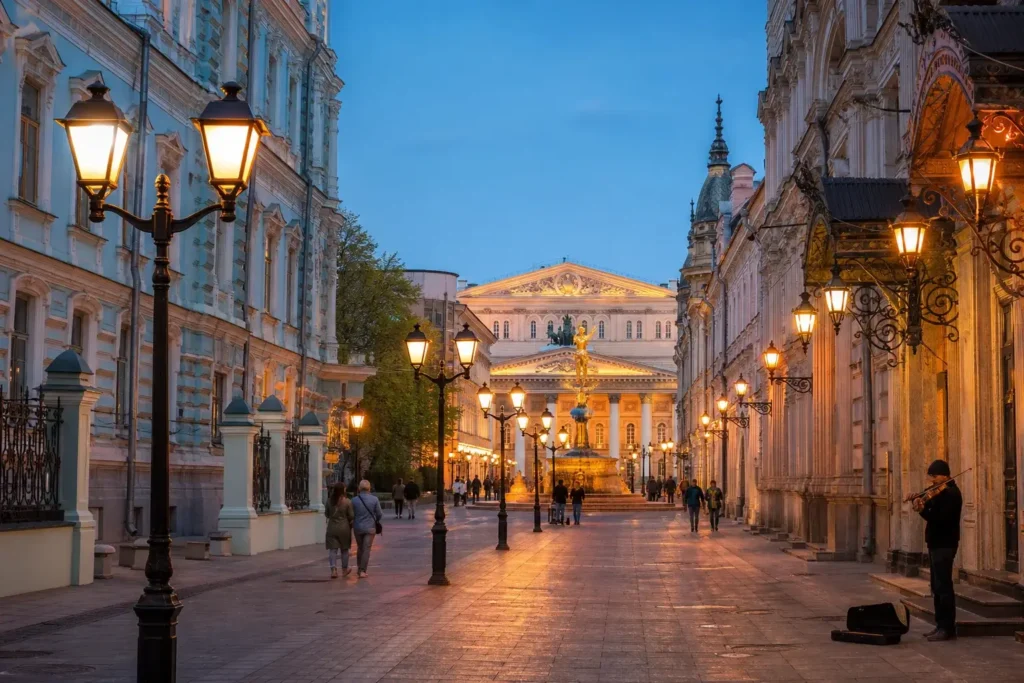
Arbat Street Moscow, usually called the Old Arbat, is a pedestrian street about one kilometer long that runs west from Arbat Square on the Boulevard Ring to Smolenskaya Square on the Garden Ring. It is one of the oldest streets of Moscow and the first one in the city to become a pedestrian zone.
The street is lined with 19th-century houses, souvenir stalls, street musicians and cafes, and its side lanes hold the quieter sights: the Tsoi Wall in Krivoarbatsky Lane, small museums and old mansions. The street is often confused with the New Arbat, a wide modern avenue built in the 1960s nearby, which is a different place.
Quick Facts
| Russian name | Арбат |
|---|---|
| Address | Arbat Street (Old Arbat), between Arbat Square and Smolenskaya Square, central Moscow |
| District | Arbat |
| Metro | Arbatskaya (Arbatsko-Pokrovskaya Line (Line 3, dark blue) and Filyovskaya Line (Line 4, light blue), At the Arbat Square end of the street; the exit and the walking time were not verified) Smolenskaya (Arbatsko-Pokrovskaya Line (Line 3, dark blue) and Filyovskaya Line (Line 4, light blue), At the Smolenskaya Square end; a guide gives about 190 meters to the Pushkin Memorial Apartment at number 53; the exit was not verified) |
| Opening hours | The street is public and open at any time; shops, cafes, museums and the theater keep their own hours. The Pushkin Memorial Apartment, for example, is closed on some weekdays, and its hours differ between sources, so check the museum's own site.
(as of October 2026 – check the official site) |
| Admission | Walking the street is free. Museums and the theater charge their own admission; the Pushkin Memorial Apartment's rates differ between sources, so check pushkinmuseum.ru. |
| Best time to visit | The street can be visited all year and is best in daylight in spring, summer and autumn, when the stalls and musicians are out. Mornings are calmer, and evenings are livelier under the lanterns. Crowd patterns were not verified. |
| Recommended duration | 2 to 3 hours |
| Last updated | October 7, 2026 |
What Is (and Isn't) Part of a Visit to Arbat?
| Part | Status | Notes |
|---|---|---|
| Old Arbat Street | Included in the standard ticket | A public pedestrian street of about 1 km that can be walked free at any time. |
| Tsoi Wall in Krivoarbatsky Lane | Included in the standard ticket | A free open-air wall in a side lane, reached on foot from the main street. |
| Pushkin Memorial Apartment (number 53) | Separate ticket or institution | A branch of the Pushkin State Museum with its own ticket and hours. |
| Andrey Bely Memorial Apartment | Separate ticket or institution | Another branch of the same museum next door, with its own ticket. |
| Vakhtangov Theatre (number 26) | Separate ticket or institution | Performances need a theater ticket; the Princess Turandot fountain in front is free. |
| House of Burganov museum | Separate ticket or institution | A museum in the lanes off the street with its own ticket and hours. |
| New Arbat | Outside / not part of it | A wide modern avenue built in the 1960s, a different street from the Old Arbat. |
| The Moscow Kremlin and Red Square | Outside / not part of it | Within walking distance but separate sights with their own guides. |
Why Visit Arbat?
The Arbat is one of the easiest places in the center to cover on foot, and it combines several kinds of Moscow in a short walk: the Vakhtangov Theatre with its Princess Turandot fountain, the house where Pushkin lived with his young wife in 1831, the graffiti-covered Tsoi Wall and a row of 19th-century buildings.
The street is also a good base for the side lanes, where old mansions and small museums are quieter than the main street. It is free to walk, has no fixed opening hours and can be combined with the Boulevard Ring or the Kremlin area. Note that the street is the most touristy of the center, with many souvenir sellers.
How Arbat Is Laid Out
The Old Arbat runs roughly west from Arbat Square, where the Arbat Gate of the old city wall once stood, to Smolenskaya Square, where it meets the Garden Ring. At the Arbat Square end are the Arbatskaya metro stations; at the other end is Smolenskaya, with the wide Smolenskaya Street continuing beyond.
Most of the sights stand along the street itself: the Vakhtangov Theatre at number 26 with the Princess Turandot fountain in front, and the Pushkin Memorial Apartment at number 53 toward the Smolenskaya end, with a monument to Pushkin and his wife across the street. Side lanes such as Krivoarbatsky Lane lead to quieter corners; the Tsoi Wall stands at the end of that lane.
A sensible route starts at Arbatskaya, walks the whole street to Smolenskaya, with a detour into Krivoarbatsky Lane, and finishes at the Pushkin apartment. Walking the other way gives the same sights in reverse order.
Highlights of Arbat
The Vakhtangov Theatre and the Princess Turandot fountain
The Vakhtangov Theatre at Arbat 26 grew out of a student studio led by Yevgeny Vakhtangov, which gave its first performance here in 1921. In front of the entrance stands a small fountain with a golden figure of Princess Turandot, named after the theater's best-known production. Performances need their own tickets. Look for the fountain at the entrance and the seven-story house opposite with two knights on its facade.
Tip: Check the theater's own site if you want to see a performance, since tickets are not sold at the fountain.
The Tsoi Wall in Krivoarbatsky Lane
The wall at the end of Krivoarbatsky Lane has been covered with graffiti and song lines in memory of Viktor Tsoi, the singer of the group Kino, since his death in 1990. It is a place where fans gather and leave messages. The wall changes constantly, so the pictures differ from visit to visit. The lane is a short detour from the main street.
Tip: Go in daylight and look at the side wall of the house rather than the street front.
The Pushkin Memorial Apartment at number 53
The poet Alexander Pushkin lived here for a few months in 1831 with his new wife Natalia Goncharova, and the house opened as a museum in 1986. It is a branch of the Pushkin State Museum, with an exhibition on Pushkin and Moscow and recreated rooms upstairs. The Andrey Bely Memorial Apartment, another branch, is next door. Each needs a ticket and has its own hours.
Tip: Check the museum's hours and closing days on its site before you go, since sources disagree.
The pedestrian street itself
The Old Arbat became a pedestrian street in 1986, according to most guides, and has distinctive street lanterns from the same time. Before that trams ran along it, and before the New Arbat was built it was part of a government route to the Kremlin. The street is lined with 19th-century houses and is crowded with musicians, portrait painters and souvenir stalls.
Tip: Walk it in the morning for a calmer view of the facades.
The Bulat Okudzhava statue
A statue of the bard and poet Bulat Okudzhava, who wrote songs about the Arbat, stands on the street. It is a small monument that many visitors pass without noticing, and it shows the street's link with Soviet-era songwriters, which also explains the Tsoi Wall. Look for it among the shop fronts.
Tip: Look for the statue on the main street, not in the side lanes.
The side lanes and the House of Burganov
The lanes off the Arbat keep older buildings than the main street, among them the museum known as the House of Burganov in the area of Krivoarbatsky Lane, according to a walking route. The lanes are quiet and give a sense of the residential Arbat of the 19th century. Check each museum's own site for hours and tickets.
Tip: Take a map and walk the lanes in a loop that returns to the main street.
Monument to Pushkin and Goncharova
Across the street from the Pushkin apartment stands a bronze statue of the poet and his wife, who married nearby and then moved into the house on the Arbat. It is a popular photo stop. The fountain rotunda dedicated to the couple on the boulevards is a separate monument.
Tip: Take the photo from the museum steps for the best angle.
Atmosphere
The Old Arbat is a pedestrian street with street lanterns, 19th-century houses of several colors and a steady flow of walkers. Street musicians, portrait painters and souvenir sellers line the way, and the sound is a mix of guitars and conversation.
By day the street is full of visitors, and in the evening the lanterns and the cafe terraces give it a different look. The side lanes are much quieter, with old mansions and small museums. The street has a reputation as the most touristy of the center, and the souvenir stalls are the most visible sign of it. The crowd varies by season and day, and no figures were verified.
History of Arbat
The Arbat is one of the oldest surviving streets of Moscow. Sources date its first mention to the 15th century, giving 1475 or 1493, and it began as a road from the Kremlin toward Smolensk. The origin of the name is uncertain, with several theories.
After the abolition of the Streltsy, the old military guard, at the end of the 17th century, and two big fires, in 1736 and 1812, the street was rebuilt as a residential street. In the 18th century the Arbat became the most prestigious residential area of Moscow, where the nobility lived, and it was almost completely destroyed by the fire of 1812 and rebuilt.
In the 19th and early 20th centuries the district became known as a street of artists, writers and academics. Alexander Pushkin lived on the street briefly in 1831 with his wife, and other writers and artists, among them Marina Tsvetaeva, Alexander Scriabin and Feodor Chaliapin, lived in the mansions along it. In 1921 the studio of Yevgeny Vakhtangov staged its first performance in the building that is now the Vakhtangov Theatre.
In the Soviet period the street was part of the route that Stalin took to the Kremlin, and trams ran along it. In the 1960s the wide New Arbat avenue was built nearby, and plans to make the Old Arbat a pedestrian street were developed in the 1970s and 1980s. In 1986 the street became the first pedestrian zone of Moscow, and distinctive street lanterns were installed. In the same year the Pushkin Memorial Apartment opened as a museum.
During Perestroika, musicians, artists and young people gathered on the Arbat, and street performers and vendors followed. After the death of the singer Viktor Tsoi in 1990, a wall in Krivoarbatsky Lane became a place for fans to leave graffiti and song lines, which has remained a symbol of the period.
In 1997 the Princess Turandot fountain was installed in front of the Vakhtangov Theatre, in the year of the city’s 850th anniversary, according to a travel site; another site gives 2007. Today the street is known for its mix of 19th-century buildings, theaters, museums and souvenir stalls, and it is one of the most visited streets of the center.
Legends and Myths about Arbat
Where the name Arbat comes from
Disputed by historians. Several theories explain the name. One links it to an Arabic word for a suburb, and a street with the same name exists in Kolomna, which is used as an argument for an old trade-route origin. None is proved, and historians have not agreed on a single explanation.
The tsar who tried to rename the street
Legend – historically unreliable. A popular story says that Tsar Alexei Mikhailovich tried to rename the street Smolenskaya, but the people kept calling it the Arbat. It is repeated in guides as an anecdote about the name's resilience, and no reliable source for it was found in the research for this guide.
Tickets and Booking for Arbat
There is no ticket for the street or the lanes. The museums and the theater sell their own tickets; for the Pushkin Memorial Apartment, use the museum’s own site, pushkinmuseum.ru. Its opening hours, closing days and ticket prices differ between the sources read, and a travel review said the museum was once closed for reconstruction, so check the site before you plan a visit. Some pages mention a late opening day and free days, which were not confirmed.
- Theater: buy Vakhtangov Theatre tickets from the theater itself; none are sold at the street.
- Payment: foreign Visa and Mastercard cards are reported not to work in Russia, and the sanctions rules of your own country may restrict some Russian payment services, so check this yourself.
Rates for Russian citizens and concessions differ; the official page for all categories is pushkinmuseum.ru.
Plan and Book
Advertisement: these are partner links. If you book or buy through them, we may earn a commission at no extra cost to you.
Suggested Itineraries for Arbat
2 hours
Start at Arbatskaya and walk the whole street toward Smolenskaya, stopping at the Vakhtangov Theatre and the Princess Turandot fountain. Make a short detour into Krivoarbatsky Lane for the Tsoi Wall and finish at the Pushkin apartment.
3 hours
Follow the 2-hour route and add a visit to the Pushkin Memorial Apartment, with a look at the monument to Pushkin and his wife opposite. Keep time for a coffee stop in one of the side lanes.
Half day
Add the Andrey Bely apartment or the House of Burganov and walk the quieter lanes off the street in a loop. End on the Boulevard Ring or walk to the Kremlin area.
How to Get to Arbat
The street runs between Arbatskaya and Smolenskaya, both metro stations on Lines 3 and 4, and the walk takes you the whole street in either direction. A guide gives about 190 meters from Smolenskaya to number 53; the exits and walking times were not verified.
- Metro: Arbatskaya for the Arbat Square end and Smolenskaya for the other end; check the exits on the station plan.
- Taxi: the street is pedestrian, so taxis stop at the ends; the taxi apps guide of this site explains the options.
Accessibility
The Old Arbat is a pedestrian street, but its surface, the steps at individual buildings and the access to the museums and the metro stations were not verified. Ask the Pushkin museum and the theater about access before you go.
Food Nearby
Cafes and restaurants line the street and its lanes. The Grand Cafe Dr. Zhivago, Turandot and Coffeemania have their own articles on this site, though their locations relative to the Arbat were not checked here; check hours and menus on site.
What to Bring
Comfortable shoes for a walk of about a kilometer on a paved street, and layers for the season. Bring rubles in cash for small purchases, since foreign cards are reported not to work.
Best Views and Photo Spots of Arbat
The Princess Turandot fountain
A small fountain with a golden figure in front of the Vakhtangov Theatre, with the theater's columns behind it. It is a clear subject with the street as a backdrop.
Best time: Morning, before the street fills.
The Tsoi Wall
A wall in Krivoarbatsky Lane covered with graffiti and song lines in many colors. The messages change, so each visit gives a different picture.
Best time: Daylight, when the colors are clear.
The street lanterns and facades
The street's lanterns and the 19th-century houses of several colors line up along a straight view. Shooting along the street gives the best sense of its length.
Best time: Evening, when the lanterns are lit.
The Pushkin monument opposite number 53
A bronze statue of the poet and his wife across from the turquoise house of the museum. The house and the monument fit in one frame.
Best time: Late afternoon light.
Photography Rules
No general photography rules for the street were found. Museums and the theater set their own rules, so look for signs and ask the staff before you photograph interiors, and avoid flash. Ask street performers before you photograph them.
Family Suitability
The street is flat, pedestrian and easy to walk with children, and street performers and the fountain are likely to appeal to them. The museums are small and may suit older children better. Stroller access at the museums was not verified.
Moscow Vibes Tips
- Start at Arbatskaya and finish at Smolenskaya, so that the Pushkin apartment is at the end of the walk.
- Do not confuse the Old Arbat with the New Arbat, a wide avenue built in the 1960s a short distance away.
- Walk into Krivoarbatsky Lane for the Tsoi Wall, which is not visible from the main street.
- Look at the seven-story house opposite the Vakhtangov Theatre, which has two knights on its facade.
- Check the Pushkin museum's closing days before you plan the walk, since the sources disagree.
- The side lanes are far quieter than the main street, so use them as a break from the crowd.
Explore Nearby Arbat
Sights near Arbat
 Vakhtangov Theatre Moscowabout 350 m away (~5 min walk) · typical visit: About 3 hours for a performance
Main image: AI-generated illustration. It may not show the place exactly as it looks.
 Melnikov House Moscowabout 550 m away (~9 min walk) · typical visit: About 1.5 to 2 hours (guided tour)
Main image: AI-generated illustration. It may not show the place exactly as it looks.
 State Museum of Oriental Art Moscowabout 650 m away (~10 min walk) · typical visit: About 1.5 to 2 hours
Main image: AI-generated illustration. It may not show the place exactly as it looks.
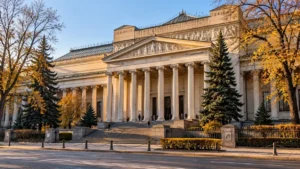 Pushkin State Museum of Fine Arts Moscowabout 700 m away (~12 min walk) · typical visit: 2–3 hours per building
Main image: AI-generated illustration. It may not show the place exactly as it looks.
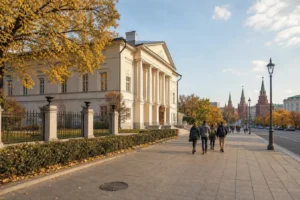 Schusev State Museum of Architecture Moscowabout 700 m away (~12 min walk) · typical visit: About 1.5 to 2 hours
Main image: AI-generated illustration. It may not show the place exactly as it looks.
 Great Ascension Church Moscowabout 750 m away (~12 min walk) · typical visit: About 30 to 45 minutes
Main image: AI-generated illustration. It may not show the place exactly as it looks.
Metro stations near Arbat
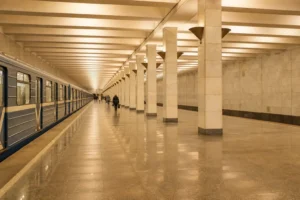 Smolenskaya Metro Stationabout 900 m away (~15 min walk)
Main image: AI-generated illustration. It may not show the place exactly as it looks.
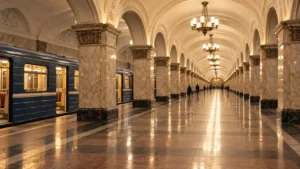 Arbatskaya Metro Stationabout 650 m away (~10 min walk)
Main image: AI-generated illustration. It may not show the place exactly as it looks.
 Borovitskaya Metro Stationabout 700 m away (~11 min walk)
Main image: AI-generated illustration. It may not show the place exactly as it looks.
Restaurants and cafes near Arbat
 Elevenabout 400 m away (~7 min walk)
Main image: AI-generated illustration. It may not show the place exactly as it looks.
 Jean-Jacquesabout 600 m away (~10 min walk)
Main image: AI-generated illustration. It may not show the place exactly as it looks.
 WA Gardenabout 850 m away (~14 min walk)
Main image: AI-generated illustration. It may not show the place exactly as it looks.
 Krasotaabout 850 m away (~14 min walk)
Main image: AI-generated illustration. It may not show the place exactly as it looks.
Nightlife near Arbat
 Rhythm & Blues Cafeabout 650 m away (~11 min walk)
Main image: AI-generated illustration. It may not show the place exactly as it looks.
 Rule Taproomabout 700 m away (~11 min walk)
Main image: AI-generated illustration. It may not show the place exactly as it looks.
Hotels near Arbat
 Bokstel Hostelabout 250 m away (~4 min walk)
Main image: AI-generated illustration. It may not show the place exactly as it looks.
 Cheers Arbat Mini-Hotelabout 650 m away (~10 min walk)
Main image: AI-generated illustration. It may not show the place exactly as it looks.
 Arbat House Hotelabout 550 m away (~9 min walk)
Main image: AI-generated illustration. It may not show the place exactly as it looks.
 Nabat Palace Arbatabout 350 m away (~6 min walk)
Main image: AI-generated illustration. It may not show the place exactly as it looks.
Train stations and river piers near Arbat
 Kievsky River Pierabout 1.8 km away (~29 min walk)
Main image: AI-generated illustration. It may not show the place exactly as it looks.
 Kievsky Railway Terminalabout 2.0 km away (~32 min walk)
Main image: AI-generated illustration. It may not show the place exactly as it looks.
Events and traditions near Arbat
 December Nights Music Festival in Moscowabout 750 m away (~12 min walk)
Main image: AI-generated illustration. It may not show the place exactly as it looks.
 Orthodox Easter in Moscowabout 900 m away (~15 min walk)
Main image: AI-generated illustration. It may not show the place exactly as it looks.
 Orthodox Christmas in Moscowabout 900 m away (~15 min walk)
Main image: AI-generated illustration. It may not show the place exactly as it looks.
Related guides
 Pushkin Memorial Apartment on Arbat Moscow: Hours, Rooms and Tips
Main image: AI-generated illustration. It may not show the place exactly as it looks.
 Stolichki Pharmacy: Moscow Branches, Hours and Payments
Main image: AI-generated illustration. It may not show the place exactly as it looks.
 Arbat and New Arbat Walking Itinerary: Route, Sights and Timings
Main image: AI-generated illustration. It may not show the place exactly as it looks.
 10 Most Impressive Soviet-Era Buildings in Moscow: Skyscrapers and More
Main image: AI-generated illustration. It may not show the place exactly as it looks.
 10 Best Squares and Streets for a Walk in Moscow: Routes and Tips
Main image: AI-generated illustration. It may not show the place exactly as it looks.
Browse more: More in Arbat · All Neighborhoods
FAQ: Arbat
What is the Arbat?
A pedestrian street about 1 km long in central Moscow, between Arbat Square and Smolenskaya Square.
Is the Arbat the same as the New Arbat?
No. The New Arbat is a wide modern avenue built in the 1960s nearby.
Is there an entrance fee?
No for the street. Museums and the theater charge their own admission.
Where is the Tsoi Wall?
At the end of Krivoarbatsky Lane, a short detour from the main street.
Which metro station is best?
Arbatskaya for the Arbat Square end, Smolenskaya for the other end.
Did Pushkin live on the Arbat?
Yes, briefly in 1831; the house at number 53 is now a museum.
When did the street become pedestrian?
In 1986, according to most guides, making it the first such street in Moscow.
How long does a visit take?
About 2 to 3 hours on foot, longer with museum visits.
Discover More of Moscow with Our Travel Tips
Get practical Moscow travel tips, new destination guides and useful updates on attractions, opening hours and prices. Plan your visit with clear, helpful information delivered to your inbox.
Moscow Vibes is a one-person project. A coffee keeps it going
Last updated: October 7, 2026. Found an error or something out of date? Report it and we will check and fix it.
How we research and update our guides
About this guide: AI assistance and accuracy
This guide is created with the help of AI and is based on official sources where available. Mistakes can still happen. Opening hours, prices, rules and other details are given to the best of our knowledge as of the date shown and can change without notice. It offers general recommendations only, not professional, legal or travel advice. Please confirm important details with the official source before you travel; you are responsible for your own plans and decisions.
International sanctions affect payments between Russia and many other countries. In practice, cards issued in the EU, the UK, the US and several other countries often do not work in Russia, Russian cards usually do not work abroad, and some booking platforms, airlines and payment providers limit or suspend their services for Russia. The situation changes frequently. We do not give legal or financial advice, and this site does not encourage anyone to break or circumvent sanctions. Whatever you plan, you are responsible for following the laws and regulations that apply to you, including those of your country of residence and citizenship. Many travelers still organise their stay lawfully. It is worth asking your bank or payment provider what is currently permitted, contacting hotels, tour operators and carriers directly about the payment methods they accept, and checking which services are open to customers from your country. Clarify payment, cancellation and refund terms before you commit to a booking, and keep your plans flexible. Partner links on this site may not be available in every country, and prices, availability and rules in our guides can differ from what you see when you book.Paying for your trip: please read
Report an issue on this page
* Affiliate link: as an Amazon Associate we earn from qualifying purchases at no extra cost to you.
 Ask Masha