

Kuskovo Estate Moscow is the former summer country house of the Sheremetev family, in the Veshnyaki District in the east of the city. The centerpiece is the Grand Palace, built between 1769 and 1775 to designs by Karl Blank for Count Pyotr Sheremetev, which faces a large pond.
Around it lies a park created between 1750 and 1780 as a formal French garden, with pavilions that include a Dutch House, an Italian House, a grotto, an orangery and a hermitage. Today the estate is a museum, home to the Russian State Museum of Ceramics, and the park is a favorite place of recreation for Muscovites. It lies near the Ryazansky Prospekt and Vykhino metro stations and suits half a day.
Quick Facts
| Russian name | Кусково |
|---|---|
| Address | Kuskovo Estate, Yunosti Street 2, Veshnyaki District, east Moscow |
| District | Veshnyaki |
| Metro | Ryazansky Prospekt (Tagansko-Krasnopresnenskaya Line (Line 7, purple), A guide gives the route as crossing the main road from this station to the park; the exit and the walking time were not verified) Vykhino (Tagansko-Krasnopresnenskaya Line (Line 7, purple), The second station listed for the estate; the exit and the walking time were not verified) |
| Opening hours | The park is free to walk in part, and one listing gives park hours of 10:00 to 20:00 in summer and 10:00 to 18:00 in winter. Museum buildings are closed on Mondays and Tuesdays in the current listing, which gives Wednesday to Sunday 10:00 to 18:00, while an older listing gave museums 10:00 to 16:00, the Hermitage 10:00 to 18:00 and a closing on the last Wednesday of the month.
(as of October 2026 – check the official site) |
| Admission | A large forest park is free, and the historic ensemble and its pavilions charge their own prices, which were not verified for this guide. A palace ticket is sold on the official site and does not include the park, according to a booking listing. |
| Best time to visit | The estate can be visited all year, and it is best on a dry day from spring to autumn, when the park and the pavilions are open. Winter gives sharp views of the formal alleys, though some pavilions close earlier. Crowd patterns were not verified. |
| Recommended duration | Half a day |
| Website | kuskovo.ru/en |
| Last updated | October 7, 2026 |
What Is (and Isn't) Part of a Visit to Kuskovo?
| Part | Status | Notes |
|---|---|---|
| Forest park and alleys | Included in the standard ticket | A large part of the park is free to walk. |
| Historic ensemble grounds | Separate ticket or institution | The fee-based area around the palace and pavilions has its own entry. |
| Grand Palace | Separate ticket or institution | Has its own ticket, which does not include the park, according to a booking listing. |
| Dutch House and Italian House | Separate ticket or institution | Small pavilions with their own tickets and hours. |
| Grotto | Separate ticket or institution | A pavilion that was reported under restoration; confirm its status. |
| Ceramics collection | Separate ticket or institution | A museum with its own hours and, in one listing, a season from May to September. |
| Ostankino Palace | Outside / not part of it | Another Sheremetev estate in the north, covered in the VDNH and Ostankino guide. |
Why Visit Kuskovo?
Kuskovo is the best surviving example in Moscow of an 18th-century noble country estate: a classical palace with a columned facade, a formal French park laid out between 1750 and 1780 and a set of small pavilions in different European styles, from a Dutch town house to an Italian villa and a shell-decorated grotto.
It also tells a Russian story, since the Sheremetevs were among the richest noble families and Catherine II visited in 1775, an event marked by an obelisk in the park. The estate has been a museum since 1919, and its ceramics collection is well known. A large part of the park is a forest for walking, so the visit can be as short or long as you like.
How Kuskovo Is Laid Out
The Grand Palace stands facing the large pond, with the formal French gardens behind it. In the far west of the main part of the gardens, on a pond linked to the large pond by a small canal, is the Dutch House, and the Grotto stands to the east of the palace. The Italian House, the Orangery and the Hermitage are among the other pavilions, and an obelisk in the park marks Catherine II’s visit of 1775.
The area is divided into two parts: a large free forest park and a smaller fee-based historic ensemble. The main address is Yunosti Street 2, and the metro stations Ryazansky Prospekt and Vykhino are the usual approach. Distances between pavilions are long, so allow time to walk.
A sensible route starts at the main entrance, goes to the palace and the pond, then walks the formal gardens to the Dutch House and the Italian House, and ends with the grotto or the forest park.
Highlights of Kuskovo
The Grand Palace
The Grand Palace was built between 1769 and 1775 under the architect Karl Blank for Count Pyotr Sheremetev. It is a two-storey classical building, in wood, with columns decorating its facade, and it faces the large pond. Its interiors have been kept in their original form, according to a guide, and the palace served for balls and receptions. It needs a ticket, which does not include the park.
Tip: See the facade from across the pond before going in.
The French park
The park of Kuskovo was created between 1750 and 1780 as a formal French garden, described as Moscow's only French park, with straight alleys, ponds and sculptures behind the palace. The estate was given to the Sheremetevs in the early 18th century, according to a guide. A large forest park beyond it is free and popular with cyclists and joggers.
Tip: Walk the straight alleys behind the palace for the symmetry of the plan.
The Dutch House
The Dutch House stands on a pond in the west of the gardens, connected to the large pond by a small canal. It was built in the middle of the 18th century in the style of a 17th-century Dutch town house, in memory of Peter the Great, who admired the Netherlands. Its brick walls show simplicity compared with the Italian pavilion. It has its own ticket.
Tip: Walk around the pond to see it reflected in the water.
The Italian House
The Italian House is a pavilion in the style of southern European architecture and is one of the estate's smaller buildings, contrasting with the modest Dutch House. It has its own ticket and hours, which were not verified. It is part of the set of pavilions that represent different European styles.
Tip: Check its hours, since small pavilions close earlier than the park.
The Grotto
The Grotto stands to the east of the palace, built from the 1750s and 1760s as a place to entertain a small group of guests on hot summer days, with decoration of shells and tufa. Dates differ between sources, and a listing of 2021 said the pavilion was under restoration, so confirm whether it is open.
Tip: Check its status on the official site before you plan to see the interior.
The ceramics collection
The estate is the home of the Russian State Museum of Ceramics, which has a large collection of Russian and foreign porcelain, glass and ceramics. The palace was nationalized in 1919, turned into a small natural history museum and renamed the State Museum of Ceramics in 1932. A listing of 2021 said the ceramics museum was open from May to September; confirm this.
Tip: Check the season and hours on the official site.
Atmosphere
Kuskovo is a place of straight alleys, still ponds and pale pavilions among old trees, with the pink-toned palace looking over the water. The sounds are birds, footsteps on gravel and, in the evenings, occasional music from concerts.
By day families, walkers and school groups spread across the large park, and the forest side is used by cyclists and joggers. In autumn the colors are strong, and in winter the formal alleys look sharp against the snow. The crowd varies by day and season, and no figures were verified.
History of Kuskovo
Kuskovo was a village that became a summer country estate of the Sheremetev family. One guide says that it was given to General Sheremetev by Peter the Great in 1715, and the park was created between 1750 and 1780 as a formal French garden. The Dutch House was built in the middle of the 18th century in memory of Peter the Great, the Grotto in the 1750s and 1760s, and the Grand Palace between 1769 and 1775, to designs by Karl Blank, for Count Pyotr Sheremetev.
The estate was a place for balls and receptions, with an Italian House, an orangery, a hermitage and a church among the buildings. Empress Catherine II visited Kuskovo in 1775, and an obelisk in the park marks the event. Another guide says that the estate was plundered by Napoleon’s troops in 1812.
In 1919 the estate was nationalized and turned into a small museum of natural history, and in 1932 it was renamed the State Museum of Ceramics. Large-scale restoration work was carried out in the 1970s and 1980s, and the estate has been a museum for almost a hundred years.
Today Kuskovo is a museum estate and a park, home to the Russian State Museum of Ceramics, and its park is a favorite place of recreation for Muscovites. A ticketed historic ensemble sits within a large free forest park, and the estate hosts concerts and events during the year. The US Embassy has traditionally held its Independence Day celebrations there, according to a guide.
The estate stands in the east of the city, in the Veshnyaki District, and it is reached by the Ryazansky Prospekt and Vykhino stations of Line 7.
Tickets and Booking for Kuskovo
A large part of the park is free, and the historic ensemble, the palace and the pavilions sell their own tickets. A booking listing shows a palace ticket on the official site that does not include park access, and a guide says that every building of interest has a QR code for fast ticket purchase, so advance booking may not be needed. No price was verified for this guide, so check the official site before you go, and see the Tretyakov Gallery and other guides on this site for other museums.
- Closing days: museums are closed on Mondays and Tuesdays in the current listing, while older listings add the last Wednesday of the month.
- Payment: foreign Visa and Mastercard cards are reported not to work in Russia, and the sanctions rules of your own country may restrict some Russian payment services, so check this yourself.
Rates for Russian citizens and concessions differ at most venues, so check the official ticket page, kuskovo.ru, for all categories.
Plan and Book
Advertisement: these are partner links. If you book or buy through them, we may earn a commission at no extra cost to you.
Suggested Itineraries for Kuskovo
2 hours
Start at the main entrance and walk to the pond and the Grand Palace. See the facade and the formal gardens, and walk to the Dutch House.
3 hours
Follow the 2-hour route and add the palace interior, planned with its hours and ticket. Return along the alleys to the Italian House.
Half day
Add the grotto, the ceramics collection and a walk in the forest park, planned with their hours. Check venue status first.
How to Get to Kuskovo
The nearest stations are Ryazansky Prospekt and Vykhino on the Tagansko-Krasnopresnenskaya Line (Line 7). A guide says to cross the main road from Ryazansky Prospekt. The address is Yunosti Street 2. The exits and walking times were not verified.
- Metro: use Ryazansky Prospekt or Vykhino; the metro guides on this site explain the lines.
- Taxi: the taxi apps guide of this site explains the options.
Accessibility
No accessibility information was found. The park paths are long and gravel in places, as far as is known, and the pavilions have stairs, so check with the museum about access before you go.
Food Nearby
Cafes and kiosks are in the park and near the metro stations. No individual venue was verified for this guide, so check opening hours and menus on site.
What to Bring
Comfortable shoes for long gravel paths, layers for the season and a camera. Bring rubles in cash for small purchases, since foreign cards are reported not to work.
Best Views and Photo Spots of Kuskovo
The Grand Palace across the pond
The columned palace reflected in the large pond, with trees on either side. The water gives a calm foreground.
Best time: Morning light.
The Dutch House on its pond
The brick Dutch House reflected in its small pond, with the canal beside it. The simple lines suit a close frame.
Best time: Late afternoon.
The formal alleys behind the palace
Straight alleys with clipped trees and sculptures leading toward the palace. The symmetry is the point.
Best time: Autumn.
Photography Rules
No general photography rules for the park were found. The palace and the pavilions set their own rules for interiors, so look for signs and ask the staff, and avoid flash. Drone rules in Moscow are strict and were not checked.
Family Suitability
The estate suits families well, with open paths, ponds and a forest park where children can run. The pavilions interest older children, and the distances are long for small ones. Stroller access in the park and the buildings was not verified.
Moscow Vibes Tips
- Plan the historic ensemble and the forest park separately, since the first is ticketed and the second is free.
- See the palace from across the pond before going in, for the full facade.
- Check whether the grotto and the ceramics collection are open, since one listing reported restoration and a seasonal opening.
- Look for the obelisk in the park that marks Catherine II's visit in 1775.
- Combine with Izmailovo or Lefortovo on another day, since distances are long.
- Do not confuse Kuskovo with Ostankino, another Sheremetev estate in the north.
Explore Nearby Kuskovo
Sights near Kuskovo
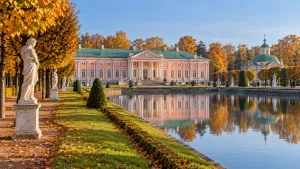 Kuskovo Estate Moscowabout 600 m away (~10 min walk) · typical visit: 2–4 hours
Main image: AI-generated illustration. It may not show the place exactly as it looks.
Related guides
 Izmailovo: Kremlin, Vernissage Market and the Romanov Estate
Main image: AI-generated illustration. It may not show the place exactly as it looks.
 Lefortovo: Catherine Palace, Lefortovo Park and Old Foreign Quarter
Main image: AI-generated illustration. It may not show the place exactly as it looks.
 Kolomenskoye: UNESCO Ascension Church, Wooden Palace and Park
Main image: AI-generated illustration. It may not show the place exactly as it looks.
 VDNH and Ostankino: Pavilions, Space Museum, TV Tower and Park
Main image: AI-generated illustration. It may not show the place exactly as it looks.
 Kuzminki Park Moscow: Golitsyn Estate, Ponds and How to Get There
Main image: AI-generated illustration. It may not show the place exactly as it looks.
Browse more: More in Veshnyaki · All Neighborhoods
FAQ: Kuskovo
What is Kuskovo?
A former summer estate of the Sheremetev family, now a museum estate and park in east Moscow.
When was the palace built?
Between 1769 and 1775, by Karl Blank for Count Pyotr Sheremetev.
Is the park free?
A large part is free; the historic ensemble and the pavilions charge.
What is the ceramics museum?
The Russian State Museum of Ceramics, which is based at the estate.
Which metro station is the nearest?
Ryazansky Prospekt or Vykhino, on Line 7.
When is Kuskovo closed?
Museums are closed on Mondays and Tuesdays in the current listing.
Is Ostankino part of Kuskovo?
How long does a visit take?
About half a day.
Discover More of Moscow with Our Travel Tips
Get practical Moscow travel tips, new destination guides and useful updates on attractions, opening hours and prices. Plan your visit with clear, helpful information delivered to your inbox.
Moscow Vibes is a one-person project. A coffee keeps it going
Last updated: October 7, 2026. Found an error or something out of date? Report it and we will check and fix it.
How we research and update our guides
About this guide: AI assistance and accuracy
This guide is created with the help of AI and is based on official sources where available. Mistakes can still happen. Opening hours, prices, rules and other details are given to the best of our knowledge as of the date shown and can change without notice. It offers general recommendations only, not professional, legal or travel advice. Please confirm important details with the official source before you travel; you are responsible for your own plans and decisions.
International sanctions affect payments between Russia and many other countries. In practice, cards issued in the EU, the UK, the US and several other countries often do not work in Russia, Russian cards usually do not work abroad, and some booking platforms, airlines and payment providers limit or suspend their services for Russia. The situation changes frequently. We do not give legal or financial advice, and this site does not encourage anyone to break or circumvent sanctions. Whatever you plan, you are responsible for following the laws and regulations that apply to you, including those of your country of residence and citizenship. Many travelers still organise their stay lawfully. It is worth asking your bank or payment provider what is currently permitted, contacting hotels, tour operators and carriers directly about the payment methods they accept, and checking which services are open to customers from your country. Clarify payment, cancellation and refund terms before you commit to a booking, and keep your plans flexible. Partner links on this site may not be available in every country, and prices, availability and rules in our guides can differ from what you see when you book.Paying for your trip: please read
Report an issue on this page
* Affiliate link: as an Amazon Associate we earn from qualifying purchases at no extra cost to you.
 Ask Masha