
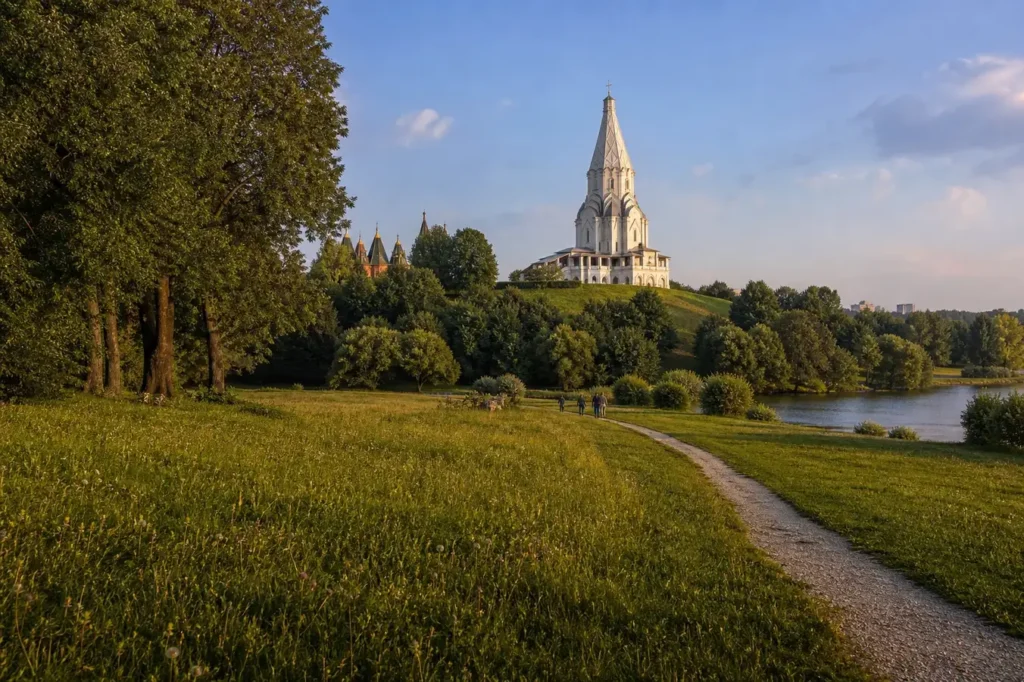
Kolomenskoye Museum Reserve is a former summer residence of the Moscow grand princes and tsars on a high bank of the Moskva River, about 10 kilometers south-east of the Kremlin. It was first mentioned in the chronicles in 1339 and holds more than 350 hectares of old woodland and park.
Its best-known sight is the Church of the Ascension, built in 1528 to 1532 for Grand Prince Vasily III to mark the birth of his heir, the future Ivan the Terrible, and inscribed on the UNESCO World Heritage List in 1994. The reserve also holds a reconstructed wooden palace of Tsar Alexei Mikhailovich, the church in Dyakovo and an open-air museum of wooden architecture. The grounds are free to walk, and the metro takes about 40 minutes from the center.
Quick Facts
| Russian name | Коломенское |
|---|---|
| Address | Kolomenskoye Museum-Reserve, Andropov Avenue 39, on the Moskva River in south Moscow |
| District | Nagatino-Sadovniki |
| Metro | Kolomenskaya (Zamoskvoretskaya Line (Line 2, green), One of the two nearest stations; a guide suggests going through the north gate toward the wooden architecture area, and one source gives about 10 minutes to the entrance; the exit was not verified) Kashirskaya (Zamoskvoretskaya Line (Line 2, green) and Bolshaya Koltsevaya Line (Line 11), The other station listed for the estate; the exit and the walking time were not verified) |
| Opening hours | The park grounds are open every day and entry to the grounds is free, according to a guide. The museums and the palace are closed on Mondays in one listing, and hours are given as 10:00 to 18:00 in one source and 9:00 to 19:00 in another, so confirm them on the official site.
(as of October 2026 – check the official site) |
| Admission | Entry to the park grounds is free. The wooden palace, the museums and the Church of the Ascension's exhibition charge their own prices, and no price was verified for this guide. |
| Best time to visit | The reserve can be visited all year, and it is best on a dry day from spring to autumn. Winter gives sharp views of the white churches. The annual Honey Fair and other festivals draw crowds, so check the calendar. Crowd patterns were not verified. |
| Recommended duration | Half a day |
| Last updated | October 7, 2026 |
What Is (and Isn't) Part of a Visit to Kolomenskoye?
| Part | Status | Notes |
|---|---|---|
| Park grounds, bluffs and paths | Included in the standard ticket | Free to enter and walk. |
| Church of the Ascension | Separate ticket or institution | A UNESCO site; the exhibition in its basement has its own ticket and hours. |
| Wooden Palace of Tsar Alexei Mikhailovich | Separate ticket or institution | A reconstruction with its own ticket. |
| Church of the Kazan Icon | Separate ticket or institution | A church with its own visiting rules. |
| Museum of Wooden Architecture | Separate ticket or institution | An open-air museum with its own rules. |
| Church in Dyakovo | Separate ticket or institution | Part of the reserve, with its own hours. |
| Lefortovo, Lyublino and Izmailovo | Outside / not part of it | Other parts of the same museum-reserve, elsewhere in Moscow, with their own guides. |
Why Visit Kolomenskoye?
Kolomenskoye shows Russian architecture before Peter the Great: the Church of the Ascension of 1532, the first tent-roofed church built in stone, standing on a bluff above the river, and the Dyakovo church of the same century, which one version calls a prototype of St. Basil’s Cathedral.
It also has the reconstructed wooden palace of Tsar Alexei Mikhailovich, once called the eighth wonder of the world, and an open-air museum of wooden buildings collected since 2008. The park is wide and green, with views of the Moskva River, and the grounds are free. It is a calm half day away from the center.
How Kolomenskoye Is Laid Out
The reserve lies on the right bank of the Moskva River, with seven entrances. From the north gate at Kolomenskaya, a path leads toward the wooden architecture area, and the park continues along the river bluffs to the Church of the Ascension, which can be seen from afar as a white tent-roofed tower.
The reconstructed wooden palace of Tsar Alexei Mikhailovich stands near the church, and the stone Church of the Kazan Icon, built under the same tsar, stands near the palace’s historic site. The Museum of Wooden Architecture, open since 2008, lies in the northern part of the reserve. The former village of Dyakovo, with the church of the Beheading of John the Baptist, lies on a hill to the south-west.
A sensible route starts at the Kolomenskaya station, goes through the wooden architecture area, follows the river path to the Church of the Ascension and the palace, and ends at Dyakovo.
Highlights of Kolomenskoye
The Church of the Ascension
The church was built in 1528 to 1532 for Vasily III in thanks for the birth of his son and heir, the future Ivan the Terrible, and it is the first tent-roofed church built in stone. It has been a UNESCO World Heritage Site since 1994. Its basement is open as a museum exhibition, and the church was last renovated in 2007, according to a guide. Hours and tickets were not verified.
Tip: See it first from the river path, where the tent-shaped roof rises above the bluff.
The Wooden Palace of Tsar Alexei Mikhailovich
The original palace, built under Tsar Alexei Mikhailovich in the 17th century, was called the eighth wonder of the world for its fairy-tale roofs and had a men's and a women's part with hundreds of rooms. It was demolished in 1768 on Catherine II's orders, and a reconstruction, built from the surviving plans, stands today. Tickets are separate, and the Moscow CityPass is reported to include it.
Tip: Plan about an hour for the palace and check its hours.
The Church of the Kazan Icon
The stone Church of the Kazan Icon of the Mother of God was built under Alexei Mikhailovich, in 1644 according to a guide, and it was originally a house church linked to the wooden palace by a covered passage. It stands near the palace's site. Its visiting rules were not verified.
Tip: Look at the church from the palace side to see how the two were connected.
The Church of the Beheading of John the Baptist in Dyakovo
The church in the former village of Dyakovo is a stone church of the 16th century on the Dyakovo hill, south-west of the Kolomenskoye hill, and was closed in 1924 and now serves worshippers again. One version calls it a prototype of the Intercession Cathedral, St. Basil's, on Red Square. It belongs to the reserve.
Tip: Allow about 25 minutes, and dress modestly if it is open for services.
The Museum of Wooden Architecture
Since 2008 an open-air museum of wooden architecture has developed on the territory of the reserve, with buildings brought from other parts of Russia, such as the gate tower of the Nikolo-Korelsky Monastery, the Bratsk fortress tower and others. It lies in the northern part, near the Kolomenskaya entrance. Hours and prices were not verified.
Tip: Enter through the north gate from Kolomenskaya to start here.
The park and the river bluffs
The reserve has more than 350 hectares of ancient woodland and meadows on a high bank of the Moskva River, with views over the river and the city. In winter it is a place for walks and, in the season, fairs and festivals, among them the annual Honey Fair. Entry to the grounds is free.
Tip: Bring a map, since the paths are long and the park has seven entrances.
Atmosphere
Kolomenskoye is quiet and open: wide meadows, old oaks and lindens, white churches on the bluff and the river far below. The sounds are birds, wind and the steps of walkers on gravel paths.
By day visitors, school groups and families spread across the large area, and the fairs and festivals bring crowds at certain times. In autumn the colors are strong, and in winter the snow gives the churches a sharp outline. The crowd varies by day and season, and no figures were verified.
History of Kolomenskoye
Kolomenskoye was first mentioned in the chronicles of Prince Ivan Kalita in 1339, and from the 14th century it was the summer residence of the Moscow grand princes and later of the Russian tsars. It lies on the bank of the Moskva River, about 10 kilometers from the Kremlin, in more than 350 hectares of ancient woodland.
In 1528 to 1532 Grand Prince Vasily III built the Church of the Ascension, a white-stone church in thanks for the birth of his heir, the future Ivan the Terrible. It was the first tent-roofed church built in stone. In the same century another church was built in Dyakovo, the Beheading of John the Baptist, and one version holds it to be a prototype of the Intercession Cathedral on Red Square.
Tsar Alexei Mikhailovich had the earlier wooden structures demolished and replaced them with a great wooden palace, famed for its fairy-tale roofs and later called the eighth wonder of the world. It was basically a summer palace but his favorite residence, with a men’s and a women’s part and hundreds of rooms. The stone Church of the Kazan Icon was built under the same tsar, in 1644 according to a guide. Peter the Great spent part of his youth here, and the future Empress Elizabeth Petrovna was born in the palace in 1709.
After the court moved to St. Petersburg the palace fell into disrepair, and on the orders of Catherine II the wooden palace was demolished in 1768 and replaced by a much more modest stone-and-brick structure. Detailed plans of the palace survived. The Dyakovo church was closed in 1924 and is now active again.
In 1994 UNESCO inscribed the Church of the Ascension on the World Heritage List. Since 2008 a museum of wooden architecture has developed in the open air on the territory of the reserve, and a reconstruction of the wooden palace, built from the old drawings, was completed in the 2010s. Kolomenskoye is now part of the Moscow State United Museum-Reserve, together with Lefortovo, Lyublino and Izmailovo, and it hosts festivals and fairs, the best known being the annual Honey Fair.
Legends and Myths about Kolomenskoye
The Dyakovo church as the model for St. Basil's
Disputed by historians. One version holds that the 16th-century stone church of the Beheading of John the Baptist in Dyakovo served as a prototype for the Intercession Cathedral, St. Basil's, on Red Square. The idea appears in guides because of the church's cluster of separate chapels around a central tower, but historians dispute it and no document confirms the link.
Tickets and Booking for Kolomenskoye
There is no ticket for the park grounds. The wooden palace, the museums and the exhibition in the Church of the Ascension sell their own tickets, and the prices were not verified for this guide. One guide says tickets bought online must be redeemed at the ticket office, and that the Moscow CityPass includes admission to the wooden palace; check this on the reserve’s own site before you go. The Tretyakov Gallery and other guides on this site cover other museums.
- Closing days: museums are closed on Mondays in one listing, though the park is open every day.
- Payment: foreign Visa and Mastercard cards are reported not to work in Russia, and the sanctions rules of your own country may restrict some Russian payment services, so check this yourself.
Rates for Russian citizens and concessions differ at most venues, so check the reserve’s own ticket page for all categories.
Plan and Book
Advertisement: these are partner links. If you book or buy through them, we may earn a commission at no extra cost to you.
Suggested Itineraries for Kolomenskoye
2 hours
Start at Kolomenskaya and walk through the north gate to the river path. See the Church of the Ascension from the bluff and the area around it.
3 hours
Follow the 2-hour route and add the wooden palace, planned with its hours and ticket. Return along the park.
Half day
Add the Museum of Wooden Architecture and the Dyakovo church, and a walk along the river bluffs. Check venue hours first.
How to Get to Kolomenskoye
The nearest stations are Kolomenskaya and Kashirskaya on the Zamoskvoretskaya Line (Line 2), about 10 minutes to the entrance according to a guide, and one guide gives about 40 minutes from downtown. A guide suggests entering through the north gate from Kolomenskaya. The exits and walking times were not verified.
- Metro: use Kolomenskaya for the north gate and the wooden architecture area; the metro guides on this site explain the lines.
- Taxi: the taxi apps guide of this site explains the options; the roads to the estate are busy.
Accessibility
No accessibility information was found. The reserve is large and the paths are long and uneven in places, as far as is known, so check with the museum about access to the palace and the churches before you go.
Food Nearby
Cafes and kiosks are in the reserve and near the entrances and the metro stations. No individual venue was verified for this guide, so check opening hours and menus on site.
What to Bring
Comfortable shoes for long gravel paths, layers for the wind on the bluff and a camera. Bring rubles in cash for small purchases, since foreign cards are reported not to work.
Best Views and Photo Spots of Kolomenskoye
The Church of the Ascension from the river path
The white tent-roofed tower rising above the bluff, with the Moskva River below. The height of the church against the sky is the point.
Best time: Late afternoon light.
The wooden palace
The fairy-tale roofs and carved details of the reconstructed palace, with trees around. The color of the wood and the roofs suits low light.
Best time: Morning light.
The bluff overlooking the Moskva River
A wide view of the river and the city beyond from the high bank. It shows why the tsars chose the site.
Best time: Sunset.
Photography Rules
No general photography rules for the park were found. The palace, the museums and the active churches set their own rules for interiors, so look for signs and ask the staff, and avoid flash. Drone rules in Moscow are strict and were not checked.
Family Suitability
The park suits families well, with wide meadows, the wooden palace and open-air buildings that children can look at. The distances are long, so small children may tire. Stroller access on the paths and in the buildings was not verified.
Moscow Vibes Tips
- Enter through the north gate from Kolomenskaya to begin with the wooden architecture area.
- See the Church of the Ascension from the river path before going close, since the view from below is the best.
- Do not confuse the reserve's reconstructed palace with the original, which was demolished in 1768.
- Bring a map, since the reserve has seven entrances and long paths.
- Check the festival calendar if you want the Honey Fair, which draws crowds.
- Combine the visit with Tsaritsyno or the Kolomna trip only on separate days, since distances are large.
Explore Nearby Kolomenskoye
Sights near Kolomenskoye
 Kolomenskoye Museum-Reserve Moscowabout 300 m away (~5 min walk) · typical visit: 2–4 hours
Main image: AI-generated illustration. It may not show the place exactly as it looks.
Metro stations near Kolomenskoye
 Kolomenskaya Metro Stationabout 1.0 km away (~16 min walk)
Main image: AI-generated illustration. It may not show the place exactly as it looks.
 Kashirskaya Metro Stationabout 2.0 km away
Main image: AI-generated illustration. It may not show the place exactly as it looks.
 Tsaritsyno Metro Stationabout 5.3 km away
Main image: AI-generated illustration. It may not show the place exactly as it looks.
Related guides
 Lefortovo: Catherine Palace, Lefortovo Park and Old Foreign Quarter
Main image: AI-generated illustration. It may not show the place exactly as it looks.
 Izmailovo: Kremlin, Vernissage Market and the Romanov Estate
Main image: AI-generated illustration. It may not show the place exactly as it looks.
 Kolomna Day Trip from Moscow: Kremlin, Pastila and the Train
Main image: AI-generated illustration. It may not show the place exactly as it looks.
 Tsaritsyno Palace and Park: Half-Day Itinerary: Palace and Fountain
Main image: AI-generated illustration. It may not show the place exactly as it looks.
 Kolomenskoye Museum-Reserve: Half-Day Itinerary: Church, Palace, Park
Main image: AI-generated illustration. It may not show the place exactly as it looks.
Browse more: More in Nagatino-Sadovniki · All Neighborhoods
FAQ: Kolomenskoye
What is Kolomenskoye?
A former royal estate on the Moskva River, now a museum-reserve and park.
Why is it a UNESCO site?
The Church of the Ascension of 1532 was inscribed in 1994 as an early tent-roofed stone church.
Is the wooden palace original?
No, the original was demolished in 1768; the present palace is a reconstruction.
Is entry free?
Entry to the grounds is free; the palace and museums charge.
Which metro station is the nearest?
Kolomenskaya or Kashirskaya, on Line 2.
Is it the same as Kolomna?
No, Kolomna is a separate town outside Moscow, covered by its own guide.
When are the museums closed?
One listing gives Mondays; check the official site.
How long does a visit take?
About half a day.
Discover More of Moscow with Our Travel Tips
Get practical Moscow travel tips, new destination guides and useful updates on attractions, opening hours and prices. Plan your visit with clear, helpful information delivered to your inbox.
Moscow Vibes is a one-person project. A coffee keeps it going
Last updated: October 7, 2026. Found an error or something out of date? Report it and we will check and fix it.
How we research and update our guides
About this guide: AI assistance and accuracy
This guide is created with the help of AI and is based on official sources where available. Mistakes can still happen. Opening hours, prices, rules and other details are given to the best of our knowledge as of the date shown and can change without notice. It offers general recommendations only, not professional, legal or travel advice. Please confirm important details with the official source before you travel; you are responsible for your own plans and decisions.
International sanctions affect payments between Russia and many other countries. In practice, cards issued in the EU, the UK, the US and several other countries often do not work in Russia, Russian cards usually do not work abroad, and some booking platforms, airlines and payment providers limit or suspend their services for Russia. The situation changes frequently. We do not give legal or financial advice, and this site does not encourage anyone to break or circumvent sanctions. Whatever you plan, you are responsible for following the laws and regulations that apply to you, including those of your country of residence and citizenship. Many travelers still organise their stay lawfully. It is worth asking your bank or payment provider what is currently permitted, contacting hotels, tour operators and carriers directly about the payment methods they accept, and checking which services are open to customers from your country. Clarify payment, cancellation and refund terms before you commit to a booking, and keep your plans flexible. Partner links on this site may not be available in every country, and prices, availability and rules in our guides can differ from what you see when you book.Paying for your trip: please read
Report an issue on this page
* Affiliate link: as an Amazon Associate we earn from qualifying purchases at no extra cost to you.
 Ask Masha