
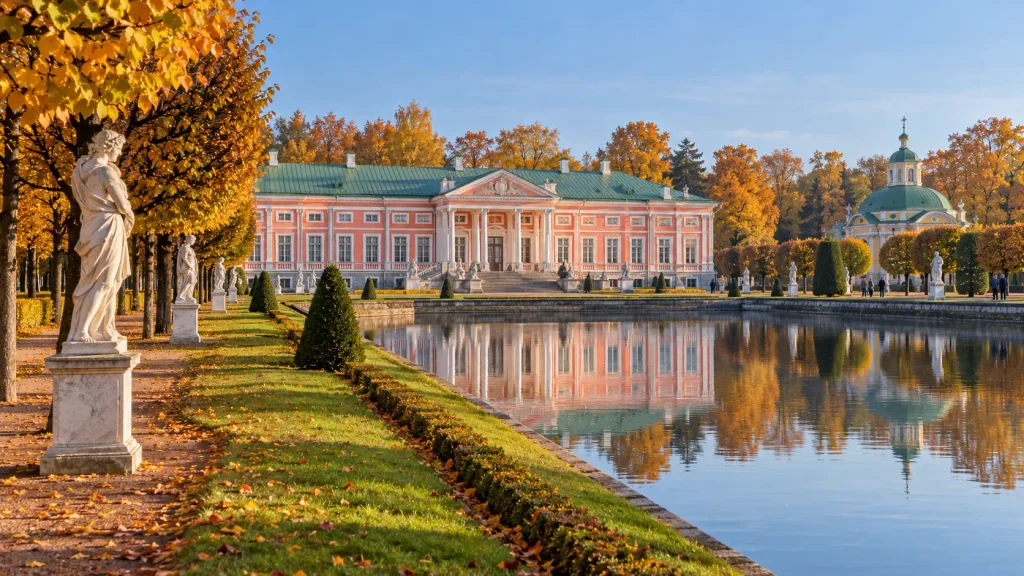
Kuskovo Estate Moscow is the 18th-century summer estate of the Sheremetev counts in the east of the city, with a salmon-pink wooden palace and a formal French park around a large pond. Kuskovo Estate Moscow tickets are sold separately for the palace, the Grotto, the Italian and Dutch houses and the ceramics exhibitions.
It lies far from the center and is reached by metro and a short bus ride, which is why many visitors plan half a day for it. This guide explains what each building offers, what is free, and how to reach it.
Quick Facts
| Russian name | Усадьба Кусково |
|---|---|
| Built / opened | 1775 |
| Architect(s) | Karl Blank, with serf architects |
| Address | Yunosti Street 2, building 1, Moscow, Russia OpenStreetMap · Google Maps |
| District | Veshnyaki |
| Metro | Ryazansky Prospekt (Line 7 (Tagansko-Krasnopresnenskaya, purple), then a bus (133 or minibus 208) to the Kuskovo stop, plus a short walk) Novogireevo (Line 8 (Kalininsko-Solntsevskaya, yellow), a walk or short taxi ride; check your map for the best route) |
| Opening hours | The park is reported open roughly from 10:00 to 18:00, with longer hours in summer on some sources. The palace and pavilions are open about 10:00 to 18:00 in the warm season, with the ticket office closing at 17:30, and about 10:00 to 16:00 from mid-October to mid-April.
One source says the estate is closed on Monday and Tuesday, and the fountains are off from October to April (as of October 2026 – check the official site, kuskovo.ru). |
| Admission | The park is free to enter on one guide, while another lists ₽. The buildings are priced separately: the palace about ₽, the Grotto about ₽ and the Italian and Dutch houses about ₽ each, with a photography fee of about ₽ reported. Prices differ by source, so check the current figures. |
| Best time to visit | Late spring to early autumn is the best time, when the park is green and the fountains run. Weekday mornings are calm, and weekends bring families and walkers.
One source says the estate is closed on Monday and Tuesday, and winter hours are shorter. The fountains are turned off from October to April. |
| Recommended duration | 2–4 hours |
| Website | kuskovo.ru/en |
| Last updated | October 6, 2026 |
What Is (and Isn't) Part of a Visit to Kuskovo Estate Moscow?
| Part | Status | Notes |
|---|---|---|
| French park and pond | Included in the standard ticket | Open for walks, free on one guide and ₽ on another. |
| Grand Palace | Separate ticket or institution | A separate ticket, about ₽ on one guide. |
| Grotto | Separate ticket or institution | A separate ticket, about ₽ on one guide. |
| Italian and Dutch houses | Separate ticket or institution | Each has its own ticket, about ₽. |
| Orangery and Museum of Ceramics | Separate ticket or institution | Exhibitions with their own hours and tickets. |
| Church of the Merciful Savior | Included in the standard ticket | A working church in the grounds; visits follow the church's own rules. |
| Izmailovo Kremlin Moscow | Outside / not part of it | A different attraction in the east of the city, not part of Kuskovo. |
Why Visit Kuskovo Estate Moscow?
Kuskovo is the best preserved noble estate in Moscow, built by Count Pyotr Sheremetev as a place for banquets, theatre and celebrations. Its wooden palace, finished in 1775, looks like stone and keeps interiors from 1779.
The park is Moscow’s only French formal park, with straight avenues, a large pond and marble statues, and it is dotted with pavilions: the shell-and-tuff Grotto, the Italian House, the Dutch House and the Hermitage.
The Museum of Ceramics, in the old Orangery, is the only museum in Russia devoted to ceramics. The park is a favorite place for Muscovites to walk, so the estate is lively in summer.
How Kuskovo Estate Moscow Is Laid Out
Kuskovo is a large estate in east Moscow, with a formal French park laid out around a main axis that leads from the palace to a long rectangular pond.
The Grand Palace stands at the head of the pond, with the church beside it. Around the park, pavilions are set among the avenues: the Grotto to the east of the palace, the Italian House just behind it, the Dutch House in the west beside a small pond, and the Hermitage. The Orangery, which holds exhibitions of the Museum of Ceramics, stands in the grounds.
The entrance is on Yunosti Street.
A sensible route is to walk through the park to the palace, see its rooms, then follow the pond to the Grotto and the Italian House, and finish with the Dutch House and the Ceramics Museum.
Highlights of Kuskovo Estate Moscow
The Grand Palace
A single-storey palace of salmon pink and white, built in 1769–1775 for Count Pyotr Sheremetev. It looks like stone but is made of wood, and it is a rare example of wooden neoclassical architecture.
Karl Blank was the chief architect, working with serf architects and craftsmen, and the rich interiors have remained largely unchanged since 1779.
Tip: Look at the wall surfaces up close; the wooden structure is painted to look like stone.
The French park and pond
A formal park laid out between 1750 and 1780, with straight avenues, a large pond and marble statues, described as Moscow's only French park.
It is open for walks, and the fountains run in the warm season and are turned off from October to April.
Tip: Walk the main axis from the palace to the end of the pond for the best view back at the building.
The Grotto
A pavilion built in 1755–1761 and decorated inside and out with shells and tuff. It was meant for entertaining small groups of guests on hot summer days, staying cool in summer and warm in winter.
It has its own ticket, reported at about ₽.
Tip: Look at the walls and ceiling, which are covered with shells arranged in patterns.
The Italian House
A small villa built in 1754–55 in the style of a 17th-century Italian palazzo, standing beside the Italian Pond behind the Grotto.
Its second floor was intended for intimate receptions and the display of Italian art from the Sheremetev collection.
Tip: Check its opening hours first; the small houses close earlier than the park.
The Dutch House
A brick house in the style of a 17th-century Dutch town house, built in 1749–51 on a small pond in memory of Peter the Great, who admired the Netherlands.
It is simple and modest compared with the Italian House.
Tip: Look at the red brick and tiled details, which contrast with the pink palace.
The Orangery and the Museum of Ceramics
The Orangery houses exhibitions of the Museum of Ceramics, Russia's only specialized museum of ceramics, and the estate's Portrait Gallery.
The palace became a museum in 1919 and was named the State Museum of Ceramics in 1932, and the collection includes Russian and foreign porcelain, glass and ceramics.
Tip: Check which halls are open; the ceramics exhibitions may keep different hours.
The Hermitage and the church
The Hermitage is a small pavilion in the park where the family could dine in privacy, and the Church of the Merciful Savior stands beside the palace.
They add detail to the estate and are quieter than the main sights.
Tip: Take the side paths to find them; most visitors stay on the main axis.
Atmosphere
The estate feels calm and ordered, with straight gravel avenues lined with trimmed trees and marble statues, and a long pond reflecting the pink palace. In summer the park is full of Muscovites walking, cycling and picnicking, and the fountains give a soft sound.
Inside the palace, the rooms are small and rich, with painted ceilings, gilded frames and polished floors, and visitors move slowly in soft shoes.
In the autumn, leaves cover the paths and the park is quieter. In winter, the fountains are off and the pond is frozen, and the pink palace stands bright against the snow.
History of Kuskovo Estate Moscow
Kuskovo was a village in the southeast of Moscow, razed during the Polish invasion of 1611 and later used as a hunting reserve. Count Boris Sheremetev, one of Peter the Great’s leading generals, decided to build a summer home here.
The estate that visitors see today was the life’s work of his son Pyotr Sheremetev, who devoted his wealth to his home and to the theatre. Serf architects and craftsmen were employed to create it, and the work was overseen by the Moscow architect Karl Blank.
The Dutch House was built in 1749–51, in memory of Peter the Great. The formal park was laid out between 1750 and 1780, and the Italian House followed in 1754–55 and the Grotto in 1755–61. The Grand Palace, a wooden building in the neoclassical style, was built in 1769–1775.
Empress Catherine II visited the estate in 1775, and an obelisk in the park marks the event. The estate was used for banquets, theatre performances and festivals, and became known as the Versailles of Moscow.
The Sheremetevs kept the estate until the Revolution. The last private owner, Sergei Dmitrievich Sheremetev, built a chalet-style house for himself in the grounds.
In 1919 the estate was nationalized and the palace became a small museum of natural history. In 1932 it was renamed the State Museum of Ceramics, which remains in the estate today.
Today Kuskovo is a museum estate and a park. The palace and pavilions can be visited with tickets, and the park is a favorite place for Muscovites to walk, especially in summer.
Tickets and Booking for Kuskovo Estate Moscow
| Ticket | Price | Includes |
|---|---|---|
| Park entry | Free | Walking in the French park and around the pond; sources differ, so check the current price. |
| Grand Palace | ₽₽ | The palace interiors; a guide gives this figure, so confirm the current price. |
| Grotto | ₽₽ | The shell-and-tuff pavilion; reduced prices exist. |
| Italian or Dutch House | ₽ | One pavilion visit per ticket; prices differ by source. |
| Photography permit | ₽ | A fee reported for taking photographs inside the buildings; unverified. |
₽ budget · ₽₽ moderate · ₽₽₽ upscale · ₽₽₽₽ splurge. Price levels are estimates compared with typical prices for visitors.
Buy tickets at the ticket offices at the entrance or on the estate’s official site, kuskovo.ru. One visitor comment recommends booking online beforehand to avoid lines. The online booking window and ID rules were not confirmed, so check the ticket page for your date; if a date does not show, sales for it may not have opened yet.
- Separate tickets: the palace, the Grotto, each pavilion and the ceramics exhibitions are priced separately.
- Closing times: the ticket office is reported to close at 17:30 in the warm season, and the buildings close earlier in winter.
Payment options for foreign cards were not verified, so carry some cash. Rates for Russian citizens and concessions differ, with reduced prices listed for some pavilions. All categories are on the official site, kuskovo.ru.
Plan and Book
Suggested itineraries Kuskovo Estate Moscow
2 hours
Walk through the park to the Grand Palace and see its rooms. Follow the pond to the Grotto and finish with a walk back along the avenues.
3–4 hours
See the palace, the Grotto and the Italian House, then walk around the pond to the Dutch House. Visit the ceramics exhibitions in the Orangery and have a coffee.
Half day
Spend the morning in the palace and pavilions, then have lunch nearby. Spend the afternoon in the French park and the Ceramics Museum before returning to the metro.
How to Get to Kuskovo Estate Moscow
Kuskovo is in the east of Moscow, about 30 to 45 minutes from the center by metro and bus.
- Ryazansky Prospekt (Line 7, Tagansko-Krasnopresnenskaya, purple): the usual route, then bus 133 or minibus 208 to the Kuskovo stop, plus a short walk to the entrance on Yunosti Street.
- Novogireevo (Line 8, Kalininsko-Solntsevskaya, yellow): reported as another option, by a walk or short taxi ride.
Bus numbers and stops change, so check a map app before you go. A taxi from either station is the simplest option.
Accessibility
Accessibility details were not confirmed. The park has long gravel avenues, and the palace and pavilions are historic buildings with steps and thresholds. Contact the estate before visiting if you need step-free access or assistance, and check kuskovo.ru for current information.
Food Nearby
There are cafes and kiosks in and around the park, though their hours and menus were not confirmed. One travel listing names a few restaurants a short walk from the estate, including an Italian restaurant and a Japanese restaurant. Check opening hours before you go.
What to Bring
Bring comfortable shoes for gravel paths and a layer for the wind by the pond. In summer, bring sun protection and water, since shade is limited on the main axis.
Best Views and Photo Spots of Kuskovo Estate Moscow
End of the pond looking at the palace
The pink palace reflected in the long pond, with the avenues framing it on both sides.
Best time: Early morning, with calm water
Main avenue with statues
Rows of marble statues and trimmed trees leading the eye toward the palace.
Best time: Late afternoon light
Grotto exterior
The shell and tuff facade of the Grotto, with the textures in sharp detail.
Best time: Overcast light
Dutch House on its pond
The red brick house reflected in a small pond with trees around it.
Best time: Autumn, when the leaves change color
Photography Rules
Photography in the park is free. Inside the buildings, a fee of about ₽ was reported, and rules can differ by building, so follow signs and staff instructions and avoid flash. Drone rules in Moscow are strict and change, so check before flying one.
Family Suitability
Kuskovo suits families, with a large park, avenues for walking and cycling and a pond to see. Children can enjoy the palace and the Grotto, though the rooms involve a lot of standing and walking. The paths are suitable for strollers in the park, but access inside the historic buildings was not confirmed.
Moscow Vibes Tips
- Check which pavilions are open on the day before you go; the small houses and the Grotto close earlier than the park.
- Walk the main axis from the palace to the end of the pond to see the French park as it was meant to be seen.
- Look at the palace walls closely; the pink building is made of wood, not stone.
- Plan a bus or taxi for the way in; the estate is a short trip beyond the metro stations.
- Go in late spring to early autumn when the fountains run; in winter the park is quieter but the fountains are off.
- Combine the Grotto and the Italian House, which stand next to each other at the east side of the park.
Explore Nearby Kuskovo Estate Moscow
Sights near Kuskovo Estate Moscow
 Moscow Metro · typical visit: 1.5–3 hours for a tour of showcase stations
Main image: AI-generated illustration. It may not show the place exactly as it looks.
Related guides
 Kuskovo: Sheremetev Palace, French Park and Pavilions in East Moscow
Main image: AI-generated illustration. It may not show the place exactly as it looks.
Browse more: More in Veshnyaki · All Landmarks · All Sightseeing
FAQ: Kuskovo Estate Moscow
Is Kuskovo free?
The park is free on one guide and ₽ on another. The palace, the Grotto and the pavilions have their own tickets. See the booking section.
Why is it called the Versailles of Moscow?
Because of its formal French park and its palace, built for banquets and celebrations by the Sheremetev counts in the 18th century.
Is the palace really made of wood?
Yes. It looks like stone but is a wooden neoclassical building, finished in 1775.
What is in the Museum of Ceramics?
Russian and foreign porcelain, glass and ceramics. It is Russia's only specialized museum of ceramics and has exhibitions in the Orangery.
How long do I need?
About two to four hours, depending on how many buildings you visit.
When is it closed?
One source says Monday and Tuesday. Hours also differ by season, so check the official site before you go.
Do the fountains run all year?
No. They are turned off from October to April.
How do I get there?
By metro to Ryazansky Prospekt, then bus 133 or minibus 208, or by taxi. See the getting there section.
* Affiliate link: as an Amazon Associate we earn from qualifying purchases at no extra cost to you.
Discover More of Moscow with Our Travel Tips
Get practical Moscow travel tips, new destination guides and useful updates on attractions, opening hours and prices. Plan your visit with clear, helpful information delivered to your inbox.
Moscow Vibes is a one-person project. A coffee keeps it going
Last updated: October 6, 2026.
How we research and update our guides
About this guide: AI assistance and accuracy
This guide is created with the help of AI and is based on official sources where available. Mistakes can still happen. Opening hours, prices, rules and other details are given to the best of our knowledge as of the date shown and can change without notice. It offers general recommendations only, not professional, legal or travel advice. Please confirm important details with the official source before you travel; you are responsible for your own plans and decisions.
International sanctions affect payments between Russia and many other countries. In practice, cards issued in the EU, the UK, the US and several other countries often do not work in Russia, Russian cards usually do not work abroad, and some booking platforms, airlines and payment providers limit or suspend their services for Russia. The situation changes frequently. We do not give legal or financial advice, and this site does not encourage anyone to break or circumvent sanctions. Whatever you plan, you are responsible for following the laws and regulations that apply to you, including those of your country of residence and citizenship. Many travelers still organise their stay lawfully. It is worth asking your bank or payment provider what is currently permitted, contacting hotels, tour operators and carriers directly about the payment methods they accept, and checking which services are open to customers from your country. Clarify payment, cancellation and refund terms before you commit to a booking, and keep your plans flexible. Partner links on this site may not be available in every country, and prices, availability and rules in our guides can differ from what you see when you book.Paying for your trip: please read
Report an issue on this page

Take this guide with you
Get a free PDF of this guide to print or read offline: key facts, tips and a map link on a few clean pages.