
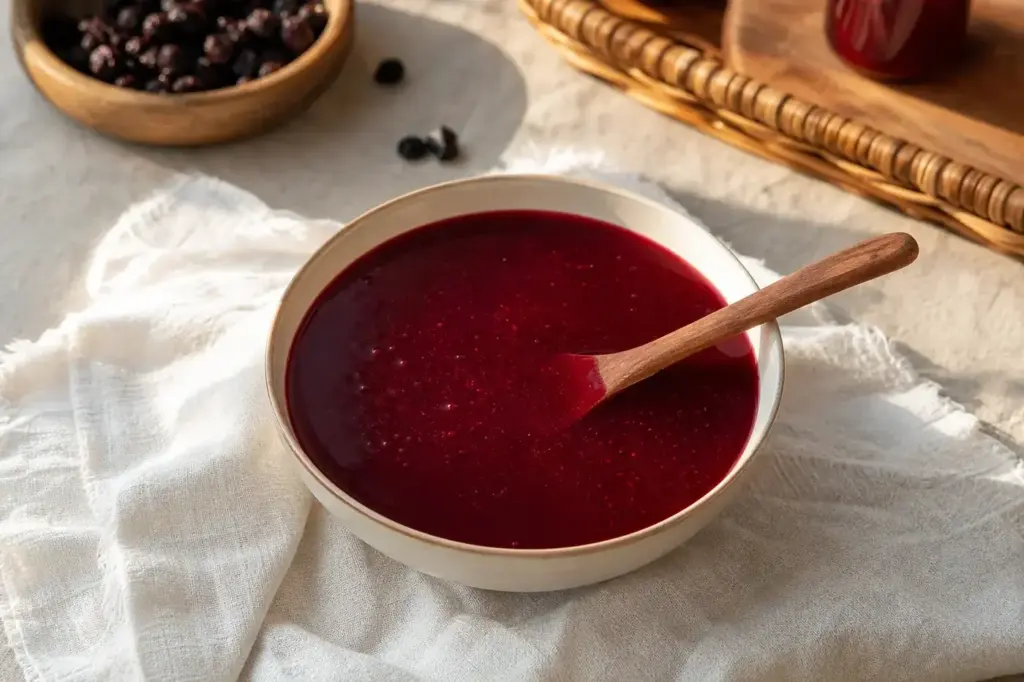
Kissel (кисель) is one of Russia’s most distinctive drinks—if you can call something you eat with a spoon a drink. A fruit-based mixture thickened with potato starch, it sits somewhere between a dessert, a pudding and a memory. Making kissel at home is straightforward: berries, water, sugar and starch come together in under 20 minutes.
This guide shows you how to prepare a simple berry kissel at home. Whether you enjoy it warm from the pot or chilled on a summer afternoon, the result is a comforting, naturally vegan treat that’s been part of Russian cuisine for over a thousand years.
Quick answer: Simmer fresh or frozen berries with water and sugar, strain, then thicken the liquid with a slurry of potato starch dissolved in cold water. Add the starch while stirring constantly until the mixture thickens, then remove from heat. Serve warm or chilled in a bowl or glass.
At a Glance
| Type | Drinks |
|---|---|
| Local name | Кисель |
| Origin | Russia and Central Europe; dates back at least to the 10th century, originally made from fermented grains |
| Servings | 2–4 servings |
| Total time | 20 minutes |
| Difficulty | Easy |
History and Story of Kissel (Кисель)
Kissel dates back at least to the 10th century, when it was mentioned in the Primary Chronicle, an ancient Russian text. The original kissel was a savoury, thick porridge made from fermented grains like oats, rye or wheat—not sweet, and often so thick it could be cut with a knife. The name derives from an old Slavic word meaning ‘sour’, reflecting its original character. Over the 19th and 20th centuries, fruit-based versions became dominant, especially in Russia and Poland. By the Soviet era, berry kissel had become a ubiquitous comfort food served in schools, hospitals and homes. Today, the sweet fruit version is far more common than the original grain kissel, though the older form still exists in some regions.
Ingredients
- 400 g fresh or frozen berries (cranberries, raspberries, cherries or red currants work best)
- 1 litre water
- 120 g sugar (adjust to taste)
- 30 g potato starch
- ¼ cup cold water (for the starch slurry)
How Kissel (Кисель) Is Made
Step 1: Prepare and cook the berries
Rinse the berries if fresh. Place them in a pot with 1 litre of water and bring to a simmer over medium heat. If using frozen berries, add them directly to the water. Simmer gently for 5–7 minutes until the berries soften and release their juice. The liquid will turn a rich colour—deep red for cranberries or raspberries, bright ruby for cherries.
Tip: Fresh berries produce more flavour but frozen work just as well year-round.
Step 2: Strain the berries
Pour the mixture through a fine sieve or cheesecloth into a clean pot, pressing gently on the berries to extract all the liquid. Discard the solids, or leave them in the liquid if you prefer a more rustic, textured version. Return the strained liquid to the stove over medium-high heat.
Tip: Straining gives a smooth, elegant drink; leaving the berries in adds body and a homey feel.
Step 3: Add sugar and heat to a boil
Stir in the sugar, tasting as you go. Bring the mixture to a boil, skimming off any foam that rises to the surface. The colour should deepen and the aroma become more concentrated. Once boiling, reduce the heat slightly.
Tip: The amount of sugar depends on the tartness of your berries. Cranberries need more; raspberries less.
Step 4: Prepare the starch slurry
While the liquid heats, measure 30 g of potato starch into a small bowl and add ¼ cup of cold water. Stir well until completely smooth with no lumps. This must be done before adding to the pot, as lumps in the hot liquid will not dissolve.
Tip: Lumps are the main mistake. Stir the slurry thoroughly and slowly pour it in; don't rush this step.
Step 5: Thicken the kissel
Slowly pour the starch mixture into the boiling berry liquid while stirring constantly with a whisk or spoon. Stir continuously and vigorously—do not stop stirring. The mixture will begin to thicken almost immediately, turning opaque and glossy. Keep stirring for 1–2 minutes as it reaches a full boil.
Tip: Constant stirring prevents lumps from forming. If you stop stirring, lumps will develop.
Step 6: Cool and serve
Remove from heat and let cool slightly. Kissel can be served warm, at room temperature or chilled. Pour into bowls or glasses. If serving warm, you may eat it with a spoon like a pudding, or drink it like a beverage depending on how thick you've made it.
Tip: Dust the surface with a little sugar to prevent a skin forming as it cools, if you prefer a smooth finish.
Variants
- Milk kissel: made with whole milk and cornstarch instead of potato starch, sweetened lightly and often served warm
- Winter kissel: made with dried fruits (apples, prunes, apricots, raisins) steeped in hot water with cinnamon and honey
- Cherry or sour cherry kissel: a summer speciality, often served chilled and slightly tart
- Red currant kissel: bright and slightly tart, popular in Scandinavia and Baltic countries
- Cranberry kissel: dark, deep-coloured and one of the most traditional versions
Common Mistakes to Avoid
- Adding starch to cold liquid and then heating it, which creates lumps. Always dissolve starch in cold water first, then add to the hot liquid while stirring.
- Not stirring constantly during thickening. Stop stirring even for a few seconds and lumps will form. This is unavoidable—stir continuously.
- Using too much starch, which makes the kissel gluey and unpleasant. Start with 30 g per litre; you can always add more if needed.
- Straining out all the berries when you prefer a rustic texture. Leave some berry solids in if you like body and visual appeal.
- Forgetting to make a cold water slurry first. Adding dry starch powder directly to hot liquid creates lumps that won't dissolve.
How to Order and Eat It
Kissel occupies a curious space between drink and dessert. If you’ve made it thin (about 1–1.5 tablespoons of starch per litre), drink it slowly from a glass, sipping the warm berry liquid. If it’s thicker (2–3 tablespoons per litre), eat it with a spoon from a bowl like a pudding. Either way, the texture is smooth and gel-like, slightly viscous on your tongue—something between a custard and fruit juice. Many Russians serve it warm, finding the warmth comforting, but it’s equally good chilled on a hot day. Some pair it with whipped cream or serve it alongside blini (thin pancakes). The flavour is sweet and fruity, with the tartness of the berries coming through.
To order: Кисель, пожалуйста [Kissel, pozhaluysta]
Diet and Allergens
- vegan
- gluten-free
Moscow Vibes Tips
- Texture control is everything. The amount of starch determines whether kissel is a sippable drink or a spoonable dessert. Too little starch and it's barely thicker than juice; too much and it becomes gluey. Start with 1.5 tablespoons per litre for a thin drinkable version, 2–3 tablespoons for a medium pourable consistency you can eat with a spoon.
- Potato starch works better than cornstarch for berry kissel. Cornstarch can taste grainy and requires more of it to achieve the same thickness. Look for potato starch in the baking aisle of supermarkets or in European food shops.
- Make kissel in bulk and chill it. It keeps in the fridge for several days and is satisfying cold on hot days. The texture sets as it cools, becoming firmer.
- Fresh berries in season produce the best flavour, but frozen berries work just as well and allow you to make kissel year-round. Thaw them first if you want to control the cooking time more precisely.
- Save time by using quality bottled or frozen berry juice instead of fresh berries. Use 1 litre of juice, skip the simmering step, and go straight to heating, adding sugar, and thickening with starch.
- Cranberries and sour cherries make the most authentic and flavourful kissel. Raspberries and strawberries are sweeter and less interesting. Red currants add tartness and a beautiful colour. Mix berries for complexity.
Where to Find Kissel (Кисель) in Moscow
Related guides
 10 Best Places to Try Russian Food in Moscow: Classics and Canteens
Main image: AI-generated illustration. It may not show the place exactly as it looks.
 10 Best Food Markets and Food Halls in Moscow: Where to Eat Indoors
Main image: AI-generated illustration. It may not show the place exactly as it looks.
 15 Best Things to Do in Moscow with Kids: Circus, Space and Parks
Main image: AI-generated illustration. It may not show the place exactly as it looks.
 Patriarch’s Ponds Moscow: Pond, Bulgakov Sites and Walking Tips11 min on foot from Mayakovskaya metro, Open 24 hours
Main image: AI-generated illustration. It may not show the place exactly as it looks.
Browse more: All Food & Drink · All Other
FAQ
Is kissel a drink or a dessert?
Both. Russians have debated this for centuries. It depends on how much starch you add. More starch makes it spoonable like pudding; less starch makes it drinkable. Either way, it's something uniquely in between.
Can I make kissel with fresh juice instead of fresh berries?
Yes. Use 1 litre of shop-bought berry juice or juice concentrate diluted with water. Skip the simmering step and go straight to adding sugar and heating to a boil, then thicken with starch.
What's the difference between kissel and kompot?
Kompot is a thinner fruit drink made by simmering fruit in water and sugar with no thickening agent. Kissel is thickened with starch to create a gel-like consistency. Both are Russian favourites but serve different purposes.
How do I stop lumps forming in kissel?
Always dissolve the starch in cold water first to make a smooth slurry before adding it to the hot liquid. Pour the slurry slowly into the boiling liquid while stirring constantly. Do not stop stirring until it thickens.
Can I make kissel without potato starch?
Potato starch is traditional and produces the smoothest texture. Cornstarch works but requires more of it and can taste grainy. Arrowroot or tapioca work too but won't thicken as much.
Is kissel gluten-free and vegan?
Yes, berry kissel is naturally both. It contains only fruit, sugar, water and potato starch. Milk kissel is vegan only if made with plant-based milk (almond or soy), not oat milk.
How long does kissel keep?
Refrigerate in a covered container for up to 3–4 days. It will thicken as it cools and continues to set. You can also freeze it for up to a month, though the texture may become slightly grainy.
What's the best way to serve kissel?
Warm kissel is traditional and comforting, drunk or eaten with a spoon straight from a pot. Chilled kissel is refreshing in summer. Either way, serve it in a bowl or glass, and add a dollop of whipped cream or sour cream if you like.
Discover More of Moscow with Our Travel Tips
Get practical Moscow travel tips, new destination guides and useful updates on attractions, opening hours and prices. Plan your visit with clear, helpful information delivered to your inbox.
Moscow Vibes is a one-person project. A coffee keeps it going
Looking for more on this? Beef Stroganoff: Authentic Russian Recipe and Cooking Method (Russia Vibes)

Take this guide with you
Get a free PDF of this guide to print or read offline: key facts, tips and a map link on a few clean pages.
Report an issue on this page
Paying for your trip: please read
Payments and bookings between Russia and many other countries are currently restricted. In practice, cards issued in the EU, the UK, the US and several other countries often cannot be used in Russia, Russian cards usually cannot be used abroad, and some booking platforms, airlines and payment providers limit or pause their services for Russia. The situation changes frequently.
We do not give legal or financial advice, and this site does not encourage anyone to break any rule that applies to them. Whatever you plan, you are responsible for following the laws and regulations that apply to you, including those of your country of residence and citizenship.
Many travelers still organise their stay without problems. It is worth asking your bank or payment provider what is currently possible, contacting hotels, tour operators and carriers directly about the payment methods they accept, and checking which services are open to customers from your country. Clarify payment, cancellation and refund terms before you commit to a booking, and keep your plans flexible.
Partner links on this site may not be available in every country, and prices, availability and rules in our guides can differ from what you see when you book.
How we research and update our guides
About this guide: AI assistance and accuracy
This guide is created with the help of AI and is based on official sources where available. Mistakes can still happen. Opening hours, prices, rules and other details are given to the best of our knowledge as of the date shown and can change without notice. It offers general recommendations only, not professional, legal or travel advice. Please confirm important details with the official source before you travel; you are responsible for your own plans and decisions.
* Affiliate link: as an Amazon Associate we earn from qualifying purchases at no extra cost to you.