
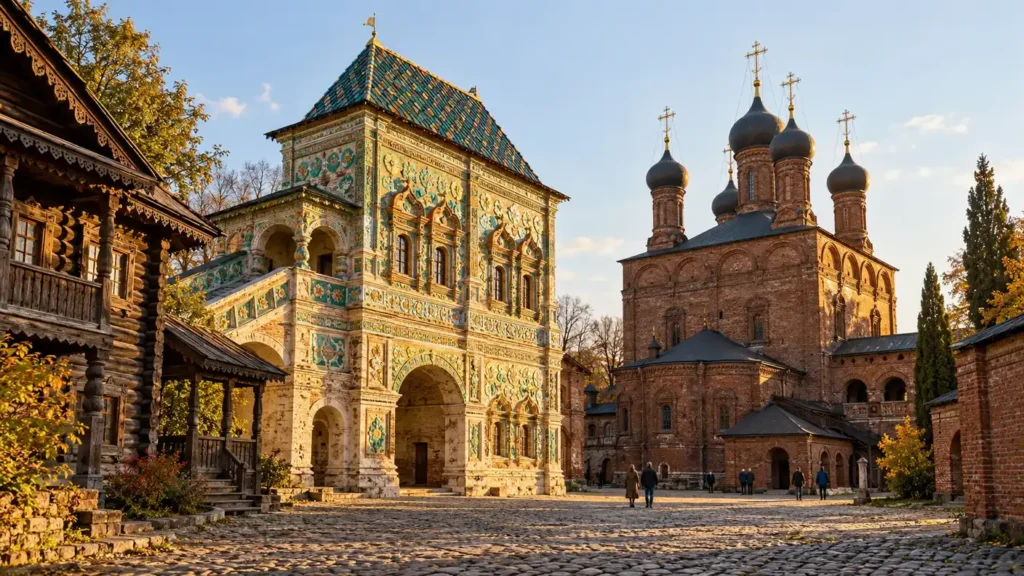
Krutitskoye Podvorye Moscow is a small walled church estate on a steep bank of the Moskva River, a short distance from Novospassky Monastery. Krutitskoye Podvorye Moscow hours are daily in the daytime, and the grounds are reported free to enter, though interiors are mainly open during services.
The best-known feature is the Krutitsky Teremok, a tiled gate tower of 1693–1694, beside a brick Dormition Cathedral and the Metropolitan’s Chambers. This guide explains what to look for, how long to plan and how to reach it from the metro.
Quick Facts
| Russian name | Крутицкое подворье |
|---|---|
| Built / opened | 1693 |
| Architect(s) | Osip Startsev and Illarion Kovalyov (Teremok and gallery) |
| Address | Krutitskaya Street 13, Moscow, Russia OpenStreetMap · Google Maps |
| District | Tagansky |
| Metro | Proletarskaya (Line 7 (Tagansko-Krasnopresnenskaya, purple), about 10–15 min walk; the exact time was not verified) Krestyanskaya Zastava (Line 10 (Lyublinsko-Dmitrovskaya, light green), about 10–15 min walk; the exact time was not verified) |
| Opening hours | The grounds are reported open daily in the daytime, with one review saying the territory is open until 21:00 and an older listing giving Wednesday to Monday from 8:00 to 20:00, closed on the first Monday of each month.
It is a working church estate, so interiors are mainly open during services (as of October 2026 – check the official site, krutitsy.ru). |
| Admission | Entry to the grounds is reported to be free, and an older listing says the museum on the estate is free of charge. No ticket information was found, so check the official site before you go. |
| Best time to visit | Weekday mornings are calm, and the estate is especially atmospheric in the evening when the buildings are lit and the territory stays open later. Late spring to early autumn is best for the courtyard, while winter snow suits the brick and tiles.
Interiors are mainly open during services, so plan around the schedule if you want to go in. |
| Recommended duration | 45–60 minutes |
| Website | krutitsy.ru |
| Last updated | October 6, 2026 |
What Is (and Isn't) Part of a Visit to Krutitskoye Podvorye Moscow?
| Part | Status | Notes |
|---|---|---|
| Grounds, courtyard and Teremok | Included in the standard ticket | Reported free to walk through during opening hours. |
| Dormition Cathedral and Resurrection Church | Included in the standard ticket | Working churches, mainly open during services. |
| Metropolitan's Chambers | Not open to visitors | Seen from outside; interior access was not confirmed. |
| Museum of Pilgrimage and Travel to Holy Places | Included in the standard ticket | Free of charge on an older listing; open according to the schedule of services. |
| Services | Not open to visitors | For worshippers; visits to churches are limited at those times. |
| Novospassky Monastery Moscow | Outside / not part of it | A separate fortified monastery nearby with Romanov tombs. |
| Bunker-42 Moscow | Outside / not part of it | A Cold War museum in the Taganka district, with its own booking. |
Why Visit Krutitskoye Podvorye Moscow?
The estate is a rare preserved corner of old Moscow, on a steep hill that was not built over in the 20th century. It was the Moscow residence of bishops, and later metropolitans, from the 13th century onward.
Its highlight is the Krutitsky Teremok of 1693–1694, a gate tower with turquoise floral tiles and carved window frames, built by Osip Startsev and Illarion Kovalyov.
The Dormition Cathedral, the Metropolitan’s Chambers and the Resurrection Church stand around a quiet courtyard of cobbles and old wooden houses. It takes under an hour and combines well with Novospassky Monastery.
How Krutitskoye Podvorye Moscow Is Laid Out
The estate is small and compact, on a hill above the Moskva River, with busy roads on two sides and the river on the west.
The Teremok stands above a gateway and arcade, with the Resurrection passages joining the Metropolitan’s Chambers to the Dormition Cathedral. The Resurrection Church stands nearby, and a courtyard of old wooden houses adjoins the main buildings. A museum on pilgrimage opens according to the schedule of services.
A sensible route is to enter by the gate, look at the Teremok from both sides, walk along the arcade to the cathedral, then look at the chambers and the church and finish in the courtyard.
Highlights of Krutitskoye Podvorye Moscow
The Krutitsky Teremok
A gate tower built in 1693–1694 above the gateway to the Metropolitan's courtyard, by the architects Osip Startsev and Illarion Kovalyov. The tiles are attributed to Stepan Ivanov.
The north facade is decorated with turquoise tiles in colorful floral designs and window frames carved like grapevines.
Tip: Look at both the north and south facades, which are decorated differently.
The Dormition Cathedral
The cathedral was built in 1682–1689 entirely of brick, including its onion domes. It contains two churches, and a lower church was opened in 1699.
In Soviet times it housed apartments, a warehouse and workshops before it was returned to the church.
Tip: Look at the brick surfaces and the proportions of the domes from the courtyard.
The Metropolitan's Chambers
The chambers were built in 1655–1670 as the residence of the metropolitans, who lived at Krutitsy from the later 15th century.
They were extended under Metropolitan Paul II, who also built a garden with Moscow's first fountain.
Tip: Look at the carved window frames and the contrast between brick and white stone.
The Resurrection passages
A covered gallery of 1693–1694 joins the chambers to the cathedral, with gates and the Teremok above it. It was built by the same architects as the tower.
Walking along it gives a close view of the tiles.
Tip: Walk the length of the arcade to see how the buildings connect.
The Resurrection Church
The church was completed in the 1650s on early 16th-century foundations, with a 15th-century white-stone basement where early church officers are buried.
It was under restoration for many years.
Tip: Ask whether the interior is open; it is mainly open during services.
The courtyard and old wooden houses
A courtyard of cobbles and pre-Revolutionary wooden houses with carved shutters adjoins the main buildings, a setting often used for films.
The hill is steep, which helped it escape rebuilding in the 20th century.
Tip: Walk through the courtyard in the evening, when the lights make the brick glow.
Atmosphere
The estate is small, quiet and unexpectedly old, with dark red brick walls, cobbled squares and wooden houses behind a busy road. The Teremok glows with turquoise tiles in the sun, and the brick domes of the cathedral stand against the sky.
Visitors walk slowly, taking photographs of the tiles and the arcade, and the sound is church bells and distant traffic. A few worshippers pass through for services.
It is especially calm on weekday mornings and pleasant in the evening, when the buildings are lit. In winter, snow gathers on the roofs and the courtyard becomes silent.
History of Krutitskoye Podvorye Moscow
Krutitsy takes its name from the steep (krutoy) bank of the Moskva River. In 1261, with the support of Grand Prince Alexander Nevsky, an eparchy called Sarsk and Podonsk was formed to serve the Russians in the Golden Horde. Around 1272 the eparchy established a court, or podvorye, on this hill, with the support of Prince Daniil of Moscow, the founder of the Moscow line of the Rurik dynasty.
Since the second half of the 15th century, the estate served as the residence, first of bishops and then of the metropolitans of the Russian Orthodox Church. It lay downriver from the Kremlin on the high left bank of the Moskva.
The buildings that visitors see today date mainly from the 17th century. The Resurrection Church was completed in the 1650s on early 16th-century foundations, and the Metropolitan’s Chambers were built in 1655–1670.
Metropolitan Paul II launched an ambitious building program, with a new Dormition Cathedral built in 1682–1689, the chambers and a garden with Moscow’s first fountain. Later improvements by his successors included the gallery and the Teremok, built in 1693–1694 by the architects Osip Startsev and Illarion Kovalyov, with tiles attributed to Stepan Ivanov. The gateway was completed shortly before Metropolitan Evfimy left in 1695 to become Metropolitan of Novgorod.
The Krutitsy society, a circle of educated clergy, gathered at the estate at the end of the 17th century, and the place was known as a center of learning.
In the 20th century the steep hill was not built over, which preserved the estate. In Soviet times the Dormition Cathedral housed apartments, a warehouse and the production facilities of a society for the protection of monuments.
The buildings were returned to the church in 1991 and 1996, and acquired the title of Patriarchal Metochion. Restoration has continued, including the Resurrection Church and a riverside dormitory. Today it is an operating church estate with a museum of pilgrimage and travel to holy places.
Tickets and Booking for Krutitskoye Podvorye Moscow
No tickets or online booking were found for the estate, and the grounds are reported free to enter during opening hours. An older listing says the museum on the estate is free of charge and opens according to the schedule of services, so check the estate’s official site, krutitsy.ru, for current information.
- Services: the churches are working churches, and interiors are mainly open during services.
- Entrance: through the gate on Krutitskaya Street; confirm the address on a map.
Payment options for foreign cards were not verified, so carry some cash for candles and donations. Rates for Russian citizens and concessions may differ if any fee applies. Check the official site for the current opening days.
Plan and Book
Suggested Itineraries for Krutitskoye Podvorye Moscow
45 minutes
Enter by the gate, look at the Teremok from both sides and walk along the arcade to the Dormition Cathedral. Finish in the courtyard of old wooden houses.
1.5 hours
See the Teremok, the cathedral, the chambers and the church, then walk the short distance to Novospassky Monastery.
Half day
Combine Krutitsy with Novospassky Monastery and Bunker-42 in the Taganka district, and have lunch along Taganskaya Square.
How to Get to Krutitskoye Podvorye Moscow
The estate stands on a hill above the Moskva River, southeast of the center of Moscow, close to Novospassky Monastery.
- Proletarskaya (Line 7, Tagansko-Krasnopresnenskaya, purple): the nearest station listed, about 10 to 15 minutes on foot; the exact time was not verified.
- Krestyanskaya Zastava (Line 10, Lyublinsko-Dmitrovskaya, light green): about 10 to 15 minutes on foot; the exact time was not verified.
A taxi can drop you at the gate on Krutitskaya Street. The estate is surrounded by busy roads, so check a map for the pedestrian route.
Accessibility
Accessibility details were not confirmed. The courtyard has cobbles and uneven surfaces, and the churches have steps and thresholds. Contact the estate before visiting if you need step-free access or assistance, and check krutitsy.ru for current information.
Food Nearby
There are no cafes confirmed inside the estate. Around Proletarskaya and Krestyanskaya Zastava metro stations and on Taganskaya Square there are cafes, restaurants and shops. Check opening hours before you go.
What to Bring
Bring comfortable shoes for the cobbles and a layer for the wind from the river. As in other Orthodox churches, modest clothing is customary, and women often cover their heads inside the churches.
Best Views and Photo Spots of Krutitskoye Podvorye Moscow
Teremok north facade
The turquoise tiles and carved window frames of the gate tower, in sharp detail.
Best time: Late morning, with side light on the tiles
Dormition Cathedral from the courtyard
The dark red brick walls and onion domes rising above the cobbles.
Best time: Late afternoon light
The arcade and passages
The covered gallery leading toward the cathedral, framing the brick and white stone.
Best time: Overcast light
Courtyard with wooden houses
Old wooden houses with carved shutters beside the brick buildings, a quiet corner of old Moscow.
Best time: Evening, when the buildings are lit
Photography Rules
Photography rules inside the churches and the museum were not confirmed and are often restricted in working churches, so follow signs and staff instructions and avoid flash. The Teremok, the courtyard and the exteriors can generally be photographed from the grounds. Drone rules in Moscow are strict and change.
Family Suitability
The estate suits families as a short, quiet stop, with a tiled tower and a courtyard that children can look at. It is a working church estate, so quiet behavior is expected. Cobbles make strollers harder to push, and access inside the churches was not confirmed.
Moscow Vibes Tips
- Look at both facades of the Teremok; the north and south sides are decorated differently.
- Visit in the evening if you can, when the territory stays open later and the brick and tiles are lit.
- Combine the estate with Novospassky Monastery, which is a short walk away along the hill.
- Do not expect large interiors; the estate is small, and the churches are mainly open for services.
- Look for the old wooden houses in the courtyard, which most visitors walk past on the way to the Teremok.
- Check a map for the pedestrian route, since two busy roads surround the hill.
Explore Nearby Krutitskoye Podvorye Moscow
Sights near Krutitskoye Podvorye Moscow
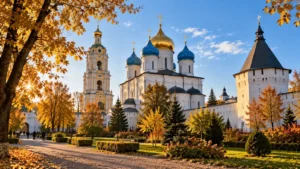 Novospassky Monastery Moscowabout 350 m away (~5 min walk) · typical visit: 1–1.5 hours
 Bunker-42 Moscowabout 1.7 km away (~27 min walk) · typical visit: 1.5–2.5 hours
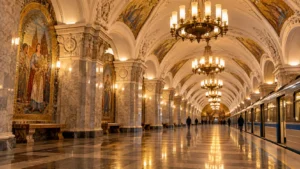 Moscow Metro · typical visit: 1.5–3 hours for a tour of showcase stations
 Sergey Yesenin Museum Moscowabout 1.7 km away (~28 min walk) · typical visit: About 1 to 1.5 hours
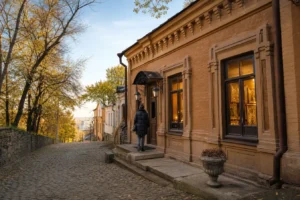 Museum of Russian Icons Moscowabout 2.2 km away · typical visit: About 1.5 to 2 hours
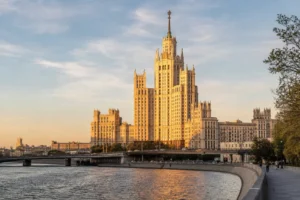 Kotelnicheskaya Embankment Building Moscowabout 2.4 km away · typical visit: About 30 minutes to 1 hour
Metro stations near Krutitskoye Podvorye Moscow
 Proletarskaya Metro Stationabout 700 m away (~11 min walk)
 Krestyanskaya Zastava Metro Stationabout 850 m away (~14 min walk)
Restaurants and cafes near Krutitskoye Podvorye Moscow
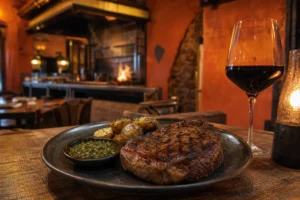 El Gauchoabout 1.3 km away (~22 min walk)
Hotels near Krutitskoye Podvorye Moscow
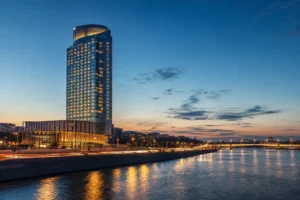 Swissotel Krasnye Holmy Moscowabout 1.1 km away (~18 min walk)
 Ibis Moscow Centre Bakhrushinaabout 1.7 km away (~28 min walk)
Train stations and river piers near Krutitskoye Podvorye Moscow
 Novospassky River Pierabout 450 m away (~7 min walk)
 Paveletsky Railway Terminalabout 1.2 km away (~19 min walk)
Related guides
 Taganka: Taganskaya Square, the Theatre and Moscow’s Old Sloboda
 Miratorg: Supermarkets in Moscow, Hours and What to Buy
 Igor Butman Jazz Club: Live Jazz Near Taganskaya, Hours and Tips
 Ploshchad Ilyicha Metro Station: Deep Hall and Lime Line Transfer
 Andrey Rublev Museum Moscow: Icons, Hours and Tickets
Browse more: More in Tagansky · All Churches · All Sightseeing
FAQ: Krutitskoye Podvorye Moscow
What is Krutitskoye Podvorye?
A small church estate that was the Moscow residence of bishops and metropolitans from the 13th and later 15th centuries.
What is the Teremok?
A gate tower of 1693–1694, with turquoise floral tiles and carved window frames, by Osip Startsev and Illarion Kovalyov.
Is it free?
The grounds are reported free to enter, and the museum was free on an older listing. See the booking section.
Is it the same as Novospassky Monastery?
No, though they are nearby. Novospassky is a fortified monastery with Romanov tombs. See the Novospassky Monastery Moscow article.
Can I go inside the cathedral?
Interiors are mainly open during services, so check the schedule.
How long do I need?
About 45 minutes to an hour.
When was the cathedral built?
In 1682–1689, entirely of brick, including its onion domes.
How far is it from the metro?
About 10 to 15 minutes on foot from Proletarskaya, though the exact time was not verified.
Discover More of Moscow with Our Travel Tips
Get practical Moscow travel tips, new destination guides and useful updates on attractions, opening hours and prices. Plan your visit with clear, helpful information delivered to your inbox.
Moscow Vibes is a one-person project. A coffee keeps it going
Last updated: October 6, 2026. Found an error or something out of date? Report it and we will check and fix it.
How we research and update our guides
About this guide: AI assistance and accuracy
This guide is created with the help of AI and is based on official sources where available. Mistakes can still happen. Opening hours, prices, rules and other details are given to the best of our knowledge as of the date shown and can change without notice. It offers general recommendations only, not professional, legal or travel advice. Please confirm important details with the official source before you travel; you are responsible for your own plans and decisions.
International sanctions affect payments between Russia and many other countries. In practice, cards issued in the EU, the UK, the US and several other countries often do not work in Russia, Russian cards usually do not work abroad, and some booking platforms, airlines and payment providers limit or suspend their services for Russia. The situation changes frequently. We do not give legal or financial advice, and this site does not encourage anyone to break or circumvent sanctions. Whatever you plan, you are responsible for following the laws and regulations that apply to you, including those of your country of residence and citizenship. Many travelers still organise their stay lawfully. It is worth asking your bank or payment provider what is currently permitted, contacting hotels, tour operators and carriers directly about the payment methods they accept, and checking which services are open to customers from your country. Clarify payment, cancellation and refund terms before you commit to a booking, and keep your plans flexible. Partner links on this site may not be available in every country, and prices, availability and rules in our guides can differ from what you see when you book.Paying for your trip: please read
Report an issue on this page
* Affiliate link: as an Amazon Associate we earn from qualifying purchases at no extra cost to you.
 Ask Masha