
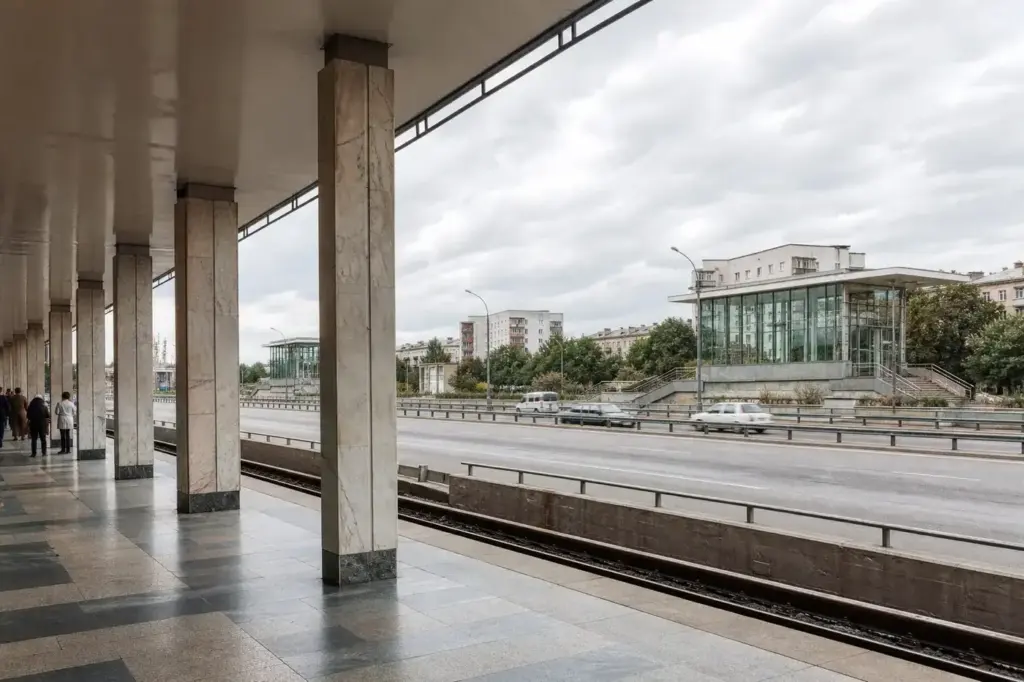
Kuntsevskaya metro station serves as a major interchange point on Moscow’s metro network, connecting the Arbatsko-Pokrovskaya line (Line 3) and Filyovskaya line (Line 4). Located in the western Kuntsevo District, the station sits at ground level along Rublyovskoye Highway and is easily identified by its distinctive glazed vestibules.
Originally opened in 1965 as a terminus for the Filyovskaya line, Kuntsevskaya was significantly expanded and rebuilt in 2008. The station now features three tracks and serves as both a cross-platform interchange between the two lines and a terminus for the Filyovskaya line. Since December 2021, it has also connected to a new station on the Circle Line (Bolshaya Koltsevaya line), creating a major transfer hub in western Moscow.
Lines and interchanges: Line 3 (Arbatsko-Pokrovskaya), Line 4 (Filyovskaya). Interchange: Kuntsevskaya (Line 3 (Arbatsko-Pokrovskaya)), Kuntsevskaya (Line 4 (Filyovskaya)).
Quick Facts
| Russian name | Кунцевская |
|---|---|
| Built / opened | 1965 |
| Architect(s) | Robert Pogrebnoy (1965); Aleksandr Vigdorov (2008 reconstruction) |
| Address | Rublyovskoye Highway, Kuntsevo District, Moscow Google MapsApple MapsYandex Maps2GIS |
| District | Western |
| Interchanges | Kuntsevskaya (Line 3 (Arbatsko-Pokrovskaya), Northern entrance (code 064) or southern entrance (code 210)) Kuntsevskaya (Line 4 (Filyovskaya), Northern entrance (code 064) or southern entrance (code 210)) |
| Opening hours | Open until 1:00 AM |
| Best time to visit | Any time of day is suitable for transiting through Kuntsevskaya. The station operates until 1:00 AM. Rush hours (weekday mornings 07:00–09:30 and evenings 17:30–20:00) bring heavier crowds and longer waits on platforms; visiting during midday (11:00–16:00) or on weekends is less crowded. Winter visitors should be prepared for cold temperatures on the open-air platforms; summer is more pleasant. The station's open design means it is less sheltered than underground stations—dress warmly in winter and bring an umbrella in wet weather. |
Why Visit Kuntsevskaya Metro Station?
Kuntsevskaya is a practical transit hub rather than a sightseeing destination, but it serves as a key connection point for visitors exploring Moscow’s western districts. The station’s ground-level design and double vestibules make it an unusual and photogenic example of Soviet-era metro architecture from the 1960s. For metro enthusiasts and architecture lovers, the contrast between the original 1965 structure and the modern 2008 reconstruction offers insight into how Moscow adapted its metro system over decades. The station connects to several bus routes (11, 16, 45, 58, 73, and others) serving the surrounding neighborhoods.
How Kuntsevskaya Metro Station Is Laid Out
Kuntsevskaya is a ground-level, open-air station configured with two identical glazed vestibules positioned on either side of Rublyovskoye Highway. The original 1965 design features two canopies at the platform ends, each supported by a single row of marble pillars. Two platforms serve the station: one side platform on the Arbatsko-Pokrovskaya line and one island platform on the Filyovskaya line, allowing cross-platform interchange between the lines. The 2008 reconstruction added a new, longer platform running parallel to the original structures. Northern (code 064) and southern (code 210) entrances provide access from either side of the highway. The new Bolshaya Koltsevaya line station, which opened in 2021, connects via transfer tunnels.
Highlights of Kuntsevskaya Metro Station
Original 1960s Glass Vestibules
The station's defining architectural feature is its pair of identical glazed vestibules, one on each side of Rublyovskoye Highway. These were part of the original 1965 design by architect Robert Pogrebnoy, created during an experimental era of surface-level metro construction in Moscow. The transparent glass structures allow natural light to flood the station and create a striking contrast with the surrounding urban landscape. This design approach was typical of 1960s Soviet metro engineering but remains visually distinctive today.
Tip: Enter via either the northern or southern vestibule depending on which side of the highway you approach from; both provide access to the same platforms.
Marble Pillar Canopies
Two canopies extend over the platform ends, each supported by a single row of marble pillars in the 1965 original design. These pillars are a signature element of the station's aesthetic and represent the era when marble was a standard material for Soviet metro construction. The canopies provide shelter on the open-air platform while maintaining the ground-level concept that made the station architecturally unusual for its time.
Tip: The marble pillars can be closely examined by walking along the platforms; the older sections show the patina of 60 years of use.
Cross-Platform Interchange
Kuntsevskaya serves as a cross-platform interchange between the Arbatsko-Pokrovskaya line (Line 3, heading toward Shchyolkovskaya or Pyatnitskoye Shosse) and the Filyovskaya line (Line 4, terminus). A cross-platform interchange means the two lines' platforms are adjacent, allowing passengers to change trains without leaving the platform area—a convenience feature that was innovative when introduced in Moscow's metro system.
Tip: When transferring between the two lines, note the different colored directional signage; blue signage indicates the Arbatsko-Pokrovskaya line, while other colors mark the Filyovskaya line.
Filyovskaya Line Terminus
The Filyovskaya line (Line 4) terminates at Kuntsevskaya, making this the westernmost station on that line. The terminus configuration is visible in the track layout and the reversed-direction signage that indicates the end of the line. Since the line was extended westward in 1965, this terminus has been the furthest reach toward the city's western suburbs for nearly 60 years before the 2021 Circle Line extension.
Tip: If arriving on the Filyovskaya line from central Moscow (toward Aleksandrovsky Sad), Kuntsevskaya is the final stop; trains reverse here for the return journey.
2008 Reconstruction and Modern Platform
The 2008 rebuild added a new, longer platform running parallel to the original structures, designed by architect Aleksandr Vigdorov as part of the Strogino–Mitino extension. This modernization doubled the station's capacity and improved crowd flow while preserving the original 1965 architectural elements. The reconstruction reflects how Moscow metro stations are adapted to serve growing ridership without destroying their historical character.
Tip: The newer platform sections (2008) show cleaner finishes and updated signage; the original structures retain their weathered appearance, making the before-and-after architectural styles visually distinct.
Connection to Bolshaya Koltsevaya Line (2021)
Since December 7, 2021, Kuntsevskaya has connected to a new station on the Bolshaya Koltsevaya line (Line 11, the Circle Line) via transfer tunnels. This addition made Kuntsevskaya a major three-line transfer hub. The new station was designed by architects Ivan Kolmanok and Alexander Tomashenko and represents the latest phase of Moscow's metro modernization, adding contemporary design to this historic transfer point.
Tip: Transfers to the Circle Line station are via ground-level tunnels that branch from the original station; allow 5–10 minutes for the walk if changing lines.
Atmosphere
Kuntsevskaya’s atmosphere is distinctly different from Moscow’s deeper, more ornate underground stations. Being ground-level and open-air, it feels more like a covered platform or bus station than a traditional metro terminus. Natural light floods through the glazed vestibules, creating an airy, less claustrophobic feeling. During rush hours (weekday mornings and evenings), the platforms become crowded with commuters connecting between the two lines, while midday traffic is lighter. The wind can sweep across the open platforms in winter, and the station can feel chilly—bring a jacket. The marble pillars and overall architectural form evoke 1960s Soviet practicality rather than grandeur, giving the space an honest, utilitarian character that contrasts sharply with the ornate early-Stalin-era stations downtown.
History of Kuntsevskaya Metro Station
Kuntsevskaya opened on August 31, 1965, as the western terminus of the Filyovskaya line (Line 4), which was the main line being extended westward from central Moscow at that time. The station was part of a significant expansion that carried the metro beyond the city center into the growing residential and industrial districts of the western suburbs. Its architect, Robert Pogrebnoy, designed it according to the standard 1960s surface-level metro approach, which represented a shift from the ornate underground ‘palaces’ of the earlier Stalin era toward more economical, functional designs.
The 1965 design was experimental and bold: two identical glazed vestibules, one on each side of Rublyovskoye Highway, with transparent walls to allow light to penetrate the station. Two canopies extended over the platform ends, supported by marble pillars. This ground-level, open-air approach was born of practicality—it was cheaper to build than deep-tunnel stations and avoided the geological challenges of Moscow’s complex subsurface. However, it had a critical flaw: Moscow’s harsh winters proved devastating to ground-level structures, making this approach ultimately unsustainable for metro expansion.
In 1965, the Arbatsko-Pokrovskaya line (Line 3) was still being built, and Kuntsevskaya initially served only the Filyovskaya line. The cross-platform interchange between the two lines came later. On January 7, 2008, Kuntsevskaya underwent a major reconstruction as part of the Strogino–Mitino extension project. The rebuilt station was designed by architect Aleksandr Vigdorov and added a new, longer platform running parallel to the original structures. This modernization was essential to handle increased passenger demand while preserving the station’s iconic visual character from the 1960s.
The most recent and dramatic change came on December 7, 2021, when the Bolshaya Koltsevaya line (Bolshaya Koltsevaya line, or Circle Line) opened, and a new station called Kuntsevskaya was built on that line with a ground-level transfer connection to the original station. This addition transformed Kuntsevskaya from a two-line interchange into a major three-line transfer hub serving western Moscow. The new Circle Line station was designed by architects Ivan Kolmanok and Alexander Tomashenko and became immediately controversial due to long transfer tunnels and narrow platforms, illustrating the challenges of retrofitting historic transfer points with modern-capacity requirements.
Legends and Myths about Kuntsevskaya Metro Station
The 'Failed Experiment' of Grade-Level Stations
Legend – historically unreliable. Kuntsevskaya and a handful of other 1960s metro stations like Kutuzovskaya were built at ground level as a cost-saving experiment during the Khrushchev era. The idea was economically sound but ignored Moscow's notoriously harsh winters. Snow, ice, and freezing rain wreaked havoc on the glass vestibules and open platforms, and maintenance costs ballooned. The legend holds that Kutuzovskaya was the 'first permanent grade-level metro station' in the world, and Kuntsevskaya followed suit. However, this approach was quietly abandoned after a few stations because the climate proved that underground was the only practical solution for Moscow's metro. Today, Kuntsevskaya stands as a visible reminder of this architectural gamble.
The 2021 Circle Line 'Transfer Nightmare'
Disputed by historians. When the Bolshaya Koltsevaya line (Circle Line) opened in 2021, locals and transit analysts immediately complained about the Kuntsevskaya transfer. The transfer tunnels connecting the new Circle Line station to the old Arbatsko-Pokrovskaya and Filyovskaya station are notoriously long and confusing, reportedly among the worst transfers on the entire Moscow metro. Passengers joke that changing at Kuntsevskaya is a 'mini-expedition' and that the tunnel system must have been designed by someone who had never actually used the station. The narrow platforms on the new Circle Line station compound the problem, making it cramped during peak hours.
Tickets and Booking for Kuntsevskaya Metro Station
Kuntsevskaya is a metro station and requires a single metro fare to enter and use. Fares for tourists: Foreign visitors can purchase a single-ride fare (valid one trip on any metro line), a rechargeable contactless card (Troika card), or use the metro’s mobile payment app. The single-ride fare is the simplest option for one trip. The Troika card can be topped up at station ticket booths and is reusable across metro, bus, and tram systems. Mobile payments via the official Moscow Metro app are increasingly accepted at automatic gates. Payment methods: Cards and contactless payments are required at most gates; cash is not accepted on trains or at modern ticket gates, though some stations maintain ticket booths for cash card purchases. Rush hours: Kuntsevskaya experiences heavy crowding on weekday mornings (07:00–09:30) and evenings (17:30–20:00) as commuters transfer between the two lines. Expect delays during these times. Note that concession fares (students, pensioners, children under 5) and local resident rates differ from tourist rates. For all current fare categories, refer to the official Moscow Metro website (mosmetro.ru) or app.
How to Get to Kuntsevskaya Metro Station
By metro: Kuntsevskaya is on the Arbatsko-Pokrovskaya line (Line 3) and Filyovskaya line (Line 4). If arriving from central Moscow on Line 3, the station is reached after Molodyozhnaya (coming from Slavyansky Bulvar and Shchyolkovskaya). If on Line 4 (Filyovskaya), Kuntsevskaya is the terminus, the final stop westbound; you arrive here from Pionerskaya and the direction of Aleksandrovsky Sad.
Entrances: Two main entrances serve the station, positioned on either side of Rublyovskoye Highway (northern entrance, code 064, and southern entrance, code 210). Choose the entrance on your side of the highway to minimize crossing.
Walking from the station: Kuntsevskaya is in the Kuntsevo District of western Moscow. The immediate surroundings are primarily residential and commercial, with buses providing connections to neighborhoods further west. Bus connections: Routes 11, 16, 45, 58, 73, 91, 135, 178, 190, 236, 240, 255, 610, 612, 688, 733, and 867 depart from the station area. For specific bus destinations, check Yandex Maps or the official Moscow transport website (mosgortrans.ru).
Taxi and ride-sharing: Standard taxi stands and ride-sharing apps (Yandex Taxi, Uber, etc.) operate outside the station.
Accessibility
Kuntsevskaya's ground-level, open-air design provides better accessibility than many of Moscow's deep-tunnel metro stations. There are no escalators or elevators to navigate, and the platform level is accessed directly from the street via gentle slopes or steps through the vestibules. However, the station does not provide dedicated wheelchair-accessible routes; access depends on the ability to traverse the vestibule entrances and navigate the open platform. Visitors with mobility challenges should be aware that the platform offers no enclosed waiting areas and can be exposed to weather. For specific accessibility details or assistance, contact Moscow Metro's customer service via mosmetro.ru or call +7 (495) 539-54-54.
Food Nearby
Kuntsevskaya station itself has no cafes or food vendors inside. The surrounding Kuntsevo District contains residential and light commercial areas with grocery stores, small restaurants, and cafes typical of Moscow's western suburbs, but these are not immediately adjacent to the station. Visitors requiring food should either bring supplies or use public transport (bus, taxi) to reach nearby dining options. For a quick snack, convenience stores (Pyaterochka, Magnit, Perekrestok) are common in Moscow and can be found within a 5–10 minute walk in most directions from the station. Check Yandex Maps for current options near the specific area you plan to visit.
What to Bring
Since Kuntsevskaya is a ground-level, open-air station, dress appropriately for Moscow's weather. In winter (November–March), bring heavy outerwear, insulated gloves, and warm footwear; the exposed platform can be bitterly cold. In summer, light clothing and sunscreen are suitable. Rain gear is useful year-round. The platform offers no seating or enclosed waiting areas. Security screening is standard at the station; avoid large bags or items that would raise suspicion at security gates.
Best Views and Photo Spots of Kuntsevskaya Metro Station
Glazed Vestibule Entrance (Northern or Southern)
The distinctive glass vestibules are the most photogenic element of Kuntsevskaya. Shooting from outside the vestibule looking inward captures the transparent glass structure framing the platform and passengers beyond, with natural light creating a luminous interior. The geometric lines of the glazing and the marble pillars visible through the glass form strong compositional elements.
Best time: Midday when sunlight streams through the glass and illuminates the interior. Overcast days also work well as they provide diffuse light without harsh shadows. Avoid rush hours when crowds obscure views.
Platform Canopy with Marble Pillars
Stand on the platform and frame the row of marble pillars supporting the canopy, receding into the distance. The pillars create a strong linear perspective and showcase the 1960s architectural character. Include travelers on the platform for scale and human interest.
Best time: Early morning or late afternoon when sunlight hits the pillars at a low angle, creating shadow contrast. Weekday mornings before 07:00 offer uncrowded platforms.
Rublyovskoye Highway Crossing View
From inside the station vestibule, shoot outward toward the opposite vestibule across Rublyovskoye Highway. This captures both glass structures and the urban traffic context, illustrating how the station sits integrated into the city's surface infrastructure rather than buried beneath it.
Best time: Late afternoon when the side lighting highlights the glass and structure. Clear days show the contrast between built elements and sky.
Perspective Down the Platform
Frame the platform receding into the distance with the marble pillars creating a vanishing point. The open-air design and 1960s architecture become evident in this composition. Include the station signage or the distant vestibule for context.
Best time: Midday or early afternoon. Overcast conditions reduce harsh shadows on the platform. Weekday early morning (before 06:00) offers clean, people-free shots.
Photography Rules
Photography is permitted at Kuntsevskaya. Tripods and professional camera equipment may attract attention from station security; check with staff if planning commercial or extensive photography. Flash photography is not prohibited but can be disruptive in the vestibules. Drones are not permitted anywhere in Moscow's metro system.
Family Suitability
Kuntsevskaya is moderately suitable for families with children. The ground-level design eliminates the need for escalators or elevators, making it easier for stroller access than deep-tunnel stations. However, the open-air platform offers no weather protection, making it uncomfortable with young children during cold or rainy weather. The station can be crowded during rush hours, which may make navigating with strollers difficult. Older children (8+) can handle the station easily. The station itself offers no play areas or child-friendly amenities; it is primarily a transit hub. The surrounding Kuntsevo District is predominantly residential but not specifically geared toward family attractions. For families, Kuntsevskaya is best used as a transit point rather than a destination.
Moscow Vibes Tips
- Use the entrance code (064 or 210) that matches your side of Rublyovskoye Highway to avoid crossing traffic. The northern entrance (064) serves the north side of the highway; the southern entrance (210) serves the south side.
- If transferring between Lines 3 and 4, use the cross-platform interchange. The two platforms are adjacent, eliminating a long walk. Check platform signage to confirm which train you need, as the layout can be confusing.
- Avoid the station during rush hours (07:00–09:30 and 17:30–20:00 on weekdays) if possible. The two-line interchange creates bottlenecks, and trains fill quickly. Midday (11:00–16:00) or weekend visits are less chaotic.
- Do not confuse Kuntsevskaya with the neighboring stations Molodyozhnaya (one stop east on Line 3) or Pionerskaya (one stop east on Line 4). Verify your destination before boarding.
- The 2021 Bolshaya Koltsevaya line connection (Circle Line) involves a 5–10 minute walk through transfer tunnels. If you need to change to the Circle Line, follow orange signage for 'BKL' or 'Bolshaya Koltsevaya.'
- In winter, the open platform becomes very cold. If transferring, plan to spend minimal time on the platform and wear appropriate outerwear. The vestibules offer more shelter than the platform itself.
Explore Nearby Kuntsevskaya Metro Station
Metro stations near Kuntsevskaya Metro Station
 Bagrationovskaya Metro Stationabout 3.6 km away
Main image: AI-generated illustration. It may not show the place exactly as it looks.
 Ramenki Metro Stationabout 4.9 km away
Main image: AI-generated illustration. It may not show the place exactly as it looks.
Browse more: More in Western · All Metro Stations · All Other Hubs
FAQ: Kuntsevskaya Metro Station
Is Kuntsevskaya an above-ground or underground station?
Kuntsevskaya is a ground-level, open-air station built on the surface rather than underground. Its two glass vestibules sit on either side of Rublyovskoye Highway, and the platforms are open to the sky. This makes it visually distinctive but less comfortable in bad weather compared to Moscow's underground stations.
What metro lines stop at Kuntsevskaya?
Three lines now serve Kuntsevskaya: the Arbatsko-Pokrovskaya line (Line 3), the Filyovskaya line (Line 4), and the Bolshaya Koltsevaya line (Circle Line, opened December 2021). Lines 3 and 4 are part of the original station; Line 11 connects via transfer tunnels.
Is it an interchange station?
Yes. The original Kuntsevskaya is a cross-platform interchange between Lines 3 and 4, meaning their platforms are adjacent. A ground-level transfer tunnel connects the 2021 Circle Line station. All three lines can be accessed from this location.
How long is the transfer between Lines 3, 4, and 11?
Transfer between Lines 3 and 4 is immediate (cross-platform). Transfer to the Circle Line (Line 11) involves a 5–10 minute walk through the transfer tunnel system, making it one of Moscow Metro's longer transfers.
What is the station's actual opening date?
Kuntsevskaya originally opened on August 31, 1965, as part of the Filyovskaya line extension. The Arbatsko-Pokrovskaya line was added later at this location. The station was rebuilt on January 7, 2008, and the Circle Line station opened December 7, 2021.
Is Kuntsevskaya the terminus of any line?
Yes, Kuntsevskaya is the western terminus of the Filyovskaya line (Line 4). Trains arriving from Aleksandrovsky Sad and the direction of central Moscow terminate here and reverse for the return journey.
What are the station code numbers for entrances?
The northern entrance carries station code 064, and the southern entrance carries code 210. These codes identify the location on official metro maps and help with navigation.
Can I use a single-ride metro ticket at Kuntsevskaya?
Yes. A single-ride metro fare grants access to one trip anywhere on the Moscow Metro system, including Kuntsevskaya. The fare is the same regardless of destination. Tourists can also use the reusable Troika card or mobile payment apps.
Discover More of Moscow with Our Travel Tips
Get practical Moscow travel tips, new destination guides and useful updates on attractions, opening hours and prices. Plan your visit with clear, helpful information delivered to your inbox.
Moscow Vibes is a one-person project. A coffee keeps it going

Take this guide with you
Get a free PDF of this guide to print or read offline: key facts, tips and a map link on a few clean pages.
Report an issue on this page
Paying for your trip: please read
Payments and bookings between Russia and many other countries are currently restricted. In practice, cards issued in the EU, the UK, the US and several other countries often cannot be used in Russia, Russian cards usually cannot be used abroad, and some booking platforms, airlines and payment providers limit or pause their services for Russia. The situation changes frequently.
We do not give legal or financial advice, and this site does not encourage anyone to break any rule that applies to them. Whatever you plan, you are responsible for following the laws and regulations that apply to you, including those of your country of residence and citizenship.
Many travelers still organise their stay without problems. It is worth asking your bank or payment provider what is currently possible, contacting hotels, tour operators and carriers directly about the payment methods they accept, and checking which services are open to customers from your country. Clarify payment, cancellation and refund terms before you commit to a booking, and keep your plans flexible.
Partner links on this site may not be available in every country, and prices, availability and rules in our guides can differ from what you see when you book.
How we research and update our guides
About this guide: AI assistance and accuracy
This guide is created with the help of AI and is based on official sources where available. Mistakes can still happen. Opening hours, prices, rules and other details are given to the best of our knowledge as of the date shown and can change without notice. It offers general recommendations only, not professional, legal or travel advice. Please confirm important details with the official source before you travel; you are responsible for your own plans and decisions.
* Affiliate link: as an Amazon Associate we earn from qualifying purchases at no extra cost to you.