
Maslenitsa (Butter Week) in Moscow is the folk festival that sees off winter in the week before Orthodox Great Lent. It is a movable date, tied to the Orthodox Easter, and it ends with Forgiveness Sunday, followed by the start of Lent on the next day. Blini, thin pancakes that symbolize the sun, are the main food, and a straw effigy of Lady Maslenitsa is burned on the final day.
The festival mixes pre-Christian seasonal customs with the Orthodox calendar. In Moscow the city runs a festival program with folk performances, games and workshops in parks and open-air venues, and many cafes serve blini all week. The weather can be anywhere between hard frost and thaw, and programs change each year, so check the official sources for the current dates.
Quick Facts
| Russian name | Масленица в Москве |
|---|---|
| Type | Recurring event |
| When | Every year in the week before Orthodox Great Lent, which is the eighth week before Orthodox Easter; the date moves with Easter, usually falling between February and mid-March. |
| Typical duration | Seven days from Monday to Forgiveness Sunday; the city's festival program often runs a few days longer than the traditional week. |
| Public holiday | No, an observance (regular working day) |
| Admission | Most open-air celebrations in parks and squares are free to attend. Food stalls, workshops, rides and any ticketed concerts set their own prices. |
| Best time to visit | The last weekend, ending with Forgiveness Sunday, is the busiest and has the burning of the effigy in the evening. Weekdays are quieter for blini in cafes, and daytime is best for families. The weather ranges from hard frost to thaw, and crowd patterns were not verified. |
| Last updated | October 7, 2026 |
Dates, programs and prices change from year to year. Always check the official website for the current edition.
Why Visit Maslenitsa (Butter Week) in Moscow?
Maslenitsa is the most informal of the Russian holidays that a visitor can join without a ticket: people eat blini outdoors, watch folk groups, try traditional games and see the effigy burn on the last day. The week is tied to the last days when dairy is still allowed before Lent, which is why the food is butter, eggs and milk.
It is also a good moment to see Moscow’s parks in late winter, with snow, fires and crowds in a cheerful mood. The festival is for families and groups, and it is relaxed about visitors who only watch. The date moves each year, so confirm it before you book a trip.
What to Expect at Maslenitsa (Butter Week) in Moscow
Traditionally the week begins on Monday and ends on Forgiveness Sunday, with each day having its own customs: visits to relatives and friends, blini at every table, songs and dancing, sleigh rides, snowball fights and organized fistfights that honor fighting spirit, according to folklore sources. The fifth day is the day of honoring mothers-in-law.
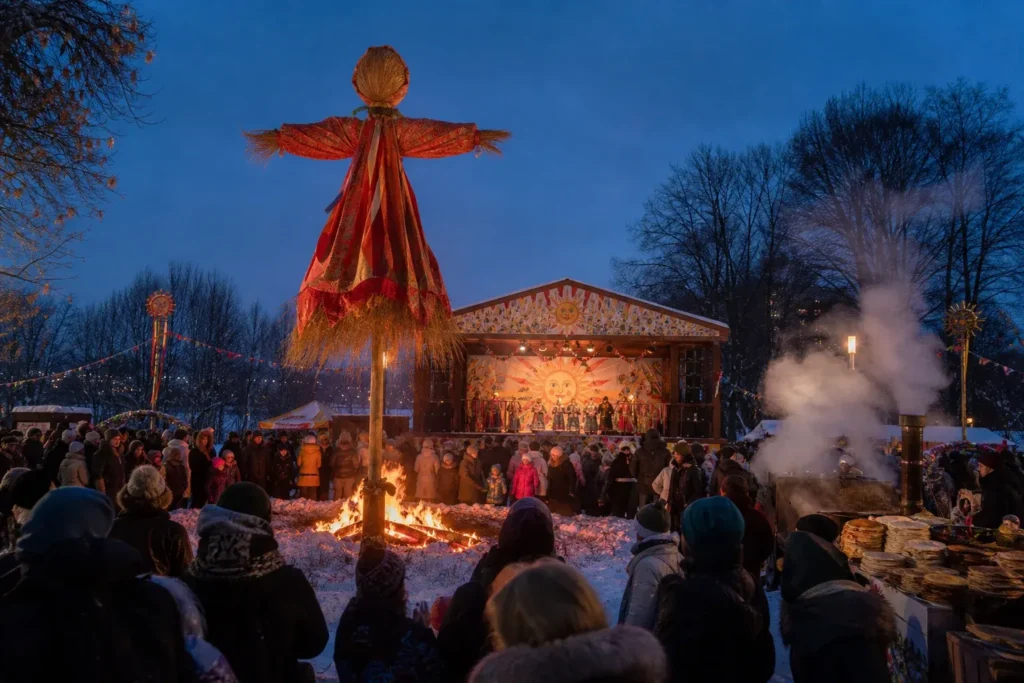
On the last Sunday a straw effigy dressed in bright rags, called Lady Maslenitsa, is burned on a bonfire as a farewell to winter, and leftover pancakes may be thrown into the fire, with the ashes buried in the snow. On Forgiveness Sunday people ask each other for forgiveness, the young from the old and then the elders from the young, and believers go to church. In Moscow the city adds a program of folk performances, creative workshops, traditional games and strongest-resident contests, held at festival venues.
Highlights of Maslenitsa (Butter Week) in Moscow
The burning of Lady Maslenitsa
The most visible ritual is the burning of a straw effigy, dressed in bright rags and fixed to a pole, on the final Sunday evening. It marks the farewell to winter, with fire standing for cleansing and renewal, and its ashes are buried in the snow. In some places an ice sculpture replaces the straw figure. The location and time of the burning differ at each venue and each year.
Tip: Come early to a park venue for the burning, since the crowd gathers around the fire.
Blini, the pancakes of the sun
Blini, thin round pancakes made with butter, eggs and milk, are the symbol of the festival, round and golden like the sun. They are eaten with sour cream, jam, caviar or savory fillings, and cafes and stalls serve them all week. Orthodox tradition allows dairy but not meat during this week.
Tip: Try blini at a festival stall for the outdoor atmosphere, and in a cafe for more choice of fillings.
Folk performances and games
The city's festival program includes folk performances, themed creative workshops, traditional games and sports and contests of the strongest resident, held at the Moscow Seasons venues, according to the city's tourism portal. Songs, dances and games like pulling a rope or climbing a pole are typical. Programs change each year.
Tip: Check the current list of venues on the city's tourism portal before you go.
Forgiveness Sunday
The last day of Maslenitsa is Forgiveness Sunday, the last day on which devout Orthodox Christians eat dairy before Easter. Relatives and friends ask each other for forgiveness and may exchange small presents, and believers go to church in the morning. The next day Great Lent begins. Visitors can attend a service quietly.
Tip: If you enter a church, dress modestly and follow the quiet of the service.
Sleigh rides and snow games
Sleigh rides, snowball fights and other snow sports belong to the festival, particularly in the last days of the week. In Moscow some festival venues arrange them in parks, depending on the weather. Whether snow is present varies with the year.
Tip: Wear boots with grip, since the paths may be icy or wet.
Parks and open-air venues
Festival events usually take place in parks and open spaces, and the Izmailovo, Kolomenskoye, Sokolniki and VDNH and Ostankino guides on this site cover areas that often host seasonal events. Which venues host Maslenitsa in a given year was not verified, so use the city's program to choose.
Tip: Choose a venue near a metro station and check its program on the day.
What It Means for Your Visit
Maslenitsa is not a public holiday, so offices, shops, museums and transport work as usual, apart from Forgiveness Sunday being a weekend day. The effects are local: parks and squares hosting the program are crowded on weekends, food lines are long, and some streets or paths near large venues may be closed for the events. Public transport runs as usual, with crowded trains to the venues on weekend afternoons.
Expect cold, wet or icy conditions, and plan for bonfires and crowds with some caution. Cafes and restaurants add blini to their menus all week and are busy at weekends. Check the city’s official tourism sources for the current dates and venues, since they change every year.
Atmosphere
Maslenitsa in a Moscow park is smoky and loud in a good way: the smell of frying blini and woodsmoke, folk songs from a stage, children running on trampled snow and a tall straw figure on a pole waiting for the evening. Stalls sell pancakes, tea from samovars and crafts, and groups of people in folk costume mix with families in winter coats.
By day the mood is cheerful and the paths are crowded, particularly on weekends. On Sunday evening the atmosphere sharpens around the bonfire, with people gathered in a ring and the figure burning. The weather can be freezing or wet, and crowd figures were not verified.
History of Maslenitsa (Butter Week) in Moscow
Maslenitsa is an Eastern Slavic religious and folk holiday celebrated in the last week before Great Lent, the eighth week before Orthodox Easter. It has a dual ancestry: the pagan side was a festival of the sun marking the end of winter, and the Christian side is the last week before Lent. The Church placed the festival in the week before Lent, when meat is no longer eaten but dairy is allowed, which gives the name Butter Week and the older church name of the week without meat.
The folk customs include the blini as a symbol of the sun, the straw effigy of Lady Maslenitsa, sleigh rides, songs and organized fistfights. In the Soviet period the festival was not part of official life, and since the collapse of the Soviet Union families have taken the festivities from the home to the streets, with some streets blocked off for merrymaking.
The date is movable and depends on the date of Orthodox Easter, so it differs each year and often differs from the Western Carnival, since Orthodox Lent begins on a Monday and the Orthodox Easter can be far from the Western date. The last day of Cheesefare Week is Forgiveness Sunday, followed the next day by the beginning of Lent.
In modern Moscow the city organizes a festival program with folk performances, workshops and games at designated venues, and the festival is aimed at residents and visitors alike. The programs and venues change each year.
Tickets and Booking for Maslenitsa (Butter Week) in Moscow
Most open-air Maslenitsa celebrations in parks and squares are free, with no ticket or booking. The city’s festival program, run in recent years at Moscow Seasons venues, is published on the official tourism portal, and venues, dates and timetables change every year, so no program or prices are given here. Food stalls, workshops, rides and any ticketed concerts or museum events sell their own tickets, usually on the spot or online.
- Dates: the date moves with Orthodox Easter, so confirm the current week before you book flights or hotels.
- Payment: foreign Visa and Mastercard cards are reported not to work in Russia, so bring rubles in cash for stalls, and the sanctions rules of your own country may restrict some Russian payment services, so check this yourself.
Rates for Russian citizens and concessions differ at ticketed events, so check the official portal, discover.moscow, and each organizer’s own page for the current edition.
Get Tickets for Maslenitsa (Butter Week) in Moscow
How to Get to Maslenitsa (Butter Week) in Moscow
The festival has no single site: venues are in parks and open spaces across the city, and the list changes each year. Choose a venue near a metro station and check the current program; see the guides to VDNH and Ostankino, Kolomenskoye, Izmailovo and Sokolniki on this site for park areas. The exits and walking times depend on the venue and were not verified.
- Metro: normal service runs, with crowded trains on weekend afternoons; the metro guides on this site explain the lines.
- Taxi: streets near large venues can be restricted; the taxi apps guide of this site explains the options.
Accessibility
No accessibility information was found for the festival. Park venues have snow, ice and uneven ground and crowds, which make movement difficult, so check conditions at the chosen venue before you go.
Food Nearby
Blini, hot tea and snacks are sold at festival stalls, and cafes and restaurants add blini to their menus during the week. No individual venue was verified for this guide, so check opening hours and menus on site.
What to Bring
Very warm clothing, waterproof boots with grip, gloves and a hat, and rubles in cash for stalls, since foreign cards are reported not to work.
Best Views and Photo Spots of Maslenitsa (Butter Week) in Moscow
The effigy on its pole before the burning
The tall straw figure dressed in bright rags against a winter sky, with the crowd below. The color stands out against the snow.
Best time: Late afternoon before the burning.
The bonfire at dusk
Flames and sparks with a ring of silhouettes around them as the effigy burns. The firelight on snow gives a strong frame; keep a safe distance.
Best time: Sunday evening.
A blini stall with steam
Cooks at griddles with rows of golden pancakes and steam in cold air. It shows the central food of the festival.
Best time: Midday.
Photography Rules
No general photography rules for the festival were found. Performers, vendors and families may not want to be photographed, so ask first, keep a distance from the bonfire and follow staff instructions. Drone rules in Moscow are strict and were not checked.
Family Suitability
Maslenitsa suits families well, with games, songs, blini and a bonfire that children often enjoy, but the cold, the crowds and the fire call for care with young children. Stroller access on snowy paths is difficult.
Moscow Vibes Tips
- Confirm the week before you book, since the date moves each year with Orthodox Easter.
- Go on the last Sunday for the effigy burning, and arrive early to get a place near the fire.
- Eat blini at a stall outdoors and then try a cafe version for the choice of fillings.
- Do not confuse Maslenitsa with the Western Carnival, since the dates and customs differ.
- Choose a venue near a metro station and check the program on the day, since venues change.
- Keep a safe distance from the bonfire and follow the staff's instructions.
Explore Nearby Maslenitsa (Butter Week) in Moscow
Related guides
 VDNH and Ostankino: Pavilions, Space Museum, TV Tower and Park
Main image: AI-generated illustration. It may not show the place exactly as it looks.
 Kolomenskoye: UNESCO Ascension Church, Wooden Palace and Park
Main image: AI-generated illustration. It may not show the place exactly as it looks.
 Izmailovo: Kremlin, Vernissage Market and the Romanov Estate
Main image: AI-generated illustration. It may not show the place exactly as it looks.
 Sokolniki: Moscow’s Falcon Park, Kitchen Debate Site and Ice Rink
Main image: AI-generated illustration. It may not show the place exactly as it looks.
 Tsaritsyno: Catherine’s Unfinished Palace, Park and Fountain Guide
Main image: AI-generated illustration. It may not show the place exactly as it looks.
Browse more: All Entertainment · All Events & Holidays
FAQ: Maslenitsa (Butter Week) in Moscow
When is Maslenitsa?
In the week before Orthodox Great Lent; the date moves each year with Easter.
What is Forgiveness Sunday?
The last day of the week, when people ask each other for forgiveness.
Why blini?
They are round and golden like the sun, and use butter, eggs and milk.
What is burned?
A straw effigy of Lady Maslenitsa, as a farewell to winter.
Is it a day off?
No, it is an observance and a normal working week.
Is it free?
Most open-air events are free; stalls and rides charge.
Where in Moscow?
In parks and open-air venues listed by the city each year.
Is it religious?
Both folk and religious: it is the last week before Lent.
* Affiliate link: as an Amazon Associate we earn from qualifying purchases at no extra cost to you.
Discover More of Moscow with Our Travel Tips
Get practical Moscow travel tips, new destination guides and useful updates on attractions, opening hours and prices. Plan your visit with clear, helpful information delivered to your inbox.
Moscow Vibes is a one-person project. A coffee keeps it going
Last updated: October 7, 2026.
How we research and update our guides
About this guide: AI assistance and accuracy
This guide is created with the help of AI and is based on official sources where available. Mistakes can still happen. Opening hours, prices, rules and other details are given to the best of our knowledge as of the date shown and can change without notice. It offers general recommendations only, not professional, legal or travel advice. Please confirm important details with the official source before you travel; you are responsible for your own plans and decisions.
International sanctions affect payments between Russia and many other countries. In practice, cards issued in the EU, the UK, the US and several other countries often do not work in Russia, Russian cards usually do not work abroad, and some booking platforms, airlines and payment providers limit or suspend their services for Russia. The situation changes frequently. We do not give legal or financial advice, and this site does not encourage anyone to break or circumvent sanctions. Whatever you plan, you are responsible for following the laws and regulations that apply to you, including those of your country of residence and citizenship. Many travelers still organise their stay lawfully. It is worth asking your bank or payment provider what is currently permitted, contacting hotels, tour operators and carriers directly about the payment methods they accept, and checking which services are open to customers from your country. Clarify payment, cancellation and refund terms before you commit to a booking, and keep your plans flexible. Partner links on this site may not be available in every country, and prices, availability and rules in our guides can differ from what you see when you book.Paying for your trip: please read
Report an issue on this page

Take this guide with you
Get a free PDF of this guide to print or read offline: key facts, tips and a map link on a few clean pages.