
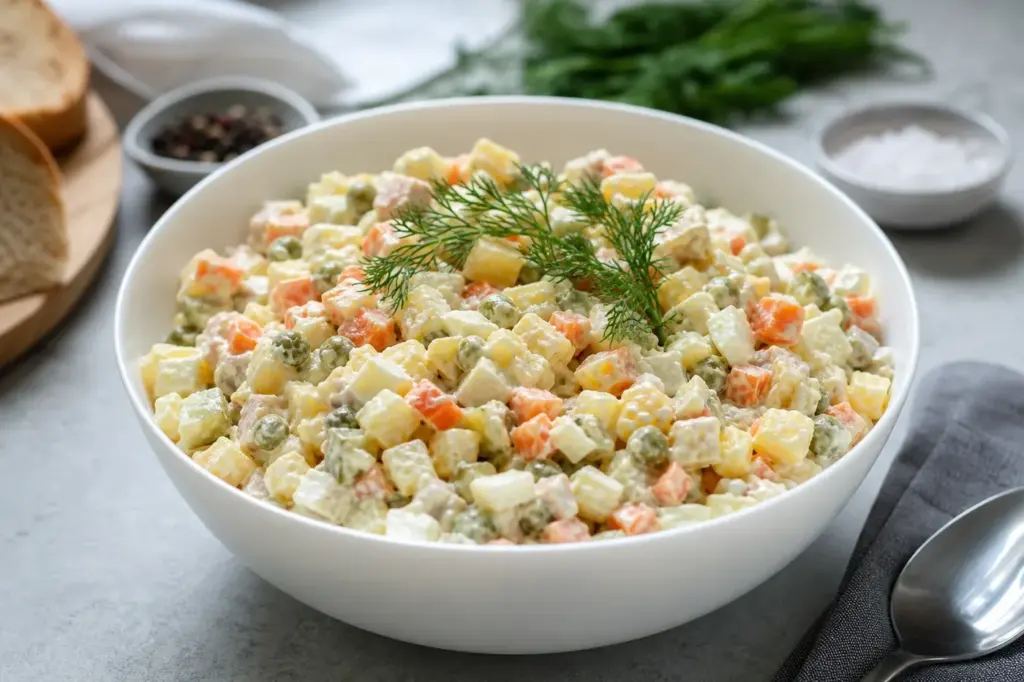
Olivier Salad is one of Russia’s most iconic dishes, especially at holiday gatherings and family celebrations. If you want to learn how to make Olivier Salad at home, this guide walks you through the classic version that appears on Russian tables year-round, from New Year feasts to summer picnics.
The salad is straightforward to prepare: you boil vegetables and eggs, dice them finely, and fold everything into mayonnaise. No special ingredients or skills required. Most visitors and home cooks prepare the Soviet-era version with potatoes, carrots, peas, pickles, eggs and ham or sausage—a far cry from the original luxurious recipe created in 1860s Moscow.
Quick answer: Boil potatoes, carrots and eggs, dice everything finely along with pickles and onion, fold into mayonnaise with cooked peas and ham. Total time: 50–60 minutes. Cost is budget-friendly.
At a Glance
| Type | Dishes |
|---|---|
| Local name | Салат оливье |
| Origin | Created in the 1860s by Lucien Olivier in Moscow, Russia. Olivier was the chef of the famous Hermitage restaurant in Moscow. The original recipe was a closely guarded secret and contained treats such as grouse, smoked duck, caviar, and crayfish. After the Russian Revolution, cheaper ingredients replaced the originals: grouse became chicken or sausage, crayfish became hard-boiled egg, and olives and capers became pickled cucumbers and green peas. |
| Servings | 4 servings |
| Total time | 50–60 minutes |
| Difficulty | Easy |
History and Story of Olivier Salad (Салат оливье)
Olivier Salad was created in the 1860s by Lucien Olivier in Moscow, Russia. Lucien Olivier was the chef of the famous French restaurant in Moscow called L’Hermitage. The original recipe contained crayfish, smoked duck, caviar, and grouse and was a closely guarded secret. At the end of the nineteenth century, Ivan Ivanov, a sous-chef of Olivier, took the recipe when Olivier was called away from the kitchen. Ivanov later served a similar salad at Moskva restaurant under the name Capital Salad (Stolichny). In 1905, the Hermitage restaurant closed and the Russian salad recipe began to be published in various publications. During the Soviet period, adaptations appeared with less expensive ingredients to make it accessible to ordinary people. The salad became an essential appetizer for New Year meals in Russia and the countries of the former USSR.
Ingredients
- 4 medium potatoes
- 2 medium carrots
- 4 eggs
- 4–5 dill pickles
- ¾ cup frozen or canned peas
- ½ small onion
- 200g cooked ham, bologna or doctor's sausage
- ½–¾ cup mayonnaise
- Salt and pepper to taste
How Olivier Salad (Салат оливье) Is Made
Step 1: Boil the vegetables and eggs
Place unpeeled potatoes and carrots in a pot of cold salted water. Bring to a boil and cook until tender, about 20–25 minutes. In a separate pot, boil eggs in water until hard-boiled, about 10 minutes. Drain vegetables and eggs, let cool slightly, then peel the potatoes and carrots. Do not peel eggs yet.
Tip: Cool vegetables quickly by placing them in cold water after draining—they'll be easier to peel and dice.
Step 2: Dice all ingredients finely
Once vegetables are cool, peel and dice the potatoes and carrots into small, even cubes about ¼ inch. Peel and dice the eggs. Dice the dill pickles and onion finely. If using ham or sausage, cut into small cubes. Aim for uniform size throughout—this matters more in Russian cuisine than you might expect.
Tip: Chill the vegetables in the refrigerator for 30 minutes before dicing; they're easier to cut cleanly when cold.
Step 3: Combine vegetables and meat
In a large bowl, gently fold together the diced potatoes, carrots, eggs, pickles, onion and ham. If using canned peas, drain them thoroughly. Add peas to the bowl and fold gently until distributed evenly. Do not mash or overmix—the goal is to keep the pieces intact.
Tip: If using frozen peas, thaw them first and drain any liquid to avoid making the salad watery.
Step 4: Add mayonnaise and season
Pour mayonnaise over the mixture. Start with ½ cup and add more if needed to bind the salad without making it heavy. Add salt and pepper to taste. Fold gently but thoroughly until all ingredients are coated evenly. A mixture of mayonnaise and sour cream also works and makes the salad less rich.
Tip: Mix the salad at least an hour before serving—flavours develop better and the texture becomes creamy as the ingredients marry.
Step 5: Chill before serving
Cover the bowl and refrigerate for at least 30 minutes, preferably longer. Olivier Salad is always served cold. Just before serving, taste and adjust seasoning if needed. Garnish lightly with fresh dill if you have it.
Tip: The salad tastes better the next day after the flavours have melded together, so it's an excellent make-ahead dish for gatherings.
Variants
- Stolichny (Capital) Salad—a variation that became popular after a sous-chef's version was served at another Moscow restaurant
- Vegetarian version without ham or sausage, sometimes with boiled chicken breast instead
- Modern versions that substitute some mayo with sour cream or yogurt for a lighter texture
- Versions with added fresh apple for crunch, or with celery root instead of some vegetables
- Regional variations across Russia, Ukraine and other post-Soviet countries with slightly different vegetable ratios or meat choices
Common Mistakes to Avoid
- Using raw vegetables instead of boiled ones. Olivier Salad is always made with cooked, cooled vegetables—never raw. Raw potatoes or carrots will make the salad texture wrong.
- Cutting ingredients unevenly. The hallmark of a well-made Olivier is uniform dicing. Uneven pieces make the salad look careless and affect how you taste each bite.
- Overmixing or mashing ingredients. This is comfort food, not mashed potato. Stop folding as soon as everything is coated; you're not trying to create a purée.
- Skipping the chill time. Olivier Salad needs time in the refrigerator for the flavours to develop and the texture to become creamy. Serving it warm or at room temperature defeats the point.
- Using too much mayonnaise. You should see the vegetables and eggs clearly in the finished salad, not a thick, pale sludge. Start with ½ cup for 4 servings and add only as needed.
- Forgetting to taste and adjust. Eggs and pickles add saltiness, but the balance changes as the salad sits. Taste just before serving and add salt and pepper if needed.
How to Order and Eat It
Olivier Salad is always served cold, straight from the refrigerator, as a side dish or appetizer. In Russia, it is the classic accompaniment to holiday meals, especially New Year’s Eve and Christmas celebrations. It pairs well with hot dishes, grilled meats, or roasted chicken. Serve it from a shared bowl so guests can help themselves, or plate individual portions and top with a small pinch of fresh dill if you have it. The salad sits peacefully on any buffet table and actually improves as it sits, since the flavours meld over time.
To order: Салат оливье [salat olivye]
Where to Try Olivier Salad (Салат оливье)
 Mari Vanna Russian
Main image: AI-generated illustration. It may not show the place exactly as it looks.
 Stolovaya 57 Russian and Soviet-style home cooking, self-service
Main image: AI-generated illustration. It may not show the place exactly as it looks.
 Cafe Pushkin Russian and French, in a 19th-century style
Main image: AI-generated illustration. It may not show the place exactly as it looks.
Moscow Vibes Tips
- Make it the day before your gathering. Olivier Salad tastes noticeably better after a night in the refrigerator, and it saves you time on the actual day. The vegetables absorb the mayonnaise and flavours deepen.
- Don't skip the uniform dicing. Russians take this detail seriously—each spoonful should have a balanced mix of potato, vegetable, egg and meat. Uneven cutting is a sign the cook wasn't paying attention.
- Use a mixture of mayonnaise and sour cream if you want a lighter version. A 50/50 blend keeps the richness while adding tang and reducing heaviness—many families make it this way.
- Chill the bowl and serving spoon. A cold dish on a warm dish melts and separates. Small details like this matter in Russian cooking traditions.
- If you add fresh dill, do it just before serving or as a garnish on top. Mixed into the salad hours ahead, dill loses colour and flavour.
- The salad works equally well with boiled chicken breast instead of ham if you prefer. Many families have their own preference—there's no single 'correct' protein.
Where to Find Olivier Salad (Салат оливье) in Moscow
Related guides
 10 Best Food Markets and Food Halls in Moscow: Where to Eat Indoors
Main image: AI-generated illustration. It may not show the place exactly as it looks.
 10 Best Places to Try Russian Food in Moscow: Classics and Canteens
Main image: AI-generated illustration. It may not show the place exactly as it looks.
 15 Best Things to Do in Moscow in Winter: Ice, Music and Warm Stops
Main image: AI-generated illustration. It may not show the place exactly as it looks.
 Moscow Food Tour: Russian Cuisine and Local Specialties: One-Day Route
Main image: AI-generated illustration. It may not show the place exactly as it looks.
Browse more: All Food & Drink · All Other
FAQ
What's the difference between the original Olivier and the modern version?
The original 1860s recipe created by chef Lucien Olivier at the Hermitage restaurant was a luxury dish containing grouse, crayfish, caviar, and smoked duck. After the Russian Revolution, ingredients were simplified and substituted with affordable everyday items like potatoes, carrots, peas, eggs, and ham—the version everyone makes today.
Can I make Olivier Salad ahead of time?
Yes, absolutely. In fact, the salad tastes better the next day. Make it the evening before your gathering, cover it, and refrigerate. It keeps well for 2–3 days. The flavours develop and meld as it sits.
Do I have to use mayonnaise?
Mayonnaise is traditional and central to the dish, but many people now use a mixture of mayonnaise and sour cream to reduce richness. Some use half mayo and half yogurt. The key is something creamy to bind the vegetables together. Pure sour cream alone won't work as well.
What meat should I use?
Traditionally in Russia, doctor's sausage (доктроская колбаса), ham, or bologna are most common. Boiled chicken breast is also widely used and popular. Some families use ground beef. Choose what you like; there's no single 'correct' answer.
Should I use fresh or frozen or canned peas?
Fresh peas are rarely used in authentic Olivier. Canned or frozen work equally well. If using frozen, thaw them first. If using canned, drain them thoroughly. Both should be added as-is—the heat from the vegetables will warm them.
Why do Russians make Olivier Salad on New Year's Eve?
Olivier became deeply embedded in Russian culture during the Soviet era as a festive, affordable dish that made people feel celebratory. It became so associated with New Year that a family meal without Olivier feels incomplete to many Russians. It's more tradition and nostalgia than anything else.
Can I make it without eggs?
You can, but eggs are a core ingredient that add richness and help bind the salad. If you skip them, use a tiny bit more mayonnaise and sour cream to compensate.
How much mayonnaise is too much?
You should see the vegetables and eggs clearly in the finished salad. A good rule of thumb is to start with ½ cup mayonnaise for 4 servings and add more only if the mixture seems too dry. Heavy mayonnaise coverage is a sign of inexperience.
Discover More of Moscow with Our Travel Tips
Get practical Moscow travel tips, new destination guides and useful updates on attractions, opening hours and prices. Plan your visit with clear, helpful information delivered to your inbox.
Moscow Vibes is a one-person project. A coffee keeps it going

Take this guide with you
Get a free PDF of this guide to print or read offline: key facts, tips and a map link on a few clean pages.
Report an issue on this page
Paying for your trip: please read
Payments and bookings between Russia and many other countries are currently restricted. In practice, cards issued in the EU, the UK, the US and several other countries often cannot be used in Russia, Russian cards usually cannot be used abroad, and some booking platforms, airlines and payment providers limit or pause their services for Russia. The situation changes frequently.
We do not give legal or financial advice, and this site does not encourage anyone to break any rule that applies to them. Whatever you plan, you are responsible for following the laws and regulations that apply to you, including those of your country of residence and citizenship.
Many travelers still organise their stay without problems. It is worth asking your bank or payment provider what is currently possible, contacting hotels, tour operators and carriers directly about the payment methods they accept, and checking which services are open to customers from your country. Clarify payment, cancellation and refund terms before you commit to a booking, and keep your plans flexible.
Partner links on this site may not be available in every country, and prices, availability and rules in our guides can differ from what you see when you book.
How we research and update our guides
About this guide: AI assistance and accuracy
This guide is created with the help of AI and is based on official sources where available. Mistakes can still happen. Opening hours, prices, rules and other details are given to the best of our knowledge as of the date shown and can change without notice. It offers general recommendations only, not professional, legal or travel advice. Please confirm important details with the official source before you travel; you are responsible for your own plans and decisions.
* Affiliate link: as an Amazon Associate we earn from qualifying purchases at no extra cost to you.