
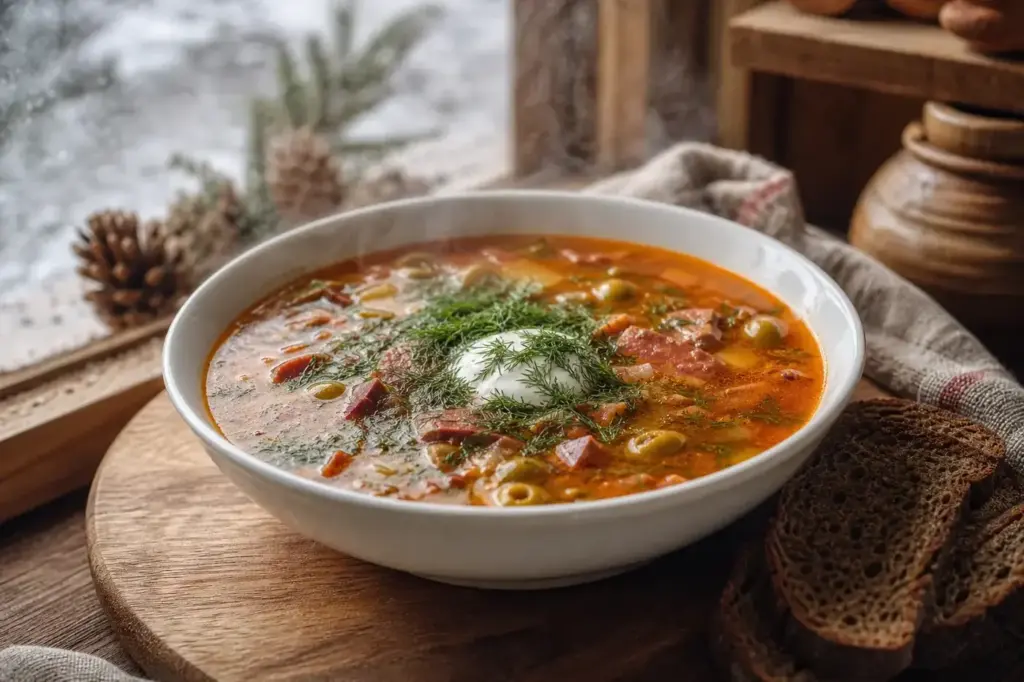
Solyanka is the essence of Russian comfort cooking: a thick, piquant soup that tastes bold and rich, with a distinctive sour edge. This dish works well for visitors who want to understand how Russians eat at home, especially in winter, when preserved vegetables and cured meats take centre stage. If you try one Russian soup in Moscow, this should be it—it appears in virtually every traditional restaurant and canteen across the city.
This guide shows you how to make authentic solyanka at home, starting with a deeply flavoured meat broth and building layer by layer with pickled cucumbers, olives, and smoked cured meats. The result is a soup that tastes nothing like it looks, and everything like a Russian kitchen.
Quick answer: Build a meat broth with beef, add sautéed onions and carrots with tomato paste, then add a mix of cured meats (ham, sausage, bacon), pickled cucumbers, and olives. The signature sour taste comes from brined cucumbers and their brine. Total time: 60–90 minutes. Cost: ₽₽
At a Glance
| Type | Dishes |
|---|---|
| Local name | Солянка |
| Origin | Solyanka first appeared in written Russian sources in the 17th century as a hot dish of cabbage, salted cucumbers, meat, poultry, fish, or mushrooms. It was transformed into a soup around the 1830s, when Russian chef Gerasim Stepanov documented it in 1834 as a type of soup (shchi). Since the 1840s, solyanka has been increasingly mentioned as a separate dish, appearing in Yekaterina Avdeyeva's 1842 Handbook of an Experienced Russian Hostess with a mushroom version. The name is believed to come from the Russian word 'solyony,' which means salty. |
| Servings | 4 servings |
| Total time | 60–90 minutes |
| Difficulty | Medium |
History and Story of Solyanka (Солянка)
The original name ‘selyanka’ can be translated as ‘settler’s soup’. Solyanka was first mentioned in Russian historical records in the 15th century, and the name likely evolved from the word ‘селянка’ (selyanka), meaning ‘villager’ or ‘peasant’, referring to the food of the peasant. Historically, solyanka is most associated with winter in Russia, when fresh vegetables were scarce and preserved vegetables became essential. It remains a hearty comfort food always served hot, perfect for lunch or dinner in the cold season. It is common throughout Russia, Ukraine, Belarus, the Baltic states, and other post-Soviet regions, and was one of the most reliably available dishes in East Germany.
Ingredients
- 700 g stewing beef (bone-in is traditional)
- 300 g mixed cured meats (ham, smoked sausage, bacon, salami)
- 200 g brined cucumbers (not pickled in vinegar)
- 100 g green olives
- 2 medium onions
- 2 medium carrots
- 3 tablespoons tomato paste
- 2 tablespoons capers
- 4–5 bay leaves
- Salt and pepper to taste
- Fresh dill for garnish
- Sour cream for serving (optional but traditional)
How Solyanka (Солянка) Is Made
Step 1: Prepare the broth
Place 700 g stewing beef in a large pot with 8–10 cups cold water. Bring to a boil, then lower heat and simmer for 30–40 minutes, skimming any foam from the surface. The broth should smell richly beefy and clear. This forms the foundation; good broth defines good solyanka.
Tip: Bone-in beef shank gives deeper flavour than boneless cuts. Do not skip the skimming step—it keeps the broth clear and clean.
Step 2: Prepare the vegetables
While the broth simmers, dice 2 medium onions and 2 medium carrots. Heat 2 tablespoons vegetable oil in a separate pan, add the onions and carrots, and sauté over medium heat until the onions turn translucent, about 5–8 minutes. This is called the 'podzharka' (sauté base).
Tip: Don't rush this step. The vegetables should soften, not brown. This slow sautéing deepens the flavour foundation of the soup.
Step 3: Add tomato and spices
Stir 3 tablespoons tomato paste into the sautéed vegetables and cook for 1–2 minutes, stirring constantly. The tomato paste should darken slightly and lose its raw smell. Add this entire mixture to the simmering broth.
Tip: Tomato paste adds body and a subtle tang. Raw tomato paste tastes metallic; cooking it briefly mellows the flavour.
Step 4: Prepare and add the meats
Cut 300 g mixed cured meats into small dice or thin strips: ham, smoked sausage, bacon, salami—any combination works, but variety gives depth. Add all cured meats to the broth. Add 4–5 bay leaves and 2 tablespoons capers, rinsed well. Simmer for another 10 minutes.
Tip: Cured meats need only a brief heating since they are already cooked. Overcooking toughens them. Capers must be rinsed to remove excess salt.
Step 5: Add pickled cucumbers and olives
Chop 200 g brined cucumbers (not vinegar-pickled) into chunks or strips. Add to the pot along with 100 g green olives. Pour in 3–4 tablespoons of the brining liquid (the juice from the cucumber jar). This is the crucial moment—the brined cucumbers and their brine give solyanka its signature sour, salty taste.
Tip: Use brined cucumbers, not vinegar-pickled ones. Brining uses salt water; vinegar creates a different, sharper flavour that is not authentic to solyanka.
Step 6: Simmer and taste
Bring to a gentle simmer and cook for 5–10 minutes. Taste carefully. Add salt and black pepper to your preference. The soup should taste boldly salty and sour, with the richness of meat underneath. Do not over-season; the brined cucumbers and capers are already quite salty.
Tip: Add salt slowly—you can always add more, but you cannot remove it. The sour-salty balance is what makes solyanka memorable.
Step 7: Finish and serve
Remove from heat. Ladle into bowls. Garnish each bowl with 1 tablespoon fresh dill, a dollop of sour cream (optional), and thin lemon slices if desired. Serve hot with dark rye or pumpernickel bread on the side.
Tip: Solyanka is traditionally eaten with sour cream stirred into it and dill scattered on top. The cool sour cream and fresh dill contrast beautifully with the hot, salty broth.
Variants
- Fish solyanka (Солянка рыбная): made with fish broth and mixed fish such as salmon, sturgeon, or herring instead of meat. Popular on Orthodox fasting days.
- Mushroom solyanka (Солянка грибная): made with vegetable or mushroom broth and fresh or dried mushrooms as the main ingredient. Also eaten during fasting periods.
- Vegetarian solyanka: made without meat or fish, relying on vegetable broth and mushrooms or vegetables, though less common than meat versions.
Common Mistakes to Avoid
- Using vinegar-pickled cucumbers instead of brined ones. Vinegar creates a sharp, acidic flavour; solyanka should taste salty and tangy-sour, not vinegary. Buy cucumbers brined in salt water, or brine your own.
- Oversalting the soup. The brined cucumbers, capers, olives, and cured meats are all high in salt. Add these ingredients first, taste carefully, and add salt only if needed. Many home cooks ruin solyanka by adding too much salt early on.
- Using raw or undercooked meat. The broth must simmer long enough for the beef to become tender and flavour the liquid deeply. A rushed broth tastes weak and thin. Allow at least 30–40 minutes.
- Skipping the tomato paste. While it seems like an odd ingredient, tomato paste adds a subtle sweetness and body that balances the saltiness. It also contributes colour. Do not leave it out or replace it with fresh tomatoes.
- Adding potatoes. Many modern recipes add potatoes to stretch the soup, but traditional solyanka does not include them. If you add potatoes, you are making a different soup. Keep to the classic formula of meat broth, cured meats, and pickled vegetables.
- Cooking the cured meats too long. They are already cooked and salted. Simmering them for more than 10–15 minutes toughens them and releases excess salt into the broth. Add them near the end.
How to Order and Eat It
Solyanka can be eaten as a starter or a main dish. It is typically eaten with sour cream and dill stirred into it and with dark bread on the side. The soup is served steaming hot in a deep bowl. Tear or break dark rye bread into chunks and eat alongside. Stir a generous spoonful of sour cream into each bowl just before eating—it cools the soup slightly and adds a creamy tang that cuts through the richness of the cured meats. The dill should be fresh and scattered on top so its aroma rises with the steam. If you have lemon, squeeze a thin slice into your bowl for extra brightness.
To order: Мне, пожалуйста, солянку мясную [Mne, pozhaluysta, solyanku myasnuyu]
Diet and Allergens
- Contains gluten (tomato paste may contain additives)
- Contains pork (bacon, ham, sausage typical)
- May contain shellfish (capers)
Where to Try Solyanka (Солянка)
 Fruits and Veges Vegan, Vegetarian
Main image: AI-generated illustration. It may not show the place exactly as it looks.
 Surf Coffee Specialty coffee, with pastries and desserts
Main image: AI-generated illustration. It may not show the place exactly as it looks.
 Masa Madre European bakery-cafe: bread, pastries, sandwiches, breakfasts and wine
Main image: AI-generated illustration. It may not show the place exactly as it looks.
Moscow Vibes Tips
- Solyanka is most famous as a winter dish, but it's eaten year-round in Moscow. Restaurant versions often taste better than homemade because they use stock simmered for hours. If making at home, don't rush the broth—the longer it cooks, the deeper and richer the final soup becomes.
- Buy brined cucumbers in jars from any supermarket (look for the word 'соленые' meaning 'salted/brined' on the label, not 'маринованные' meaning 'pickled in vinegar'). The brine liquid is precious—pour some into the soup for authenticity.
- Solyanka freezes very well. Make a large batch and freeze it in portions. The flavours actually deepen after a day or two in the refrigerator as the brining liquid continues to infuse the broth.
- If you find the soup too sour, do not add water (it dilutes all the flavour). Instead, add more sour cream or a pinch of sugar to balance the acidity. If it's too salty, a squeeze of lemon helps mask excess salt without diluting the broth.
- Traditionally, solyanka is believed to be a good hangover cure due to its salty, briny nature. Russians often eat it the morning after a big meal or celebration. If you see it on a restaurant menu under 'закуски' (appetizers) rather than soups, it is served as a small, intensely flavoured first course.
Where to Find Solyanka (Солянка) in Moscow
Related guides
 10 Best Places to Try Russian Food in Moscow: Classics and Canteens
Main image: AI-generated illustration. It may not show the place exactly as it looks.
 10 Best Food Markets and Food Halls in Moscow: Where to Eat Indoors
Main image: AI-generated illustration. It may not show the place exactly as it looks.
 Moscow Food Tour: Russian Cuisine and Local Specialties: One-Day Route
Main image: AI-generated illustration. It may not show the place exactly as it looks.
 6 Days in Moscow: Complete Travel Itinerary: Day-by-Day Plan and Tips
Main image: AI-generated illustration. It may not show the place exactly as it looks.
 Patriarch’s Ponds Moscow: Pond, Bulgakov Sites and Walking Tips11 min on foot from Mayakovskaya metro, Open 24 hours
Main image: AI-generated illustration. It may not show the place exactly as it looks.
Browse more: All Food & Drink · All Other
FAQ
What is the difference between brined and pickled cucumbers for solyanka?
Brined cucumbers are preserved in salt water; pickled cucumbers use vinegar. Solyanka requires brined cucumbers because they create a salty, tangy-sour taste. Vinegar-pickled cucumbers taste sharp and acidic and will ruin the soup's character. Always check the label or ask in the shop for 'соленые' (brined) cucumbers, not 'маринованные' (pickled).
Can I make solyanka without cured meats?
Not authentically. The soup's deep, savoury flavour comes from the combination of fresh beef broth with cured meats like ham, sausage, and bacon. You can make a vegetarian or fish solyanka, but these are different dishes with their own recipes and are less common than meat solyanka.
Is solyanka gluten-free?
It depends on the ingredients. The base soup contains no gluten, but some brands of tomato paste, capers, or cured meats may contain additives that include gluten. Always check the labels of processed ingredients if you need to avoid gluten.
Why do Russians serve solyanka with sour cream?
Sour cream cools the hot soup slightly, adds a creamy contrast, and balances the salt and sourness of the broth. Stirring it in is not optional—it's part of how the dish is meant to taste. The temperature difference and richness of the cream make each spoonful more complex.
How long does homemade solyanka keep?
In the refrigerator, solyanka keeps for 3–4 days in an airtight container. It freezes very well for up to 3 months. Some cooks say the flavours improve slightly after a day or two as the brining liquid continues to infuse the broth. Reheat gently on the stove, not in the microwave, to preserve the broth's flavour.
What bread is best with solyanka?
Dark rye or pumpernickel bread is traditional. The dense, slightly sour character of rye complements the briny, salty soup perfectly. Avoid white bread, which is too soft and mild. Break the bread into chunks and eat it alongside the soup rather than dipping it.
Can I make solyanka with chicken instead of beef?
Yes, but it will taste different. Chicken broth is milder and less rich than beef broth. If you use chicken, increase the amount of cured meats and use a good-quality stock to compensate for the less robust base. Many family recipes use chicken for economy, but beef is considered more traditional.
Is solyanka spicy?
No, solyanka is not spicy in the sense of hot chilli heat. It is 'piquant,' meaning it has bold, complex flavours: salty, sour, and savoury. Some recipes add a pinch of paprika or ground allspice for warmth, but these are subtle additions. The distinctive taste comes from the brining liquid and cured meats, not from spice.
Discover More of Moscow with Our Travel Tips
Get practical Moscow travel tips, new destination guides and useful updates on attractions, opening hours and prices. Plan your visit with clear, helpful information delivered to your inbox.
Moscow Vibes is a one-person project. A coffee keeps it going

Take this guide with you
Get a free PDF of this guide to print or read offline: key facts, tips and a map link on a few clean pages.
Report an issue on this page
Paying for your trip: please read
Payments and bookings between Russia and many other countries are currently restricted. In practice, cards issued in the EU, the UK, the US and several other countries often cannot be used in Russia, Russian cards usually cannot be used abroad, and some booking platforms, airlines and payment providers limit or pause their services for Russia. The situation changes frequently.
We do not give legal or financial advice, and this site does not encourage anyone to break any rule that applies to them. Whatever you plan, you are responsible for following the laws and regulations that apply to you, including those of your country of residence and citizenship.
Many travelers still organise their stay without problems. It is worth asking your bank or payment provider what is currently possible, contacting hotels, tour operators and carriers directly about the payment methods they accept, and checking which services are open to customers from your country. Clarify payment, cancellation and refund terms before you commit to a booking, and keep your plans flexible.
Partner links on this site may not be available in every country, and prices, availability and rules in our guides can differ from what you see when you book.
How we research and update our guides
About this guide: AI assistance and accuracy
This guide is created with the help of AI and is based on official sources where available. Mistakes can still happen. Opening hours, prices, rules and other details are given to the best of our knowledge as of the date shown and can change without notice. It offers general recommendations only, not professional, legal or travel advice. Please confirm important details with the official source before you travel; you are responsible for your own plans and decisions.
* Affiliate link: as an Amazon Associate we earn from qualifying purchases at no extra cost to you.