
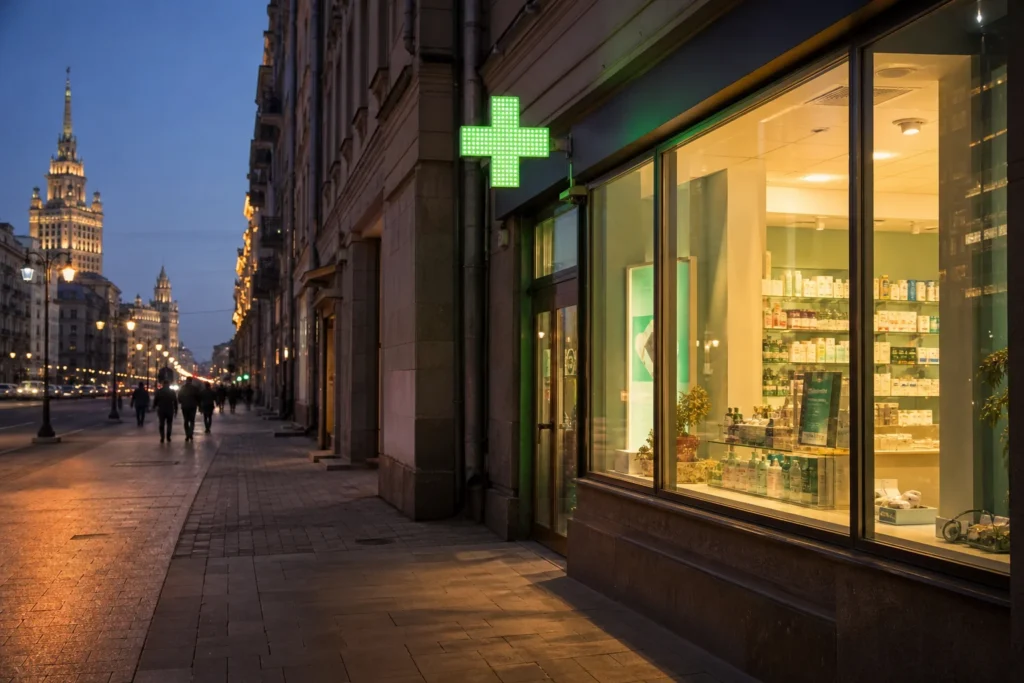
This guide explains how to find a pharmacy and get medical help in Moscow, for travelers from abroad who want to know the numbers and the steps before they need them. Emergency care is free for foreign visitors, while other treatment is paid or covered by insurance, so a few preparations make a difference.
The recommended way is to carry travel insurance, save 103 and 112 on your phone, and know where to find a pharmacy and a clinic with English-speaking staff. This guide is practical information, not medical advice; in an emergency, call at once.
Quick answer: In an emergency call 103 or 112, free and with English-speaking operators; emergency care is free for foreigners, other treatment is paid or insured. Look for an apteka, many open 24 hours, and use private clinics for English-speaking care.
At a Glance
| Total time | An ambulance team arrives within about 20 minutes in the first case described by the city, an emergency doctor within about two hours in the second |
|---|---|
| Typical cost | Free for emergency care; non-emergency treatment, private clinics and dental care are paid or insured |
| Last updated | Oktober 7, 2026 |
What You Need Before You Start
- Travel or health insurance with an assistance number saved on your phone, and the policy number to hand
- The numbers 103 and 112 saved, and the contact of your embassy
- The names of your regular medicines, written down by their active ingredient
- Rubles in cash, since foreign bank cards are reported not to work in Russia
- Your passport, which clinics may ask for
Compare Your Options
| Option | Duration | Price | Notes |
|---|---|---|---|
| Ambulance, 103 or 112 | Arrival within about 20 minutes for acute cases, according to the city | Free for emergency care, including for foreigners | For acute illness, sudden deterioration or a serious injury. 103 works from landlines and mobiles; 112 works without a SIM card and connects to an English-speaking operator. |
| Remote consultation by 103 | Emergency doctor within up to about two hours if sent | Free, according to the city | For other situations: a senior doctor at the medical advisory station advises by phone, and English-speaking staff are always at the station, according to the city. |
| Private clinic with English-speaking staff | Same day or appointment | Paid or billed to your insurer; not verified | The American Medical Centre and the European Medical Centre cooperate with international insurers and treat in English, and GVM International offers a translator, according to a university guide; one 2026 guide lists a 24-hour English line for EMC at +7 495 933-6655. |
| City emergency stations | Open around the clock | Paid for non-emergency care unless covered | Can be visited for a non-life-threatening injury, according to a city guide; English may not be spoken. |
| Pharmacy (apteka) | A few minutes | Paid for medicines; not verified | Many are open 24 hours, according to a city guide. Show the active ingredient, written down. |
Step-by-Step Instructions
Step 1: Prepare before you travel
Emergency medical care is free for foreign nationals, but any further treatment is free only for people with compulsory medical insurance, and otherwise you pay, according to a city guide, so travel insurance is recommended. Save your insurer's assistance number, your policy number and your embassy's emergency line on your phone. Note your regular medicines by their active ingredient.
Tip: Keep the insurance card and policy number in your wallet.
Step 2: In an emergency call 103 or 112
The ambulance number in Moscow is 103, from a landline or a mobile phone, and 112 is the single emergency number, according to the city's site. The call is free, even if your phone has no balance or no SIM card. After connecting to 112, you are switched to an English-speaking operator, and the 103 operations department always has English speakers, though not every operator speaks English.
Tip: If the line is busy on 103, you may hear a recorded message; hold on.
Step 3: Give the key facts
State your address or landmark, the person's condition, age and symptoms in short sentences, and your phone number. In the first case, where the condition is acute, an ambulance team comes, with an arrival time of up to 20 minutes according to the city; in other cases, a remote consultation with a senior doctor at the medical advisory station by calling 103 may lead to an emergency doctor, arriving within up to two hours.
Tip: Write your hotel's address in Russian script to read out.
Step 4: Know where the ambulance takes you
Russian state ambulances transport patients to the nearest state hospital by default, according to a clinic guide, and emergency care is provided free to all, including foreigners, regardless of insurance, according to guides. If you prefer a private clinic, call your insurer's assistance line first, since private ambulances and clinics are paid and billed through insurance.
Tip: Tell your insurer where you were taken as soon as you can.
Step 5: For non-emergencies, call first
For a non-life-threatening problem, the city's ambulance site says to consult your travel or health insurance policy and act accordingly. Round-the-clock emergency stations can be visited for a non-life-threatening injury, according to a city guide, and a private clinic with English-speaking staff is an option; call first to ask about appointments, languages and insurance. Dental care is usually paid separately.
Tip: Ask whether the clinic bills your insurer directly.
Step 6: Find a pharmacy
A pharmacy in Russian is аптека, pronounced apteka, and pharmacies are found in many places around the city, many of them open 24 hours a day, according to a city guide. Show the pharmacist the name of the medicine by its active ingredient, written down, since brand names differ between countries. Whether a prescription is needed for a given medicine was not verified, so ask.
Tip: Take a photo of the packaging of your regular medicine.
Step 7: Keep receipts and records
Pay in rubles in cash, and keep every receipt, the doctor's notes and any prescription for your insurer. A visit to a clinic for non-emergency treatment is paid by the patient or billed to the insurer, according to guides. Ask for a written summary in English if possible, and keep the ambulance's record of your treatment.
Tip: Photograph the documents before you leave the clinic.
Common Mistakes to Avoid
- Delaying a call because of cost: emergency care is free for foreigners, so call 103 or 112 at once for an acute problem.
- Assuming every 103 operator speaks English: not all do, though the operations department always has English speakers.
- Expecting the ambulance to go to a private clinic: it takes you to the nearest state hospital by default.
- Traveling without insurance: non-emergency treatment, private clinics and dental care are paid.
- Asking for medicine by brand name: show the active ingredient, since brands differ.
- Paying with a foreign card: guides report that foreign cards do not work in Russia, so carry rubles in cash.
- Not keeping receipts: your insurer will need them.
Tickets, Payment and Booking
Emergency care by ambulance is free for everyone, including foreigners, according to the city’s site, mos.ru, and guides; call 103 or 112, which are free even without a SIM card. Non-emergency treatment, private clinics, dental care and medicines are paid by the patient or billed to the insurer. A 2026 guide reports that foreign Visa and Mastercard cards do not work in Russia, so carry rubles in cash; whether private clinics take foreign cards or bill insurers directly was not verified.
- Prices: no price lists were found, so ask the clinic or pharmacy; prices differ.
- Insurers: some private clinics work with international insurers, according to a university guide; confirm before you go.
Check the current numbers and rules on mos.ru and with your insurer.
Helpful Links
Compare hotel pricesSearch flights
Advertisement: these are partner links. If you book or buy through them, we may earn a commission at no extra cost to you.
Moscow Vibes Tips
- The Medincentre of the Ministry of Foreign Affairs at 4th Dobryninsky Pereulok 4, near Dobryninskaya metro station, is listed by a university guide with English-speaking staff at +7 499 237-17-06; the guide is old, so check before you rely on it.
- Your embassy provides English-language emergency assistance, and major embassies keep 24-hour lines for citizens, according to a guide, so save yours.
- Dial 112 when you have no balance, a blocked SIM or no SIM at all; the city's site says it works in all of these cases.
- A pharmacy's sign often shows the 24-hour hours, according to a guide, but check before you travel across the city at night.
- Some Russian hospitals have arrangements with the diplomatic corps administration and accept foreigners at more moderate prices than Western clinics, according to a guide; ask your insurer.
- Keep a photo of your passport and your insurance card on your phone in case you cannot reach your wallet.
Explore Nearby How to find a pharmacy and get medical help in Moscow
Metro stations near How to find a pharmacy and get medical help in Moscow
 Dobryninskaya Metro Station
Main image: AI-generated illustration. It may not show the place exactly as it looks.
Related guides
 How to register your stay in Moscow as a foreign visitor: Deadlines
Main image: AI-generated illustration. It may not show the place exactly as it looks.
 How to use taxi apps in Moscow: Yandex Go, Cash Payment and Safety
Main image: AI-generated illustration. It may not show the place exactly as it looks.
 How to use the Moscow Metro as a tourist: Tickets, Fares and Lines
Main image: AI-generated illustration. It may not show the place exactly as it looks.
 How to avoid common tourist scams in Moscow: Taxis, Fake Police, Bills
Main image: AI-generated illustration. It may not show the place exactly as it looks.
 How to read Cyrillic quickly as a traveler: Letters, Words and Signs
Main image: AI-generated illustration. It may not show the place exactly as it looks.
Browse more: All Etiquette and Safety · All How-To
FAQ
What number do I call for an ambulance?
103, from a landline or mobile, or 112, the single emergency number. Both are free.
Is emergency care free for tourists?
Yes, emergency care is provided free to foreigners, regardless of insurance, according to guides.
Is English spoken?
112 connects to an English-speaking operator, and the 103 operations department always has English speakers, though not every operator does.
How do I find a pharmacy?
Look for аптека, apteka; many are open 24 hours, according to a city guide.
Do I need insurance?
It is strongly advised: non-emergency treatment is paid or insured.
Which clinics treat English speakers?
The American Medical Centre, the European Medical Centre and GVM International are listed, according to a university guide.
Can I call without a SIM card?
Yes, 112 works with no SIM or balance, according to the city's site.
Is dental care free?
No. Dental care is usually paid separately, and fees are often high, according to a city guide.
Discover More of Moscow with Our Travel Tips
Get practical Moscow travel tips, new destination guides and useful updates on attractions, opening hours and prices. Plan your visit with clear, helpful information delivered to your inbox.
Moscow Vibes is a one-person project. A coffee keeps it going
Last updated: October 7, 2026. Found an error or something out of date? Report it and we will check and fix it.
How we research and update our guides
About this guide: AI assistance and accuracy
This guide is created with the help of AI and is based on official sources where available. Mistakes can still happen. Opening hours, prices, rules and other details are given to the best of our knowledge as of the date shown and can change without notice. It offers general recommendations only, not professional, legal or travel advice. Please confirm important details with the official source before you travel; you are responsible for your own plans and decisions.
International sanctions affect payments between Russia and many other countries. In practice, cards issued in the EU, the UK, the US and several other countries often do not work in Russia, Russian cards usually do not work abroad, and some booking platforms, airlines and payment providers limit or suspend their services for Russia. The situation changes frequently. We do not give legal or financial advice, and this site does not encourage anyone to break or circumvent sanctions. Whatever you plan, you are responsible for following the laws and regulations that apply to you, including those of your country of residence and citizenship. Many travelers still organise their stay lawfully. It is worth asking your bank or payment provider what is currently permitted, contacting hotels, tour operators and carriers directly about the payment methods they accept, and checking which services are open to customers from your country. Clarify payment, cancellation and refund terms before you commit to a booking, and keep your plans flexible. Partner links on this site may not be available in every country, and prices, availability and rules in our guides can differ from what you see when you book.Paying for your trip: please read
Report an issue on this page
* Affiliate link: as an Amazon Associate we earn from qualifying purchases at no extra cost to you.
 Ask Masha