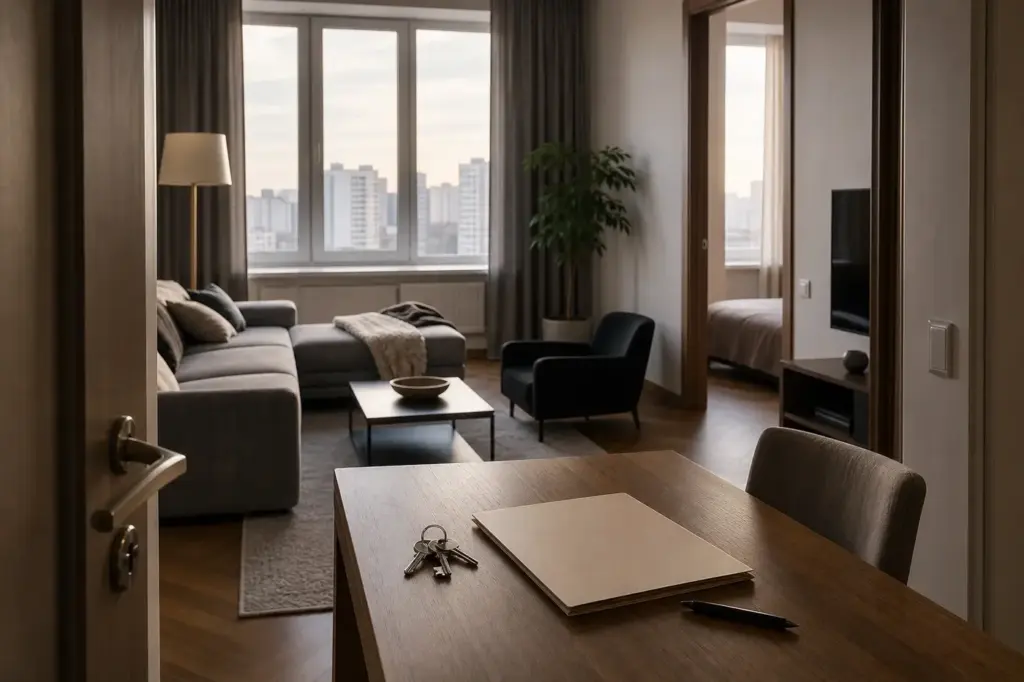
This guide explains how to rent an apartment in Moscow, from checking the owner’s authority to signing a contract and recording the flat’s condition. It is for foreign residents and anyone planning a longer stay who needs to understand what the landlord, agent and tenant are each responsible for. View the flat, verify who can sign, and agree on the written terms before handing over money.
If you need migration registration, discuss it at the first viewing and settle who will submit the arrival notification before committing. This guide reflects official information as of November 2026. Requirements can change. For property records, check with Rosreestr. For migration registration, confirm your case with the territorial office of the Russian Ministry of Internal Affairs. This is general information, not legal advice.
Quick answer: View the flat, verify the landlord’s authority, and sign a written agreement covering rent, deposit, fees and move-in. Agree who will handle any migration notification. Timing and costs depend on the property and the parties.
At a Glance
| Total time | Allow time for viewings, document checks and contract review. The move-in date depends on when the flat is available and when both parties can sign and complete the handover. |
|---|
What You Need Before You Start
- Passport or other identity document accepted for the agreement
- Intended move-in date, tenancy length and names of occupants
- Budget for rent, utilities, security payment and any agent fee
- Exact address and, where available, the cadastral number
- Owner’s identity and ownership documents, or proof of a representative’s authority
- Draft tenancy agreement and handover record
- Migration documents and a filing plan if registration is required
Compare Your Options
| Option | Duration | Price | Notes |
|---|---|---|---|
| Rent directly from the verified owner | Depends on availability and document checks | Suitable if you can arrange viewings and review the terms yourself. The owner is your main contact for the tenancy agreement, property handover and any cooperation required for migration registration. | |
| Rent through a real estate agent | Depends on search, viewing and signing schedules | Useful if you need help finding suitable flats, arranging viewings or communicating in Russian. Confirm the scope of the service and the commission terms separately. Check the owner’s identity and the authority of anyone signing on the owner’s behalf. | |
| Use a serviced apartment while searching | According to the accommodation booking | Useful if you need an address on arrival and want to view longer-term options in person. Ask the operator whether it handles migration registration and how it will give you proof. Check the arrangements again for the later move into a private flat. | |
| Arrange housing through an employer or university | According to the institution’s housing terms | Check this option if the institution offers staff housing, university accommodation or a landlord referral. Ask who signs the occupancy agreement, what happens when work or study ends, and which person handles registration for your actual address. |
₽ budget · ₽₽ moderate · ₽₽₽ upscale · ₽₽₽₽ splurge. Price levels are estimates compared with typical prices for visitors.
Step-by-Step Instructions
Step 1: Decide where you need to live
Start with your daily destination and test the journey from the flat’s street address. Measure the walk to the station entrance, the transfers and the walk at the other end. Ask for the full breakdown of recurring costs and the amounts due at move-in. If you are comparing furnished flats, identify anything you would need to buy yourself. This gives you comparable figures across listings with different utility and furnishing arrangements.
Tip: If a listing says the flat is near a metro station, check which station entrance you would use and whether the walking route crosses a major road.
Step 2: Ask about registration before arranging a viewing
Tell the owner or agent that you will be living at the address and may need migration registration there. Ask whether the owner will provide the documents and cooperate with the arrival notification. If a partner or child will live with you, give the details needed to confirm the arrangement for each person. Where Moscow’s Amina pilot applies, check the address-reporting procedure with the Moscow Migration Centre before agreeing to a filing plan.
Tip: Ask the owner to explain what they will do in practice. A listing that says registration is available leaves the filing steps open.
Step 3: Inspect the flat and the building
Visit the actual unit and confirm the building, entrance, floor and flat number. Test the taps, hot water, appliances, locks and windows with the person showing you the property. Look for water marks, damaged fittings or extractor fans that do not work. Ask how the building handles heating and repairs, and confirm internet availability at the address. Write down the defects the owner agrees to deal with before or after you move in.
Staying a few nights? A sleep mask could be worth bringing.
Tip: Ask to see the utility meters during the viewing so you know whether you can read them yourself at handover.
Step 4: Verify who has authority to let the flat
Ask the owner to show identity and current ownership evidence and compare it with the address and flat details. An extract from the Unified State Register of Real Estate, called EGRN, is the usual starting point. A third-party extract may omit the owner’s personal details. If an agent, relative or other representative will sign or receive money, check the document giving them that authority. If several people own the flat, establish whose signature or authority is required.
Tip: Compare the representative’s authority to sign with their authority to receive payments. Ask about each separately.
Step 5: Agree on what each payment covers
Separate rent, the security payment, any advance rent, utilities and the agent’s fee. Put each item in writing with its purpose, recipient and due date. For the security payment, agree on what it covers, what evidence supports a deduction and when the balance is returned after handover. If the owner says you can apply the security payment to the last month’s rent, ask for that term in the agreement before relying on it.
Spending time on the metro? A power bank may come in handy.
Tip: Ask whether final utility charges will be available at checkout and how the parties will settle them if the bill arrives later.
Step 6: Review the full tenancy agreement
A residential tenancy agreement with an individual tenant is generally called a dogovor nayma and is made in writing. Check the address, parties, permitted occupants, dates, payment terms and procedure for ending the agreement. Agree who handles repairs and how the owner will arrange access to the flat. If you are working from a translation, check which wording will govern and clarify ambiguous clauses before signing. Have the owner and tenant retain signed copies.
Tip: Specify where formal notices should be sent and which method the parties will use to confirm receipt.
Step 7: Check the agent’s terms separately
If an agent is involved, ask who engaged them, which services they provide and who owes the commission. Read the agency agreement and confirm what triggers payment, such as signing the tenancy agreement or reaching handover. Clarify any reservation or viewing charge before agreeing to it. An agent may arrange the viewing and negotiate the terms while the owner retains authority to sign. Obtain the agent’s written terms separately from the accommodation agreement.
Long journey ahead? Coloring books may make the trip a little easier.
Tip: If the agent offers a package, ask which services continue after signing and whom you should contact about a problem at handover.
Step 8: Sign the handover record and document payments
At move-in, go through an acceptance and handover record, often called an akt priyoma-peredachi. Record the condition of the rooms, furniture and appliances, any unresolved defects, meter readings and the keys or access devices received. Date the record and keep copies of any agreed photographs. Pay the amounts due under the signed agreement and obtain proof showing the recipient, the purpose of each payment and the period it covers.
Tip: Photograph the meter display with its identifying number where visible, so a later reading can be matched to the correct meter.
Step 9: Complete registration and plan for checkout
Follow the migration procedure confirmed for your status and address after moving in. Ask for the accepted arrival notification or other applicable confirmation and save it with your tenancy documents. Keep the handover record, communication about repairs and proof of payments throughout the tenancy. Before moving out, review the notice provisions and arrange a final inspection, key return and meter readings so there is a clear record for the deposit settlement.
Exploring on foot all day? A sling bag could be worth having.
Tip: Put the agreed notice date in your calendar as soon as you sign, especially if you expect to leave before the contract ends.
Common Mistakes to Avoid
- Committing to an advertised flat before confirming its exact unit and inspecting it. Arrange a viewing of the unit you would occupy.
- Accepting a cropped ownership document without matching it to the person and property. Ask for current evidence and check the details.
- Paying the agent and assuming the amount will be credited to rent. Record the payee and purpose for every payment.
- Agreeing to a security payment without putting the refund conditions and timing in the contract.
- Taking keys without recording damaged items or opening meter readings. Sign the handover record while both parties can inspect the flat.
- Relying on an informal promise about migration registration. Confirm the responsible filer, required documents and applicable deadline.
Tickets, Payment and Booking
Use the listing to arrange a viewing and obtain the draft terms. Before paying a reservation amount, confirm the property, the proposed signer and the written conditions for refund or credit toward another payment. At signing, agree how rent and any other charges will be paid and recorded. For a transfer, confirm the named recipient and payment reference. For cash, obtain a signed receipt that identifies the payment and the flat.
When comparing offers, include rent, utility items, the security payment and any separate agent commission. If an intermediary asks for money to release the owner’s contact details, check what written service it is actually offering and when you would owe the charge.
Moscow Vibes Tips
- Check the journey at the time you would normally travel. A viewing on a quiet afternoon tells you little about the walk and transfers during your morning commute.
- Ask who must be contacted for an urgent leak or loss of heating. Keep the owner’s instructions and the building management contact with your tenancy records.
- Confirm which furniture and appliances belong to the letting if the current occupant is still moving out. Ask for the inventory to reflect what will actually be there at handover.
- If you need a bilingual agreement, match the clause numbers in both versions. This makes it easier to discuss a particular repair, payment or notice term later.
- If you plan to work from home, ask which providers serve the building and whether the current connection stays active after the owner or previous tenant leaves.
Keep reading
Next steps



FAQ
Does a Moscow apartment tenancy have to be registered with Rosreestr?
Article 674 of the Russian Civil Code requires state registration of the restriction on the owner’s property rights arising from a residential tenancy concluded for at least one year. Ask Rosreestr what the parties must submit for your agreement. This property-register procedure is separate from migration registration at the address.
Can I file my own migration arrival notification with a signed rental contract?
Russian migration law provides a route for a foreign national with a qualifying residential tenancy agreement to submit an arrival notification personally in defined circumstances. Confirm the requirements with the territorial office of the Ministry of Internal Affairs, including what the agreement must show and whether a Moscow pilot procedure applies to you.
What if the owner says a relative will sign for them?
Ask to see the document authorising the relative to act and compare the identity details with the people involved. Check which actions it covers, including signing the agreement, receiving funds and carrying out the handover. If the scope is unclear, confirm the arrangement with the owner before signing or paying.
Is a security payment the same as paying rent in advance?
The agreement should state what each payment does. Advance rent covers a specified rental period. A security payment can cover agreed obligations, subject to the contract’s terms and applicable law. Ask the owner to identify the payment clearly in both the agreement and the receipt, including when any remaining security amount is due back.
Can the landlord raise the rent during the tenancy?
Check the existing rent clause and any provisions on changes, including the date, method and notice period. The Russian Civil Code generally limits unilateral changes to residential rent to cases allowed by law or the agreement. If a proposed increase is unclear or disputed, obtain advice on the wording and the rules that apply.
Who pays for repairs and damage in a rented flat?
Read the agreement for the allocation of maintenance, repairs and responsibilities for damage. The handover record helps establish the condition when you moved in. Report a defect promptly and keep the discussion in writing. If an urgent repair is needed, clarify who can authorise the work and how any costs will be handled.
What should I do if I need to move out early?
Check the agreement and applicable notice rules before setting a departure date. Give notice through a documented channel and confirm the date for the final inspection, meter readings and key return. Ask for an itemised account of outstanding rent, utilities or claimed deductions, and keep the records until the final settlement is complete.
Can my partner or child move in after I sign?
Check the agreement and discuss adding the occupant with the owner. Confirm whether the parties need to amend the tenancy documents and whether the new resident has a separate migration registration requirement. If the owner, agent or institution arranged the initial filing, ask who will handle any additional notice for the new arrival.
Discover More of Moscow with Our Travel Tips
Get practical Moscow travel tips, new destination guides and useful updates on attractions, opening hours and prices. Plan your visit with clear, helpful information delivered to your inbox.
Moscow Vibes is a one-person project. A coffee keeps it going
Not legal advice. This is general information for visitors. Rules on visas, entry, registration, customs and similar matters change often and can depend on your nationality. Check the official source and, if in doubt, ask your embassy or a qualified adviser.
More in this section: Living in Moscow
Get a free PDF of this guide to print or read offline: key facts, tips and a map link on a few clean pages.
Take this guide with you
About this page
Report an issue on this page
Paying for your trip: please read
Payments and bookings between Russia and many other countries are currently restricted. In practice, cards issued in the EU, the UK, the US and several other countries often cannot be used in Russia, Russian cards usually cannot be used abroad, and some booking platforms, airlines and payment providers limit or pause their services for Russia. The situation changes frequently.
We do not give legal or financial advice, and this site does not encourage anyone to break any rule that applies to them. Whatever you plan, you are responsible for following the laws and regulations that apply to you, including those of your country of residence and citizenship.
Many travelers still organise their stay without problems. It is worth asking your bank or payment provider what is currently possible, contacting hotels, tour operators and carriers directly about the payment methods they accept, and checking which services are open to customers from your country. Clarify payment, cancellation and refund terms before you commit to a booking, and keep your plans flexible.
Partner links on this site may not be available in every country, and prices, availability and rules in our guides can differ from what you see when you book.
How we research and update our guides
About this guide: AI assistance and accuracy
This guide is created with the help of AI and is based on official sources where available. Mistakes can still happen. Opening hours, prices, rules and other details are given to the best of our knowledge as of the date shown and can change without notice. It offers general recommendations only, not professional, legal or travel advice. Please confirm important details with the official source before you travel; you are responsible for your own plans and decisions.
* Affiliate link: as an Amazon Associate we earn from qualifying purchases at no extra cost to you.