
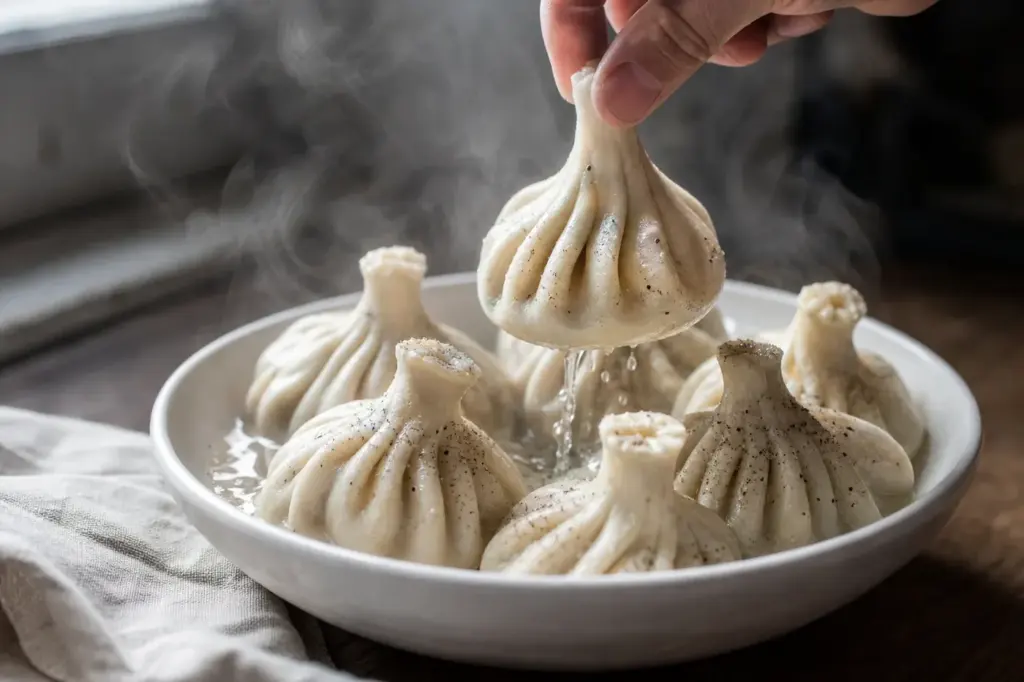
Khinkali are dumplings in Georgian cuisine that have become increasingly familiar across Moscow restaurants and at Georgian tables. This guide walks you through making them at home—from preparing the dough to shaping the characteristic pleated top and boiling them until they float.
Making khinkali is practical and achievable for a home cook, though the folding requires practice. The key step is understanding that the meat filling is uncooked when the khinkali is assembled, so when cooked the juices of the meat are trapped inside the dumpling. This creates the distinctive broth that makes eating them an experience rather than just a meal.
Quick answer: Khinkali originate in the mountainous regions of eastern Georgia. The traditional recipe combines a soft dough wrapper with a seasoned raw meat filling. After assembly, they boil for 6–8 minutes until they rise to the surface and are ready to serve.
At a Glance
| Type | Dishes |
|---|---|
| Local name | Хинкали |
| Origin | Khinkali originate in the mountainous regions of eastern Georgia, and the invention of the dish is credited to the Mokhevians, as well as the Pshavians, Mtiuletians, and Khevsurians. |
| Servings | 2–3 as a main (4–6 dumplings per person) |
| Total time | 60–75 minutes (including 30–40 minutes dough rest) |
| Difficulty | Medium |
History and Story of Khinkali (Хинкали)
Khinkali originated in the mountainous regions of Georgia, where they were traditionally prepared by shepherds and farmers. The dish was created as a hearty and portable meal. Traditionally, khinkali are made with coarsely chopped meat. In the mountain areas, this method of preparation is still used. Khinkali is also connected to old Georgian hospitality traditions — it was a must-serve dish during feasts and gatherings. The famous “pleats” (the twisted top of the dumpling) became a symbol of craftsmanship: the more folds a cook could create, the more respected they were.
Ingredients
- 300 g all-purpose flour
- 150 ml warm water
- 1 egg
- ½ teaspoon salt (for dough)
- 250 g ground beef and pork mix
- 1 small onion, finely chopped
- ½ cup cold water (for filling)
- ½ teaspoon salt (for filling)
- 1 teaspoon ground cumin
- ¼ teaspoon black pepper
- 2 tablespoons fresh cilantro, finely chopped
How Khinkali (Хинкали) Is Made
Step 1: Prepare the dough
In a mixing bowl, combine the flour and salt. Gradually add warm water, mixing with a wooden spoon until a smooth dough forms. Knead the dough on a floured surface for about 10 minutes until it becomes soft and elastic. The dough should be smooth but not sticky.
Tip: Add water a little at a time; you may not need all of it depending on flour absorbency.
Step 2: Rest the dough
Cover the dough with a clean kitchen towel and let it rest for at least 30 minutes. This will allow the gluten to relax and make it easier to roll out. Do not skip this step—rested dough is easier to shape.
Tip: A dough that is too stiff to work with has not rested long enough.
Step 3: Make the filling
In a large mixing bowl, combine the ground beef or lamb with the chopped onion, salt, black pepper, and red pepper flakes. Mix everything together until well combined. Gradually add the water to the filling mixture, stirring constantly until it becomes a smooth and slightly sticky consistency. The main secret is the water in the filling. It turns to steam and then to broth during cooking. The filling should be almost liquid, not a firm ball.
Tip: The water-to-meat ratio is what creates the broth inside; don't be afraid of a wet filling.
Step 4: Shape the dumplings
Roll out the dough into a thin sheet, about 1/8 inch thick. Using a round cookie cutter or a cup, cut out circles of dough, approximately 3-4 inches in diameter. Place a tablespoon of filling in the center of each circle of dough. Take the edges of the dough and pinch them together at the top to form a pouch, leaving a small hole at the top. The knot at the top (called the kudi) should be twisted firmly to seal.
Tip: Work quickly so the dough circles do not dry out; cover unused dough with a kitchen towel.
Step 5: Boil the khinkali
Bring a large pot of salted water to a boil. Gently place the khinkali in the boiling water, making sure they don't stick together. Use a spoon to gently move them around so they don't stick to the bottom. Boil your Georgian dumplings for about 6 to 8 minutes (they will flip upside down and float to the surface when done). Lower the heat if needed so it's a gentle but not rapid boil.
Tip: Boil in batches if your pot is small; overcrowding causes them to stick.
Variants
- Cheese, potato, or mushroom fillings are alternatives to meat.
- In the mountain version — mtiuluri — khinkali are made small, with a more pungent filling and more herbs. The city version — kalakuri — appeared later: larger, milder in flavour, with thinner dough.
- City versions include kalakuri khinkali (with thinly chopped parsley) and khevsuruli khinkali (without parsley).
- Lamb khinkali: In the mountains, khinkali is often made with a lamb filling.
Common Mistakes to Avoid
- If you pierce khinkali with cutlery, the juice flows onto the plate because inside the khinkali is hot broth. Assemble the dough seal firmly so it does not leak during cooking.
- If the dough is too thick, the khinkali will be doughy rather than tender. Roll to no more than ⅛ inch thickness.
- If the filling is too dry (no water added), there will be no broth inside—only tough, stringy meat. Mix in water until the filling resembles a loose paste.
- Overcrowding the pot causes khinkali to stick together and tear. Boil in batches or use a very large pot.
- If the water is not adequately salted, the khinkali will taste bland. Use seawater-level salinity.
- Skipping the dough rest means the dough will be difficult to shape and more likely to tear when you pleat it.
How to Order and Eat It
Use your hands. Pick the khinkali up by its topknot, the twisted knob of dough called the kudi, and turn it upside down so the knot points at the ceiling. Take a small bite from the side, then suck out the hot broth before you eat anything else. This is the moment that separates good khinkali from bad: the filling should release a real mouthful of juice. Eat your way around the dough and filling, and put the topknot back on your plate. It’s thick and undercooked by design, a handle rather than food.
The kudi is not eaten — it is the cook’s “handle” for shaping and the diner’s grip for eating. The number of kudis left on your plate at the end of a meal is traditionally how portions are counted. Georgians grind plenty of black pepper over the heap before anyone starts. It’s the only seasoning most people add.
To order: Хинкали [khinkali]
Where to Try Khinkali (Хинкали)
 Khachapuri Georgian
Main image: AI-generated illustration. It may not show the place exactly as it looks.
 Bagebi Georgian, with author dishes and French technique
Main image: AI-generated illustration. It may not show the place exactly as it looks.
 Sakhli Georgian
Main image: AI-generated illustration. It may not show the place exactly as it looks.
 Megobari Georgian
Main image: AI-generated illustration. It may not show the place exactly as it looks.
Moscow Vibes Tips
- The water inside khinkali is very hot when they arrive at the table. Let them rest for 1–2 minutes and make a small first bite to release steam before slurping the broth to avoid burning your lips.
- The filling should release a real mouthful of juice. If there is almost no broth inside your finished khinkali, the cook did not add enough water to the filling or the filling was squeezed out during shaping.
- In Moscow restaurants, many chef cooks now make khinkali, but consistency varies widely. Those made with hand-pressed filling and properly sealed dough will have the most broth.
- If you cannot find fresh cilantro, finely chopped fresh parsley is an acceptable substitute, though cilantro is more traditional.
- Typically contains gluten. The filling traditionally contains pork; lamb and beef versions are common alternatives.
Where to Find Khinkali (Хинкали) in Moscow
Related guides
 10 Best Places to Try Russian Food in Moscow: Classics and Canteens
Main image: AI-generated illustration. It may not show the place exactly as it looks.
 10 Best Food Markets and Food Halls in Moscow: Where to Eat Indoors
Main image: AI-generated illustration. It may not show the place exactly as it looks.
 Moscow Food Tour: Russian Cuisine and Local Specialties: One-Day Route
Main image: AI-generated illustration. It may not show the place exactly as it looks.
Browse more: All Food & Drink · All Other
FAQ
What is the difference between khinkali and pelmeni?
Khinkali has a high volume of broth—it is essentially a soup bowl made of dough that must be slurped first. Pelmeni have low volume; the meat is juicy, but there is no heavy liquid trapped inside. Khinkali are eaten by hand, pelmeni with a fork.
Can I make khinkali ahead of time?
Yes. After shaping, place khinkali on a floured tray and freeze them uncovered for 2 hours, then transfer to a freezer bag. They can be boiled directly from the freezer; add 1–2 minutes to cooking time.
Why did my khinkali burst while cooking?
The seal was not tight enough or the dough was punctured during shaping. Make sure the pleated knot is twisted firmly so no gap remains. Also check that the water was at a rolling boil when you added them.
Is it okay to eat the kudi (topknot)?
It's thick and undercooked by design, a handle rather than food. It is not harmful to eat but is deliberately left on the plate in traditional Georgian dining.
What should I serve with khinkali?
Georgians grind plenty of black pepper over the heap before anyone starts. It's the only seasoning most people add. They pair well with cold beer or amber wine.
Can I use a food processor to chop the onion?
Yes. A food processor creates a finer, more evenly chopped onion than a knife, which helps distribute moisture evenly through the filling.
How many khinkali should I make for one person?
A normal serving is 6–10 pieces per person. Order 5 to start, then get more.
What does khinkali taste like?
Fresh coriander, cumin, and a heavy, warming dose of cracked black pepper define the spice profile. The broth inside is savory and hot, the filling richly spiced.
Discover More of Moscow with Our Travel Tips
Get practical Moscow travel tips, new destination guides and useful updates on attractions, opening hours and prices. Plan your visit with clear, helpful information delivered to your inbox.
Moscow Vibes is a one-person project. A coffee keeps it going

Take this guide with you
Get a free PDF of this guide to print or read offline: key facts, tips and a map link on a few clean pages.
Report an issue on this page
Paying for your trip: please read
Payments and bookings between Russia and many other countries are currently restricted. In practice, cards issued in the EU, the UK, the US and several other countries often cannot be used in Russia, Russian cards usually cannot be used abroad, and some booking platforms, airlines and payment providers limit or pause their services for Russia. The situation changes frequently.
We do not give legal or financial advice, and this site does not encourage anyone to break any rule that applies to them. Whatever you plan, you are responsible for following the laws and regulations that apply to you, including those of your country of residence and citizenship.
Many travelers still organise their stay without problems. It is worth asking your bank or payment provider what is currently possible, contacting hotels, tour operators and carriers directly about the payment methods they accept, and checking which services are open to customers from your country. Clarify payment, cancellation and refund terms before you commit to a booking, and keep your plans flexible.
Partner links on this site may not be available in every country, and prices, availability and rules in our guides can differ from what you see when you book.
How we research and update our guides
About this guide: AI assistance and accuracy
This guide is created with the help of AI and is based on official sources where available. Mistakes can still happen. Opening hours, prices, rules and other details are given to the best of our knowledge as of the date shown and can change without notice. It offers general recommendations only, not professional, legal or travel advice. Please confirm important details with the official source before you travel; you are responsible for your own plans and decisions.
* Affiliate link: as an Amazon Associate we earn from qualifying purchases at no extra cost to you.