
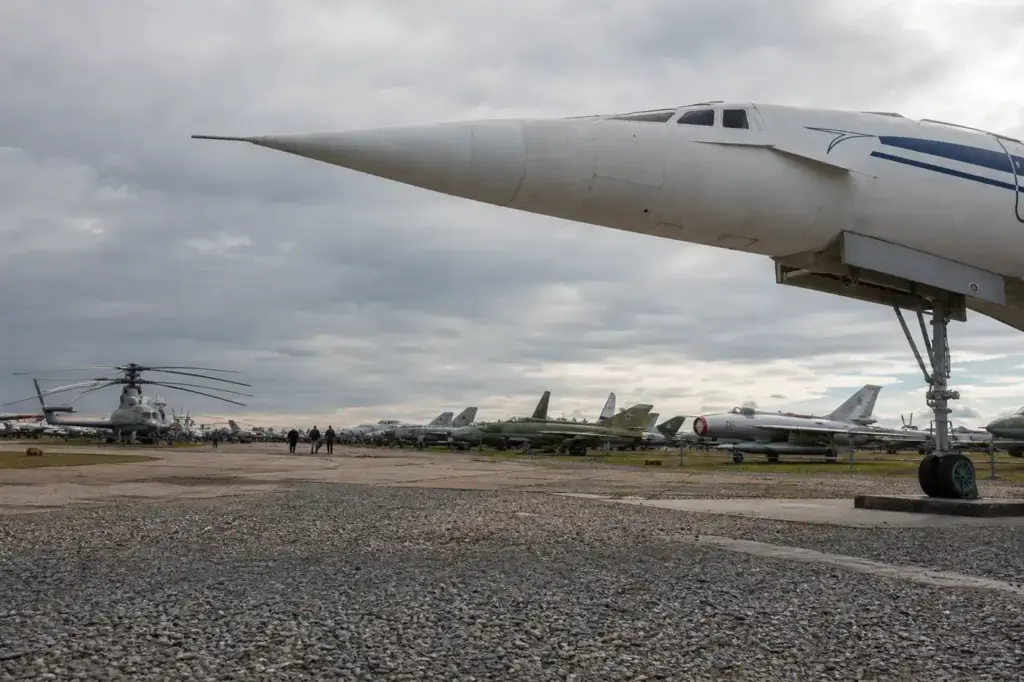
The Monino Air Force Museum Day Trip from Moscow takes you to one of the world’s largest aviation collections. The Central Air Force Museum, as it is officially known, occupies a sprawling former airfield with aircraft arranged across hangars and open-air grounds. Home to over 170 planes and helicopters—many unique prototypes—the museum chronicles Soviet and Russian air power from the 1920s to today.
The journey itself is straightforward: a fast commuter train departs hourly from Yaroslavsky Station in central Moscow, taking approximately 90 minutes to Monino. From there, a short walk or ride brings you to the gates. Most visitors spend 4–5 hours exploring the collection before returning the same day.
Quick Facts
| Russian name | Центральный музей Военно-воздушных сил Российской Федерации |
|---|---|
| Distance from Moscow | 40 km (25 miles) |
| Travel time from Moscow | 1.5–2 hours by commuter train each way |
| Built / opened | 1958 |
| Address | Muzeynaya Ulitsa 2, Monino, Moscow Oblast 141170, Russia Google MapsApple MapsYandex Maps2GIS |
| Opening hours | Wed-Sun 10:00-17:00; Mon-Tue closed |
| Admission | ₽ (budget) |
| Best time to visit | Spring (April–May) and early autumn (September–early October) are ideal: mild temperatures, clear skies, and manageable crowds. Summer (June–August) brings heat and tourists; some aircraft cabins and unheated hangars become uncomfortably warm. Winter (November–February) means cold, snow, and ice on the ground—bring insulated boots and warm layers. Most of the collection is outdoors.Avoid Russian school holidays and national holidays (May 9 Victory Day, June holidays) when domestic visitor numbers surge. Weekday mornings (Tuesday–Thursday) are typically quieter than weekends.The museum closes Mondays and Tuesdays; plan your visit for Wed–Sun. Wednesday–Friday tend to have fewer visitors than Saturday–Sunday. |
| Website | cmvvs.ru |
What Is (and Isn't) Part of a Visit to Monino Air Force Museum Day Trip from Moscow?
| Part | Status | Notes |
|---|---|---|
| Central Air Force Museum main exhibits (hangars 1, 6, 8 and open-air Cold War section) | Included in the standard ticket | Single entrance ticket covers all exhibits. Outdoor and indoor areas included. |
| Guided tours in English | Separate ticket or institution | English-speaking guides available for hire on-site or through booking platforms; not included in standard admission. |
| Photography and video inside hangars | Included in the standard ticket | Most tourist tickets include photo permission; confirm when buying your ticket. Some older sources note restricted photography, but current policy permits it. |
| Library and archival films | Included in the standard ticket | Free access to reference library with books, photographs and archive films about Soviet aviation. No separate charge. |
| Cockpit entry on special days (May 9, August 18) | Separate ticket or institution | Certain aircraft cockpits open to visitors only on Russian holidays and air show days. Check official website for dates. |
| Gagarin Air Force Academy | Outside / not part of it | The adjacent military academy is not open to tourists. Do not attempt to enter. The museum lies on its grounds but has a separate perimeter. |
| Active Russian Air Force Base (Chkalovsky Airfield) | Outside / not part of it | The base is adjacent to the museum but off-limits. Aircraft activity overhead is normal and part of the experience; photography of current military jets is not permitted. |
How to Get from Moscow to Monino Air Force Museum Day Trip from Moscow
| Option | Duration | Price | Notes |
|---|---|---|---|
| Commuter train (Elektrichka) from Yaroslavsky Station | 1.5–2 hours return journey; 4–5 hours at museum | ₽ | Most practical independent option. Depart central Moscow via Metro Line 1 or 5 (brown circle) to Komsomolskaya station; walk to adjacent Yaroslavsky Station (also serves long-distance trains to Yaroslavl and Kazan). At the ticket counter inside, ask for a return ticket to Monino (Мо́нино). Trains depart hourly, roughly every 1.5–2 hours. The trip takes ~90 minutes each way. Once at Monino station, walk downhill toward town or take a shared taxi (~3 km) to the museum. Last return trains leave Monino in late afternoon/evening; check the schedule at the station. |
| Private guided tour by car or van | 7–8 hours total (including round-trip transfer from hotel) | ₽₽₽ | Hotel pickup, English-speaking guide, museum entrance fee included. Tour operators offer skip-the-line access and often arrange professional translators (useful if you don't speak Russian). Tours leave early morning and return mid-afternoon. Convenient but significantly more expensive than independent travel. Variants include tours led by former military pilots. |
| Taxi or ride-share (Yandex.Taxi, Uber) door-to-door | 1–1.5 hours each way plus museum time | ₽₽ | Faster than train and direct hotel-to-museum. More expensive than commuter train. Driver waits or departs; arrange return time. Avoid rush hours (8–10 am, 5–7 pm) if possible. Share taxis operate from Monino station; ask the station staff. |
₽ budget · ₽₽ moderate · ₽₽₽ upscale · ₽₽₽₽ splurge. Price levels are estimates compared with typical prices for visitors.
Why Visit Monino Air Force Museum Day Trip from Moscow?
Aviation enthusiasts find treasures here unavailable elsewhere: the Tupolev Tu-144 supersonic airliner, the Mil V-12 (the largest helicopter ever built), experimental designs like the Sukhoi T-4 strategic bomber, and the towering Ilyushin Il-2 Sturmovik. The museum also preserves Cold War artifacts—uniforms, instruments, weapons, and personal effects of Soviet pilots.
Non-specialists appreciate the sheer scale and tangible presence of these machines. Walk among giants: transport planes, fighters, spy planes, and oddities of Soviet engineering. Many aircraft are unique, produced in tiny numbers and displayed nowhere else on Earth. The adjacent active Russian Air Force base adds authenticity; you may hear or see current jets overhead.
Highlights of Monino Air Force Museum Day Trip from Moscow
Tupolev Tu-144 Supersonic Airliner
The Soviet answer to the Concorde, this sleek needle-nosed aircraft sits in the open-air Cold War section. The Tu-144 flew the Moscow-Leningrad route in the 1970s but only briefly; its unique fuselage shape and cranked-delta wings still impress. Look for the twin verticals and the delta canard configuration. Few people have seen one in person.
Tip: Photograph it from the side to capture the distinctive profile. It sits among other strategic aircraft, making a natural photo cluster.
Mil V-12 Heavy Lift Helicopter
In the open-air section, you'll spot the largest helicopter ever built: the Mil V-12 (also called Mi-12). This twin-rotor monster was designed in the 1960s to lift strategic missiles but was cancelled when its purpose became obsolete. At over 37 meters long, it dwarfs every other aircraft present. The raw size is what strikes you first.
Tip: Walk underneath and around it to grasp the scale. The rotor heads alone are taller than a house. Avoid windy days when dust obscures photographs.
Ilyushin Il-2 Sturmovik
The most-produced military aircraft in history sits in hangar 6 (WWII section). The Il-2's angular armor-plated fuselage and low-wing design are instantly recognizable. Dubbed the 'flying tank,' it saw brutal service on the Eastern Front. A placard explains its role in the Great Patriotic War.
Tip: Hangars are dim; bring a torch or use your phone's flashlight to see interior details. The hangar door tends to be partially open for light.
Sukhoi T-4 Strategic Bomber
A sleek, futuristic experimental aircraft from the 1960s Cold War, the T-4 sits in the open-air Cold War section. Built as a high-altitude, high-speed reconnaissance bomber, it was never mass-produced; only a handful of prototypes flew. Its long fuselage, variable-geometry wings, and pointed nose hint at advanced metallurgy and aerodynamics.
Tip: This is the only surviving example anywhere. Station yourself low to capture the airframe against sky for dramatic shots.
Ilyushin Il-76 Cargo Transport
A four-engine transport jet that became the backbone of Soviet logistics, the Il-76 sits in the outdoor section. Familiar to aviation enthusiasts worldwide, it remains in service. The high-mounted wings and cargo-door design are immediately obvious. This represents the 'working' end of Soviet air power.
Tip: Its sheer bulk (and the size of the cargo door) impress close-up. Walk the full fuselage length to sense the scale.
Antonov An-22 Antei Cargo Transport
Called the Antheus in the West, this turboprop-powered giant is the world's largest turbo-prop aircraft. With two massive swept wings and a high tail, it was built to haul military loads. The machinery is visible: proportions are enormous. It sits in the outdoor Cold War exposition.
Tip: Position yourself at the nose for a humbling perspective. The cockpit windows alone are the size of car windows.
Hangar 1: Early Aviation and Military History
Inside the blue-roofed ticket building, this indoor exhibition covers Soviet aviation origins (1920s–1940) and broader Russian military history. Display cases hold piston engines, propellers, pilot uniforms, medals, photographs and paintings. A replica of Mozhaysky's glider (often credited as Russia's first aircraft attempt) features here. Texts are in Russian only.
Tip: Spend 30–40 minutes here, but do not linger if time is tight; the outdoor collection is richer visually.
Hangar 6: World War II Aircraft
Divided into sections 6A and 6B, this hangar showcases fighters and bombers from 1941–1945, including the iconic Polikarpov I-16, Tupolev Tu-2 bomber, and foreign types like the North American B-25 Mitchell and Douglas A-20. The hangar is unheated and dim; bring warm clothes in winter. English-language placards are present for major aircraft.
Tip: Hangar lighting is poor; a flashlight helps. Start at the hangar entrance and work your way back to let your eyes adjust.
Atmosphere
Stepping off the train at Monino station, you enter a small provincial town. A 15–20 minute walk (or short ride) through quiet residential streets brings you to the museum gates. The atmosphere shifts once inside: the vastness of the grounds and the sheer mass of the machines create a sense of scale and power.
Outdoors, the open-air Cold War section feels like a graveyard of giants. Aircraft are tightly packed but still visibly arranged. On clear days, you feel exposed under sky; on overcast days, the metal fuselages merge into the grey. Hangers are dim, cool and slightly damp-smelling. The library room (in one hangar) offers respite—quieter, with archived films and reference works.
Weekday mornings are quieter; weekends and Russian holidays see more Russian school groups and military enthusiasts. Non-Russian speakers rarely appear mid-week. The active air base nearby means you may hear jets overhead at any time. English-language signage is sparse except in the Cold War outdoor section, where major aircraft have English text. Russian-language audio guides and some tours are available.
History of Monino Air Force Museum Day Trip from Moscow
The museum traces its origins to 1940, when the Soviet military selected the village of Monino, east of Moscow, as the site for what would become the Gagarin Air Force Academy. An airfield was built alongside the academy. After the airfield closed to active flying operations in 1956, the Academy retained the base for training.
In 1958, the museum was formally established with a small collection of 6 aircraft and 20 aircraft guns. When it opened to public visitors in 1960, it held 14 aircraft. The Cold War era saw rapid growth: by 1970, the collection had swelled to roughly 40 aircraft. The 1990s brought rearrangement by design bureau (the manufacturer) and chronological order, making the museum more navigable. Over the decades, acquisitions grew until today the museum houses over 170 aircraft.
In 2005, a fire destroyed much of the main hangar and some unique exhibits—a loss that still marks historians. After the Gagarin Air Force Academy relocated in 2009, the museum’s future briefly seemed uncertain. However, it remained open and independent, continuing to acquire aircraft and preserve Soviet aviation heritage. The museum became increasingly accessible to international visitors, with English signage gradually added to major exhibits.
Tickets and Booking for Monino Air Force Museum Day Trip from Moscow
| Ticket | Price | Includes |
|---|---|---|
| Foreign adult admission | ₽ | Access to all hangars and outdoor exhibits, reference library |
| Foreign child/teenager (typically under 16–18; verify on site) | ₽ | Same as adult; reduced rate applies |
| Family ticket (varies by promotions) | ₽₽ | Check official website for current family bundle pricing |
| Group rate (10+ people) | ₽ | Per-person discount for organized groups; book in advance through official site |
₽ budget · ₽₽ moderate · ₽₽₽ upscale · ₽₽₽₽ splurge. Price levels are estimates compared with typical prices for visitors.
Walk-up tickets are available at the blue-roofed ticket office at the museum entrance during opening hours (Wed–Sun, 10:00–17:00). No advance booking is typically required for individual foreign visitors; arrive with 30 minutes before closing to allow time for entry and initial exploration.
The cash desk closes 30 minutes before the museum closes. Payment is in cash (rubles) or card; confirm accepted methods on arrival. Your ticket includes photo permission.
Note: Admission rates for Russian citizens, students, pensioners and military personnel are substantially lower; these are not available to foreign visitors. For the most current pricing and any group bookings, consult the official website cmvvs.ru.
Suggested itineraries Monino Air Force Museum Day Trip from Moscow
4 hours on site
Arrive mid-morning. Start with Hangar 1 (early aviation history): 30–40 minutes. Move to Hangar 6 (WWII section): 40 minutes. Cross to the outdoor Cold War section. Focus on iconic aircraft: Tu-144, Mil V-12, Sukhoi T-4, An-22 (90 minutes walking and viewing). Exit and catch a late afternoon return train to Moscow, arriving ~6:00 pm.
5–6 hours (full day visit)
Morning train arrival by 11:00 am. Hangar 1 and early aviation: 45 minutes. Hangar 6 (WWII): 1 hour. Lunch at museum café or pack food (30–60 minutes). Open-air Cold War section, methodically: 2–2.5 hours (aircraft by era, design bureau). Visit library or special exhibition (30 minutes if time permits). Depart museum by 4:00 pm, return to Moscow by 5:30 pm.
Half-day morning trip
Earliest commuter train from Yaroslavsky (check timetable). Arrive Monino ~9:30 am. Quick run: Hangar 1 (20 minutes), Hangar 6 (30 minutes), one loop of Cold War outdoor highlights: Tu-144, Mil V-12, Sukhoi T-4, An-22 (90 minutes). Return to station by 12:30 pm, back to Moscow by 2:00 pm. Suits visitors with limited time.
Full day with private guide
Hotel pickup 8:30–9:00 am. Arrive museum 10:30–11:00 am. Guided tour led by ex-pilot or professional guide (2–2.5 hours): structured narrative of collection, history, and notable aircraft. Lunch break (1 hour). Free exploration time (1–1.5 hours). Depart museum 3:00–3:30 pm, return to hotel 4:30–5:00 pm.
How to Get to Monino Air Force Museum Day Trip from Moscow
By commuter train (recommended for independent visitors):
- Take the Moscow Metro to Komsomolskaya station (Line 1, red, or Line 5, brown circle line)
- Walk to the adjacent Yaroslavsky Railway Station (Ярославский вокзал). It is a large imperial-era building; you cannot miss it.
- Inside the station, ignore the international long-distance ticket windows and signs to platform 1 (long-distance trains). Instead, walk past the main waiting hall toward the rear of the building, turn left just before the exit doors, and enter the regional train ticket hall (marked Пригородные). Here, small ticket booths serve local and commuter destinations.
- Ask for a return (туда и обратно) ticket to Monino. Say ‘Монино’ to the ticket seller. Trains leave hourly or every 90 minutes depending on the day. Single fare is budget-friendly.
- The journey takes approximately 90 minutes. Trains are basic regional stock—not express, fairly crowded during peak hours.
- At Monino station, exit and walk downhill into the town toward the museum (roughly 15–20 minutes on foot, well signposted, or take a shared taxi for a few hundred rubles).
By taxi or ride-share: Use Yandex.Taxi or Uber from your hotel. Journey is 45–70 minutes depending on traffic and time of day. More comfortable but significantly more expensive than train.
By car with a guide/tour operator: Hotel pickup included; driver navigates. Arrive in 1–1.5 hours from central Moscow.
Accessibility
The museum offers limited accessibility. The grounds are largely flat concrete and gravel in the outdoor section, but some unevenness exists. Hangar floors are concrete and generally level. No wheelchair rental is available on-site. Disabled visitors can contact the museum in advance (phone on official website) to arrange assistance; bring documentation if you require a companion at reduced fare or free entry.Accessible toilets exist but are sparse. Benches and rest areas are minimal. Unheated hangars and open-air exposure mean visitors with certain medical conditions should plan carefully. Heat, cold, and long walking distances (easily 2–3 km within the grounds) are not suited to those with limited mobility.
Food Nearby
The museum grounds lack a full-service café or restaurant. A small kiosk or snack stand may operate during peak seasons (summer), but it is unreliable. The nearby town of Monino has basic shops and small eateries (café, bakery, convenience stores) within a 10–15 minute walk of the station, but these are modest and menus are typically in Russian only.Recommendation: Pack a lunch (sandwiches, snacks, water) from Moscow. Bring a flask of hot tea or coffee if visiting in cold months. The return train journey takes 90 minutes; plan to eat before boarding the return journey or wait until you reach Moscow.
What to Bring
Wear comfortable walking shoes; the grounds are expansive and you will cover 2–3 km on foot. Bring weather-appropriate layers: in summer, a hat and sunscreen (little shade outdoors); in winter, insulated coat, gloves and warm hat (many hangars are unheated). A light rain jacket is useful year-round.Bring a camera or smartphone with a charged battery and good storage. Bring a flashlight or use your phone torch to see interior hangar details. Pack snacks and water; no food is reliably available on-site. Leave large bags at your hotel; the museum does not have a cloakroom, and bag searches are standard security practice at entry.
Best Views and Photo Spots of Monino Air Force Museum Day Trip from Moscow
Tupolev Tu-144 nose-on view from the south
Position yourself south of the Tu-144 to capture the sleek, pointed nose head-on. The delta-wing profile and twin vertical stabilizers frame dramatically. The sun-lit metal contrasts sharply against the Russian sky.
Best time: Morning light (8–10 am) or late afternoon (4–5 pm) from the south or east provides warm side-lighting and defined shadows.
Mil V-12 from beneath the rotor head
Stand directly under the helicopter's massive rotor head and look up. The twin rotors and overhead structure dwarf you and convey impossible scale. The grid pattern of the rotor hub is visible and graphically striking.
Best time: Midday (11 am–3 pm) when overhead light illuminates the rotor structure. Cloudy days reduce glare.
Cold War open-air section panorama from the southeast corner
From a raised spot or standing on a small embankment at the southeast corner of the outdoor exhibition, you capture dozens of aircraft in ranks. The layered perspective—fighters, bombers, transports—receding into the distance creates depth and shows the museum's vastness.
Best time: Afternoon (2–4 pm) when the low sun casts long shadows between aircraft and emphasizes their profiles.
Sukhoi T-4 strategic bomber profile shot
Approach from the west or east to shoot the T-4's long fuselage and variable-geometry wing profile. The sleek, futuristic lines are the aircraft's defining feature; capture the entire side from nose to tail.
Best time: Early morning or late afternoon side-lighting at a low angle reveals surface details and rivets. Avoid harsh overhead noon sun.
Hangar 1 entrance and historic exhibits (interior)
Inside Hangar 1, photograph early aircraft engines, propellers, and display cases of uniforms and medals. The blue-roofed building exterior, photographed from outside, frames the entrance; daylight streaming through hangar doors creates interesting interior shadows.
Best time: Mid-morning (10–11 am) when doors are open and natural light fills the hangar interior.
Photography Rules
Photography and video are permitted with standard admission tickets (confirm when you buy your ticket). Flash photography inside hangars is generally not prohibited, but it may disturb other visitors. Tripods are not explicitly restricted in most sources but may be regulated; ask staff on arrival. The outdoor Cold War section is ideal for photography: wide-angle shots of massed aircraft, close-ups of fuselage details, and dramatic sky backdrops work well. Avoid photographing military personnel or any current aircraft at the adjacent air base.
Family Suitability
Children aged 6 and older generally enjoy the museum; it combines history education with the excitement of giant machines. Young children (under 6) may find the distances and scale overwhelming; the outdoor section requires sustained walking in all weathers. Strollers are impractical on uneven ground.Older children and teenagers fascinated by aviation, engineering, or military history will find exceptional educational value. Interactive cockpit entry (available on May 9 and August 18) delights children. The outdoor scale and freedom to walk between aircraft appeal to families seeking active engagement.Hangar interiors are cool and dim; bring warm jackets even in summer. Unheated hangars in winter are uncomfortable for young children. Accessibility is challenging for families with toddlers or limited mobility. No onsite childcare, café, or play areas.Recommendation: Suit to children aged 8+; plan a half-day visit for younger children.
Moscow Vibes Tips
- Check the train schedule before you go. Commuter trains to Monino depart roughly hourly but with gaps during midday and evening. A missed return train can strand you for 60–90 minutes. Arrive at Yaroslavsky station with 20 minutes to spare and ask staff to confirm the next departure and platform.
- Wednesday is the best day to visit if you value quietness. The museum opens at 10:00 am on Wednesday but is less crowded than Saturday or Sunday. Friday is also relatively quiet. School groups often visit Thursday–Friday; avoid these if crowds bother you.
- Bring a flashlight (or use your phone torch). Hangars 1 and 6 are poorly lit. You will miss details of early aircraft engines and interior displays without supplementary light. A torch makes a dramatic difference to photography inside.
- The outdoor Cold War section can feel aimless if you wander without plan. Pick your must-see aircraft (Tu-144, Mil V-12, Sukhoi T-4, An-22, Ilyushin Il-2) and navigate to them methodically. Ask staff at the ticket office for a printed map or directional guidance if available.
- Do not underestimate the walk. The museum grounds span 20 hectares. Even if you focus on key exhibits, you will walk at least 2 km. Wear supportive shoes and bring water. Allow time for rest; benches are scarce.
- The last return commuter train from Monino typically leaves early evening (check the timetable). If you take a mid-afternoon train, you may only have 3–4 hours at the museum. Aim to arrive by 11:00 am if visiting on a single day trip to maximize time on-site.
Explore Nearby Monino Air Force Museum Day Trip from Moscow
Related guides
 How to get from Moscow to Yaroslavl: Train, Timing and Practical Tips
Main image: AI-generated illustration. It may not show the place exactly as it looks.
More guides
 Konstantinovo and Yesenin Museum Day Trip from Moscow
Main image: AI-generated illustration. It may not show the place exactly as it looks.
 Kubinka Tank Museum Day Trip from Moscow
Main image: AI-generated illustration. It may not show the place exactly as it looks.
 Klin and Tchaikovsky House Museum Day Trip from Moscow
Main image: AI-generated illustration. It may not show the place exactly as it looks.
 Moscow Museum Week: Free Museum Days, Dates and How to Book
Main image: AI-generated illustration. It may not show the place exactly as it looks.
 How to Buy Moscow Museum Tickets Online Without a Russian Bank Card
Main image: AI-generated illustration. It may not show the place exactly as it looks.
Browse more: All Day Trips · All Museums
FAQ: Monino Air Force Museum Day Trip from Moscow
Is Monino inside Moscow city limits?
No. Monino is in Moscow Oblast, approximately 40 km east of Moscow's city center. It is a separate administrative area and reached by a regional commuter train, not the Moscow Metro.
How long should I plan for a day trip?
A full day (8–9 hours total) allows 4–5 hours at the museum. Arrival and departure via train takes roughly 2 hours round-trip. By private tour, the entire excursion is typically 7–8 hours. A half-day visit is possible but feels rushed.
Is there a café at the museum?
No reliable on-site food service exists. A small kiosk may operate in summer but is unpredictable. Bring packed food from Moscow or eat at a café in Monino town before or after your visit.
Do I need to book tickets in advance?
No. Foreign visitors may walk up and buy tickets at the entrance during operating hours (Wed–Sun, 10:00–17:00). No pre-booking is required. Groups of 10+ should book ahead; the museum website provides contact details.
Is the museum accessible for people with reduced mobility?
Limited accessibility. The outdoor sections are mostly flat but expansive (2+ km of walking). Hangar floors are level but unheated. No wheelchair rental; contact the museum in advance if you require assistance.
Can I enter the cockpits of aircraft?
Cockpit entry is restricted to special days (May 9 Victory Day and August 18). Check the official website for annual dates and any special air show events that may open cockpits.
Is English spoken or information available in English?
Limited English signage exists, mainly in the Cold War outdoor section. Hangar 1 and early exhibits are mostly Russian-language only. English-speaking guides are available for hire through booking platforms or on-site. Basic museum staff speak little English; bring a translation app.
What is the best transport option from Moscow—train, taxi, or tour?
For budget travelers: commuter train from Yaroslavsky Station (cheapest, ~90 min each way, hourly departures). For comfort and convenience: private guided tour (most expensive, door-to-door). Taxi is a middle ground. Independent train travel requires Russian language basics but is perfectly feasible.
Discover More of Moscow with Our Travel Tips
Get practical Moscow travel tips, new destination guides and useful updates on attractions, opening hours and prices. Plan your visit with clear, helpful information delivered to your inbox.
Moscow Vibes is a one-person project. A coffee keeps it going
Looking for more on this? Downtown Yekaterinburg: History, Walking Routes and What to See (Russia Vibes)

Take this guide with you
Get a free PDF of this guide to print or read offline: key facts, tips and a map link on a few clean pages.
Report an issue on this page
Paying for your trip: please read
Payments and bookings between Russia and many other countries are currently restricted. In practice, cards issued in the EU, the UK, the US and several other countries often cannot be used in Russia, Russian cards usually cannot be used abroad, and some booking platforms, airlines and payment providers limit or pause their services for Russia. The situation changes frequently.
We do not give legal or financial advice, and this site does not encourage anyone to break any rule that applies to them. Whatever you plan, you are responsible for following the laws and regulations that apply to you, including those of your country of residence and citizenship.
Many travelers still organise their stay without problems. It is worth asking your bank or payment provider what is currently possible, contacting hotels, tour operators and carriers directly about the payment methods they accept, and checking which services are open to customers from your country. Clarify payment, cancellation and refund terms before you commit to a booking, and keep your plans flexible.
Partner links on this site may not be available in every country, and prices, availability and rules in our guides can differ from what you see when you book.
How we research and update our guides
About this guide: AI assistance and accuracy
This guide is created with the help of AI and is based on official sources where available. Mistakes can still happen. Opening hours, prices, rules and other details are given to the best of our knowledge as of the date shown and can change without notice. It offers general recommendations only, not professional, legal or travel advice. Please confirm important details with the official source before you travel; you are responsible for your own plans and decisions.
* Affiliate link: as an Amazon Associate we earn from qualifying purchases at no extra cost to you.