
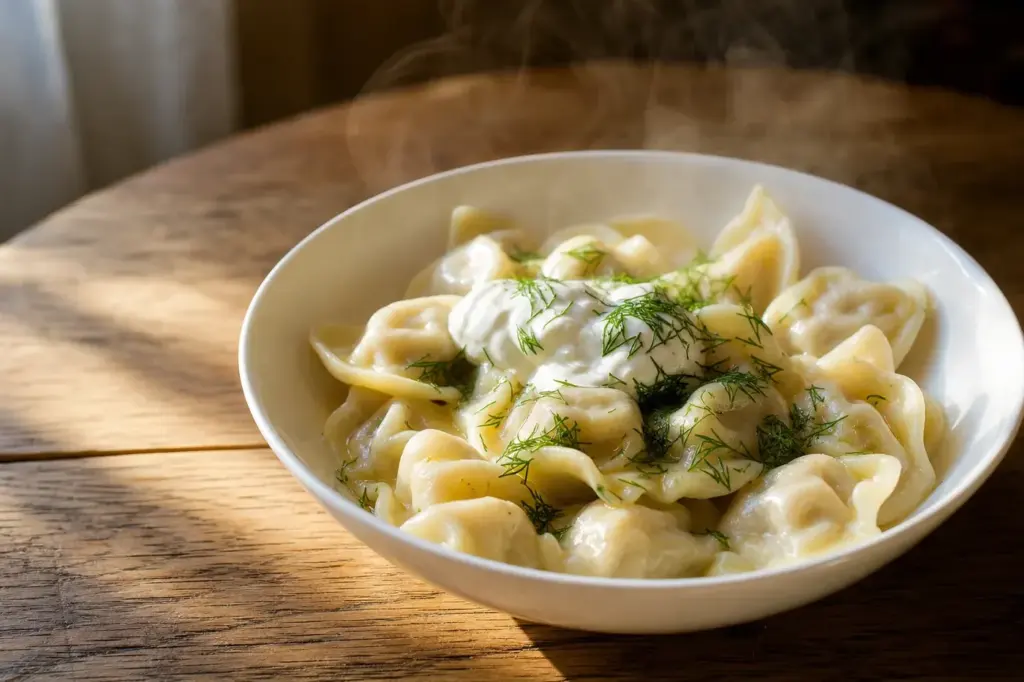
Pelmeni are essential Russian comfort food: small dumplings with thin, delicate dough enclosing a savory meat filling. If you’re interested in how to make pelmeni at home, this guide covers the complete process from dough to serving—no special equipment needed beyond a kitchen table.
The recommended approach is to make the dough first, let it rest, then prepare and fold the dumplings one by one. The filling can be made while the dough rests. Fresh pelmeni cook in minutes; frozen ones take only slightly longer.
Quick answer: Mix a simple dough with flour, water, salt, and egg; rest it for 30 minutes. Make a meat filling from ground beef or pork with onion, salt, and pepper. Roll the dough thin, cut circles, fill, fold into ear-shaped packages, and boil until they float. Total time: 90 minutes for 40–50 dumplings.
At a Glance
| Type | Dishes |
|---|---|
| Local name | Пельмени |
| Origin | Pelmeni became a staple of Russian cuisine during Russian expansion into the Ural Mountains and Siberia. The term "pelmeni" comes from native Finno-Ugric-Komi and Udmurt languages, meaning "ear bread" in reference to their unique shape. It is believed that the Chinese version of this dish arrived in Russian Siberia and the Urals in the 15th century approximately. These small, savoury dumplings were initially developed as a practical and convenient way to preserve meat during long, harsh winters. |
| Servings | 2–4 servings (makes 40–50 dumplings) |
| Total time | 90 minutes |
| Difficulty | Medium |
History and Story of Pelmeni (Пельмени)
This dish originates from Siberia and was a popular meal among coachmen or hunters on their long trips across this vast and cold part of Russia. Families in Siberia would gather to make huge quantities of pelmeni because they can be easily prepared and preserved during long Siberian winters. In lieu of freezers, people would place bags of pelmeni outside during the winter months, a practice still sometimes used today. Residents of central Russia developed a taste for pelmeni around the 19th century, sometimes calling them “little ears” because of their shape. At that time, people began traveling more frequently between regions, partly due to the development of new transport, adopting their neighbors’ traditions. Since then, pelmeni have become firmly established as a staple Russian dish.
Ingredients
- 300–400 g all-purpose flour
- 150 ml water
- 1 egg
- 1 teaspoon salt (divided)
- 250 g ground beef
- 250 g ground pork
- 1 medium onion, finely grated or minced
- 1/2 teaspoon black pepper
How Pelmeni (Пельмени) Is Made
Step 1: Make the dough
In a large bowl, combine 300–400 g flour with 1 teaspoon salt. Make a well in the center and add 1 egg and about 75 ml cold water. Mix with your hands until a shaggy dough forms, adding the remaining water gradually. Knead on a lightly floured surface for 8–10 minutes until the dough becomes smooth and elastic. Shape into a ball, cover with plastic wrap, and rest at room temperature for at least 30 minutes.
Tip: The dough should feel slightly stiff but not dry. If it's too sticky, dust with a bit more flour.
Step 2: Prepare the filling
While the dough rests, combine 250 g ground beef and 250 g ground pork in a bowl. Add 1 finely grated or minced medium onion, 1/2 teaspoon black pepper, and 1/2 teaspoon salt. Mix gently until evenly combined. Some recipes add 1–2 tablespoons of ice water to keep the filling moist during cooking.
Tip: Use meat that's not too lean (at least 20% fat) so the filling stays juicy. Cold filling is easier to work with.
Step 3: Roll and cut the dough
Divide the rested dough into 4 equal pieces. On a floured surface, roll one piece very thin—about 2 mm thick. Using a 3-inch round cutter or a small glass, cut circles from the dough. Place the circles on a floured surface. Gather the scraps, reroll once, and cut more circles. Repeat with the remaining dough pieces.
Tip: Keep unused dough covered with plastic to prevent it from drying out. Pelmeni freeze beautifully at this stage if you want to cook them later.
Step 4: Fill and fold the dumplings
Place about 1 teaspoon of filling in the center of each dough circle. Fold the circle in half, then bring the two corners together and pinch to seal, forming an ear or crescent shape. Press firmly to ensure no filling leaks. Set each finished dumpling on a floured board or plate.
Tip: If the edges dry out while you work, lightly brush them with water before sealing. The classic shape is called a "little ear," but half-moons also work.
Step 5: Boil the pelmeni
Bring a large pot of salted water to a rolling boil. Carefully add the pelmeni and stir gently to prevent them from sticking to the bottom. Let them return to a boil. Once they float to the surface, cook for an additional 4–5 minutes until they are firm and the meat is fully cooked. Remove with a slotted spoon.
Tip: Fresh pelmeni cook faster than frozen. If boiling frozen ones, add them directly to boiling water without thawing.
Step 6: Finish and serve
Transfer the cooked pelmeni to a clean bowl. Toss with a few tablespoons of melted butter. Serve hot with generous dollops of sour cream and fresh dill. Some prefer a splash of white vinegar or a sprinkle of salt on top.
Tip: You can also serve pelmeni directly in their cooking broth as a light soup, or toss them with fried onions for extra richness.
Variants
- Ural pelmeni are prepared with a filling made of a large quantity of onion mixed with three types of ground meat: beef (45 percent), lamb (35 percent) and pork (20 percent).
- Siberian pelmeni use dough made of flour and salt wrapped around filling, which is usually ground beef and pork.
- In southern Udmurtia, traditional mushroom pelmeni called gubien pelnyani have filling made of fried mushrooms, onions and eggs.
- Fish pelmeni called chorygen pelnyani have filling consisting of chopped fish fillet mixed with eggs, vegetable oil or melted butter and salt.
- In Siberia, pelmeni fillings may include game meat like venison or elk.
Common Mistakes to Avoid
- Skipping the dough rest: Resting allows gluten to relax, making the dough easier to roll thin. Rushing this step results in thick, tough dumplings.
- Rolling the dough too thick: Pelmeni should have delicate, thin wrappers. If your circles are thick, the dough won't cook evenly with the filling.
- Overfilling: More than a teaspoon of filling makes the dumplings hard to seal and the filling can burst out during cooking.
- Not sealing completely: Any gaps in the seal will leak meat into the water. Pinch edges firmly and press corners together for the traditional ear shape.
- Cooking them immediately after folding: If you boil them right away, they may fall apart. Let them rest on a floured surface for 10–15 minutes first, or freeze them for later.
- Using ground meat that is too lean: Lean meat produces dry, tough filling. Aim for at least 20% fat content so pelmeni stay juicy.
How to Order and Eat It
Pelmeni are always served hot, straight from the boiling water. Pelmeni are usually served with butter and sour cream or in their cooking liquid which becomes a flavorful broth. The traditional way is to place them in a bowl, add a generous spoonful of sour cream, and garnish with fresh dill. Many Russians also add a drizzle of white vinegar for brightness. You eat them with a spoon and fork together, piercing the soft dough to release the juicy filling. The soup or melted butter in the bowl is part of the dish—do not drain it away.
To order: Пельмени, пожалуйста [Pelmeni, pozhaluysta]
Diet and Allergens
- Contains eggs
- Typically contains gluten
Where to Try Pelmeni (Пельмени)
 Khachapuri Georgian
Main image: AI-generated illustration. It may not show the place exactly as it looks.
 Mari Vanna Russian
Main image: AI-generated illustration. It may not show the place exactly as it looks.
 Grabli Russian home cooking and European dishes, self-service
Main image: AI-generated illustration. It may not show the place exactly as it looks.
 Shokoladnitsa Coffee shop with desserts, breakfast and full meals
Main image: AI-generated illustration. It may not show the place exactly as it looks.
 Yolki-Palki Russian tavern cooking with home-style dishes
Main image: AI-generated illustration. It may not show the place exactly as it looks.
 Teremok Russian fast food: blini, pelmeni, vareniki, soups and salads
Main image: AI-generated illustration. It may not show the place exactly as it looks.
 Aina Cuisines of the peoples of Russia, with Russian and author dishes
Main image: AI-generated illustration. It may not show the place exactly as it looks.
 Lepim i Varim Pelmeni, Russian dumplings, in a fast-casual format
Main image: AI-generated illustration. It may not show the place exactly as it looks.
Moscow Vibes Tips
- If you make a large batch and want to freeze pelmeni, lay them on a baking tray in a single layer and freeze for a few hours before transferring to a bag. This prevents them from sticking together.
- The filling tastes better if you chill it before filling the dumplings. Cold filling is easier to work with and stays put during folding.
- Brown onions in a little butter before mixing into the filling. This adds depth of flavor and makes the filling more moist.
- If your dough is too sticky to roll, let it rest in the fridge for 30 minutes instead of at room temperature. Cold dough is firmer and easier to handle.
- The water used to boil pelmeni becomes a light broth from the meat. Strain it and save it to serve alongside or to use as a light soup base.
- A pelmeni mold (a two-part wooden or plastic device with dimples) makes assembly faster, but hand-folding on a table works just as well and produces more rustic results.
Where to Find Pelmeni (Пельмени) in Moscow
Related guides
 10 Best Places to Try Russian Food in Moscow: Classics and Canteens
Main image: AI-generated illustration. It may not show the place exactly as it looks.
 10 Best Food Markets and Food Halls in Moscow: Where to Eat Indoors
Main image: AI-generated illustration. It may not show the place exactly as it looks.
 Moscow Food Tour: Russian Cuisine and Local Specialties: One-Day Route
Main image: AI-generated illustration. It may not show the place exactly as it looks.
Browse more: All Food & Drink · All Other
FAQ
What is the difference between pelmeni and vareniki?
Pelmeni are distinguished by their typically small size, thin dough, and a filling made exclusively of raw minced meat. Vareniki are larger, have thicker dough, and may contain cooked fillings like potato, cheese, mushroom, or even fruit.
Can I use only pork or only beef?
The most traditional combination is a blend of pork and beef, which gives the perfect balance of juiciness and flavour. However, you can use just one meat. The result will be slightly different in texture and taste—pure pork will be richer, pure beef leaner.
Do I need a pelmeni mold?
No. A mold speeds up assembly, but you can hand-fold dumplings on a table without any special equipment. The only tools you need are a rolling pin, a round cutter (or glass), and a sharp knife.
Can I use the filling cooked or raw?
Raw ground meat mixed with onions, salt, and pepper is the traditional filling. Raw filling cooks in the boiling water and stays juicy. Cooked filling changes the texture and is not traditional.
How long do frozen pelmeni keep?
Properly frozen pelmeni will keep for 2–3 months. Freeze them in a single layer on a tray first, then transfer to a freezer bag to prevent them from sticking together.
What should I serve with pelmeni?
Pelmeni are usually served with butter and sour cream or in their cooking liquid which becomes a flavorful broth. Fresh dill and a splash of vinegar are also traditional.
Can I make pelmeni without eggs?
Yes. Traditional dough can be made with just flour, water, and salt. Egg makes the dough richer and slightly easier to work with, but it is not essential.
How do I know when pelmeni are cooked?
When pelmeni float to the surface of the boiling water, they are partially cooked. Continue boiling for 4–5 more minutes until they are firm and the meat inside is fully cooked through.
Discover More of Moscow with Our Travel Tips
Get practical Moscow travel tips, new destination guides and useful updates on attractions, opening hours and prices. Plan your visit with clear, helpful information delivered to your inbox.
Moscow Vibes is a one-person project. A coffee keeps it going

Take this guide with you
Get a free PDF of this guide to print or read offline: key facts, tips and a map link on a few clean pages.
Report an issue on this page
Paying for your trip: please read
Payments and bookings between Russia and many other countries are currently restricted. In practice, cards issued in the EU, the UK, the US and several other countries often cannot be used in Russia, Russian cards usually cannot be used abroad, and some booking platforms, airlines and payment providers limit or pause their services for Russia. The situation changes frequently.
We do not give legal or financial advice, and this site does not encourage anyone to break any rule that applies to them. Whatever you plan, you are responsible for following the laws and regulations that apply to you, including those of your country of residence and citizenship.
Many travelers still organise their stay without problems. It is worth asking your bank or payment provider what is currently possible, contacting hotels, tour operators and carriers directly about the payment methods they accept, and checking which services are open to customers from your country. Clarify payment, cancellation and refund terms before you commit to a booking, and keep your plans flexible.
Partner links on this site may not be available in every country, and prices, availability and rules in our guides can differ from what you see when you book.
How we research and update our guides
About this guide: AI assistance and accuracy
This guide is created with the help of AI and is based on official sources where available. Mistakes can still happen. Opening hours, prices, rules and other details are given to the best of our knowledge as of the date shown and can change without notice. It offers general recommendations only, not professional, legal or travel advice. Please confirm important details with the official source before you travel; you are responsible for your own plans and decisions.
* Affiliate link: as an Amazon Associate we earn from qualifying purchases at no extra cost to you.