
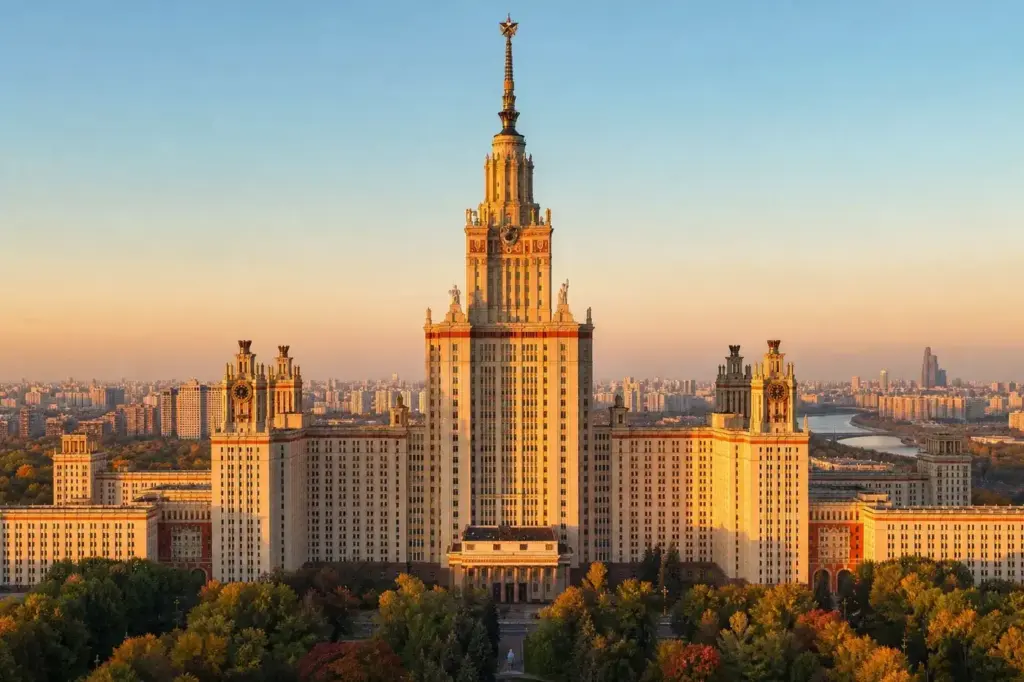
The Moscow Seven Sisters Stalinist skyscrapers itinerary is for architecture enthusiasts and visitors who want to understand how Soviet leaders reimagined their capital after World War II. This route assumes 2–3 days of unhurried exploration, mixing metro travel with walking passages through different districts.
By the end, you will have stood before all seven completed buildings—from the tallest (Moscow State University at 240 metres) to the smallest (Leningradskaya Hotel at 136 metres)—and grasped why they still dominate Moscow’s skyline and draw crowds of architecture photographers.
At a glance: Day 1 focuses on the three sisters in the western and central zones, including Moscow State University and Hotel Ukraina, with street-level observation and nearby parks. Day 2 covers the northern and eastern sisters—Leningradskaya Hotel, Red Gates Administrative Building, Kotelnicheskaya Embankment Building, and Ministry of Foreign Affairs—using metro connections. Day 3 captures Kudrinskaya Square Building and offers skyline views and local architectural context.
Day 1: Moscow State University and the Southwestern Sisters
Begin at Moscow State University on Sparrow Hills, the tallest and most recognisable sister. Walk through campus grounds to see the building's scale and the distinctive wedding-cake silhouette topped by a 57-metre spire. Descend to the river viewpoints, then travel west to Hotel Ukraina and the Ministry of Foreign Affairs. This day emphasizes high vantage points and the buildings' role in Moscow's skyline composition.
- Moscow State University main building – Vorobyovy Gory; tallest of the seven at 240 metres, completed 1953; climb to plaza for exterior views (1 hour)
- Sparrow Hills viewpoint – South of MSU; sight lines toward Kremlin and the Seven Sisters across the city (20 minutes)
- Hotel Ukraina (Radisson Collection) – Kutuzovskaya metro, Kutuzovsky Prospect; second-tallest sister at 206 metres, completed 1957; visible from Moskva River embankment (20 minutes exterior viewing)
- Ministry of Foreign Affairs building – Smolenskaya metro; 172 metres, completed 1953; walk to its base on Smolenskaya-Sennaya Square to see the massive Soviet coat of arms on the facade (30 minutes)
- Arbat Street – Nearby pedestrian zone leading to the Foreign Ministry; historic street with cafes (45 minutes)
Tip: Start your day trip in the early morning at Sparrow Hills. The viewpoint gets crowded by midday, and the light hits the buildings better from the south-facing hillside in late morning. Skip climbing inside MSU unless you have a university guide; focus on the exterior and plaza instead.
Day 2: Northern Sisters and the Central Riverfront Tower
Travel by metro to the northern and eastern sisters, then work back toward the city centre. Komsomolskaya Square hosts the Leningradskaya Hotel near three railway stations—an ideal metro hub. The Red Gates Administrative Building sits at a busy intersection. Kotelnicheskaya Embankment Building stands closest to the Kremlin and Red Square. This day blends metro efficiency with dramatic architectural encounters.
- Leningradskaya Hotel (Hilton Moscow Leningradskaya) – Komsomolskaya metro; 136 metres, completed 1954; restored 2008; view from Komsomolskaya Square and the railway station vestibule (30 minutes)
- Red Gates Administrative Building – Krasnye Vorota metro; 133 metres, completed 1953; occupies the highest point on the Sadovoe ring road; see it from the metro vestibule and adjacent square (20 minutes)
- Kotelnicheskaya Embankment Building – Taganskaya or Kitay-Gorod metro; 176 metres, completed 1952; walk along the embankment at the confluence of Moskva and Yauza rivers; closest to Red Square (15 minutes' walk) (30 minutes)
- Moskva River embankment walk – East from Kotelnicheskaya toward Kremlin; views of the building from the water and historical plaque (30 minutes)
Tip: Visit Komsomolskaya in the morning or early afternoon, then use the metro to leap to Krasnye Vorota and Taganskaya. Avoid the evening rush hours (5–8 pm). The embankment walk between Kotelnicheskaya and Red Square is short but satisfying; the building looms differently from the water than from the street.
Day 3: Kudrinskaya Square and Architectural Reflection
Conclude with Kudrinskaya Square Building in the Presnensky District, the last-completed sister (1954). Explore the plaza and surrounding residential apartment blocks designed as companions to the central tower. Revisit your notes on the architectural signatures shared by all seven: stepped silhouettes, spires, Soviet ornament, and vertical ribs that emphasize height. This day allows time for local cafes and reflection on what you've seen.
- Kudrinskaya Square Building – Mayakovskaya metro; 174 metres with 22 central floors, completed 1954; designed for Soviet cultural elite; view the central tower and side residential wings forming a unified ensemble (45 minutes)
- Kudrinskaya Square plaza – Open area with benches and surrounding restaurants; compare this sister's architectural detailing with others you've seen (30 minutes)
- Nearby cafes on Bolshaya Sadovaya Street – Short walk east; rest and review architectural notes (1 hour optional)
Tip: Kudrinskaya Square is less crowded than the other sisters and often overlooked by tourists. Use this day to step back and compare what you've seen. Bring photographs or sketches from Day 1 and 2. The central tower is visible from multiple angles around the square—walk the full circuit to understand its proportions.
Moscow Vibes Tips
- All seven sisters are free to view from the street. None require tickets for exterior observation. Hotel Ukraina, Leningradskaya Hotel, and Ministry of Foreign Affairs are government or private buildings; do not expect access to interiors without special arrangements.
- The Metro Ring Line (Koltsevaya) connects most of the sisters. Study the metro map in advance: Komsomolskaya (north), Krasnye Vorota (east), Taganskaya (east-central), Smolenskaya (west), and Mayakovskaya (west-central) are your main hubs. Avoid peak hours for clearer viewing of the buildings' exteriors.
- Each sister displays a distinctive sculptural and decorative programme—Soviet coats of arms, ornamental ribs, and clock faces. Bring binoculars or use a smartphone camera zoom to study details on facade and spires from ground level. The intricacy is lost at a distance.
- Weather and season affect your experience significantly. Autumn (September–October) and spring (April–May) offer clear skies and moderate crowds. Winter snow can be dramatic on the spires but daylight is short. Summer crowds peak in June–July. Avoid heavy rain; concrete and sculpture detail disappear in poor light.
- Do not confuse the Seven Sisters with later Soviet buildings or modern skyscrapers. The key diagnostic features are the pointed spires (except Foreign Ministry), five-pointed stars at the top, tiered wedding-cake silhouettes, and completion between 1952–1957. Triumph Palace (completed 2006) and Edelweiss (2003) are later homages, not part of the original group.
- Photography from street level can be challenging due to building height and surrounding structures. Sparrow Hills offers the only panoramic view of multiple sisters together. For individual portraits, position yourself at least 100 metres back from the base to capture the full silhouette and spire. Early morning and late afternoon light (golden hour) suit architectural photography best.
More for you
Sights near Moscow Seven Sisters: Stalinist Skyscrapers Itinerary
 Kotelnicheskaya Embankment Building Moscow · typical visit: About 30 minutes to 1 hour14 min on foot from Taganskaya metro, Open 24 hours
Main image: AI-generated illustration. It may not show the place exactly as it looks.
 Novodevichy Cemetery Moscow · typical visit: About 1.5 to 2 hours7 min on foot from Luzhniki MCC Station metro, Open daily 09:00–19:00
Main image: AI-generated illustration. It may not show the place exactly as it looks.
Related guides
 10 Best Places for Russian Architecture in Moscow: Domes and Palaces
Main image: AI-generated illustration. It may not show the place exactly as it looks.
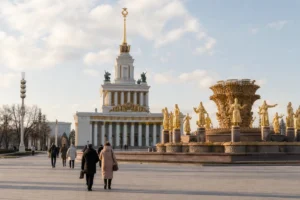 10 Best Places for Soviet History in Moscow: Museums, Metro and Space
Main image: AI-generated illustration. It may not show the place exactly as it looks.
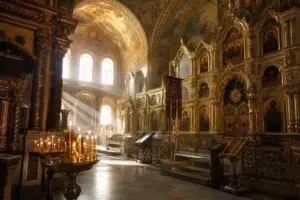 How to visit Orthodox churches in Moscow respectfully: Dress code, etiquette and service rules
Main image: AI-generated illustration. It may not show the place exactly as it looks.
Browse more: All Itineraries · All Themed Routes
FAQ
Are the Seven Sisters all visible in one day?
Technically yes, but not comfortably. Each sister deserves 20–45 minutes of observation from multiple angles. A rushed one-day itinerary risks missing the architectural details and skyline context that make them remarkable. Two to three days allows for proper metro connections, walking, and reflection.
Can I go inside any of the Seven Sisters?
Moscow State University allows daytime campus visits and exterior exploration without a formal tour, though access to buildings beyond the main plaza may be restricted. Hotel Ukraina and Leningradskaya Hotel welcome guests and diners; non-guests can often view lobbies. The other four (Red Gates, Kotelnicheskaya, Kudrinskaya, Foreign Affairs) are government offices or residential buildings with no public interior access.
What is the architectural style of the Seven Sisters?
Stalinist neoclassicism, also called Stalinist Gothic or Soviet Baroque. The style blends Russian imperial traditions (ornament and verticality), American 1930s skyscraper design (steel frames and grid facades), and Soviet symbolism (stars, hammers and sickles, coats of arms). The distinctive tiered or wedding-cake silhouette and soaring central spire are signatures of all seven buildings.
Why are they called the Seven Sisters?
Originally Stalin commissioned eight towers (1947) to mark Moscow's 800th anniversary. Only seven were built before 1957. The eighth (Zaryadye Administrative Building) was abandoned after Stalin's death in 1953 because it would have overshadowed the Kremlin. The name "Seven Sisters" is a loose Western reference, similar to sister cities; the Russian term is Stalinskiye Vysotki (Stalin's High-Rises).
Is the best view from Sparrow Hills?
Yes, for a group panorama. Sparrow Hills (Vorobyovy Gory) on the south side offers the clearest sightline across Moscow to five or six of the sisters. However, you cannot see the individual buildings at close range. For detailed architectural study, street-level visits to each location are essential.
Which sister is easiest to reach by metro?
Kotelnicheskaya Embankment Building has two nearby metro stations (Taganskaya and Kitay-Gorod) and is only 15 minutes' walk from Red Square. Leningradskaya Hotel sits directly on Komsomolskaya metro station. Both are more accessible than Kudrinskaya Square or Moscow State University, which require uphill walks.
Do I need a guide or can I explore on my own?
Self-guided exploration works well if you have a metro map and smartphone navigation. The buildings are unmissable landmarks, and street-level viewing requires no special knowledge. A local architecture guide can deepen your understanding of Stalinist symbolism, construction techniques, and urban planning, but is not essential for basic sightseeing.
Can I photograph the sisters from inside the metro?
Not easily. Most metro stations serving the sisters are underground. The Komsomolskaya station vestibule (red-brick chamber) offers a partial view of the Leningradskaya Hotel above, but full architectural photography requires you to exit the metro and position yourself outdoors. Allow extra time for this.
Discover More of Moscow with Our Travel Tips
Get practical Moscow travel tips, new destination guides and useful updates on attractions, opening hours and prices. Plan your visit with clear, helpful information delivered to your inbox.
Moscow Vibes is a one-person project. A coffee keeps it going
Looking for more on this? Strelka: Where Two Rivers Meet in Nizhny Novgorod (Russia Vibes)

Take this guide with you
Get a free PDF of this guide to print or read offline: key facts, tips and a map link on a few clean pages.
Report an issue on this page
Paying for your trip: please read
Payments and bookings between Russia and many other countries are currently restricted. In practice, cards issued in the EU, the UK, the US and several other countries often cannot be used in Russia, Russian cards usually cannot be used abroad, and some booking platforms, airlines and payment providers limit or pause their services for Russia. The situation changes frequently.
We do not give legal or financial advice, and this site does not encourage anyone to break any rule that applies to them. Whatever you plan, you are responsible for following the laws and regulations that apply to you, including those of your country of residence and citizenship.
Many travelers still organise their stay without problems. It is worth asking your bank or payment provider what is currently possible, contacting hotels, tour operators and carriers directly about the payment methods they accept, and checking which services are open to customers from your country. Clarify payment, cancellation and refund terms before you commit to a booking, and keep your plans flexible.
Partner links on this site may not be available in every country, and prices, availability and rules in our guides can differ from what you see when you book.
How we research and update our guides
About this guide: AI assistance and accuracy
This guide is created with the help of AI and is based on official sources where available. Mistakes can still happen. Opening hours, prices, rules and other details are given to the best of our knowledge as of the date shown and can change without notice. It offers general recommendations only, not professional, legal or travel advice. Please confirm important details with the official source before you travel; you are responsible for your own plans and decisions.
* Affiliate link: as an Amazon Associate we earn from qualifying purchases at no extra cost to you.